This year’s tourism season is proceeding at different paces, as geopolitical turmoil and travelers’ increased caution are creating a new balance in demand, with some destinations facing challenges while others are regaining their lost momentum.
A key feature of this year’s tourism season is last-minute bookings, which are expected to be the decisive factor in shaping the season’s final outcome.
Although demand for Greece as a destination remains strong, the timing of tourists’ decision-making has shifted significantly, with the result that a large portion of searches now result in bookings just a few days before the trip.
At the start of the season, in March and April, the overall picture pointed to a 25%–35% year-over-year slowdown in the rate of confirmed bookings, with demand, however—that is, searches on hotels’ online systems, whether or not they result in bookings—remaining at last year’s levels or even higher.
“This season is turning into a puzzle. Demand for Greece remains strong this year; even in March and April, demand was high. This is a positive sign for Greek tourism,” emphasized Square Lime founder Vasilis Lapanitis.
“There is demand; tourists want to travel to Greece—they just need a ‘signal’ that has mainly to do with geopolitical developments, which is why they’re postponing their vacations to a later date. September and October are very strong months,” he added, noting that in June the trend toward last-minute bookings was particularly strong.
“The booking window—that is, the time between booking and travel—has been reduced to less than a month,” said V. Lapanaitis.
This shift in demand has also caused changes in prices, with the ADR (average daily rate) for the period from September –November being 10%–15% higher, in contrast to the July–August period, which shows a 5%–7% decline on a year-over-year basis. Consequently, V. Lapanaitis generally forecasts occupancy rates for hotels comparable to last year’s, but lower revenue due to pressure on prices.
Among the characteristics of this year’s season, as reflected in data from the WebHotelier platform for the hotel portfolio managed by Square Lime—which has developed a portfolio of 45 hotels throughout Greece— including changes in traveler behavior that extend beyond booking methods to the deeper motivations behind travel.
After a decade dominated by the search for unique experiences, the trend toward the “Connection Economy” has been gaining momentum over the past two years. Travelers are now seeking a meaningful connection with their destination, the local community, and the people there, placing greater value on authenticity, a sense of belonging, and the quality of the time they share.
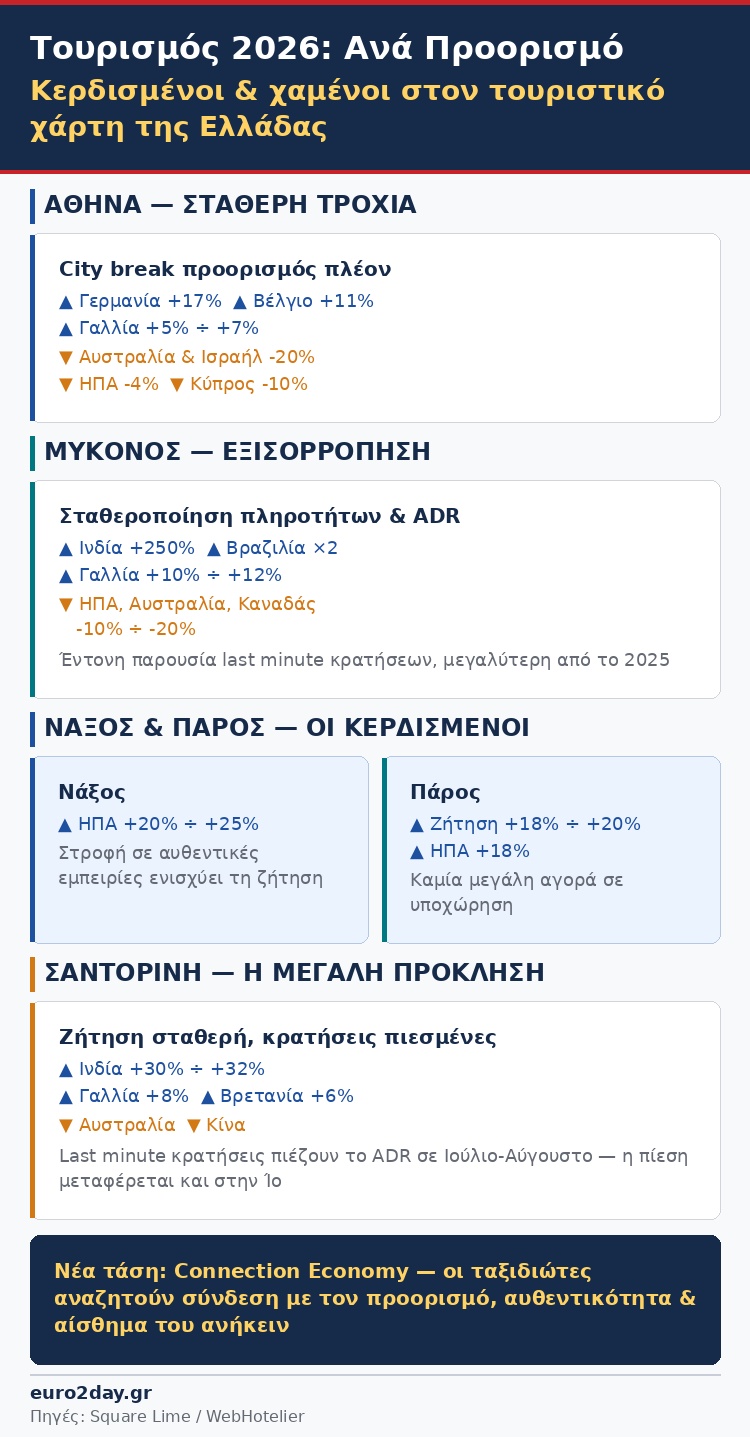
The picture by destination
Athens: The capital is on a steady trajectory this year, with demand since the beginning of the year showing a slight increase compared to last year. The major change concerns the composition of the markets, with Germany recording a significant 17% increase in demand, as the Greek capital has now established itself as a standalone city break destination rather than merely a stopover on the way to the islands, with the increase in air connections further reinforcing this trend.
The outlook is also positive for Belgium (+11%) and France (+5%–7%), while, conversely, Australia and Israel are down by about 20%, as is the U.S. market, which shows a marginal decline (-4%). Cyprus is also recording a decline of about 10%, mainly due to the increased cost of airline tickets.
Of course, despite the positive outlook for demand, the conversion rate of searches to bookings remains lower than last year, as travelers are delaying their decisions while waiting for a clearer picture of prices.
Mykonos: Mykonos is showing the first signs of stabilization this year following the pressure of previous years, with the market appearing more stable in terms of occupancy rates and ADR. A key feature of this season, however, is the strong presence of last-minute bookings, to a greater extent than in 2025.Demand varies significantly by market. The increase from India is particularly striking, at approximately 250%, while Brazil has doubled compared to last year. France is also on the rise, with a 10%–12% increase. In contrast, markets such as the U.S., Australia, and Canada are showing declines of between 10% and 20%.
Naxos and Paros: Naxos and Paros stand out as the big winners of this season, two islands showing the strongest momentum this year as they benefit from the shift in international demand toward more authentic experiences and less crowded destinations.
In Naxos, demand from the U.S. has risen by 20%–25%, with a corresponding increase in bookings.
The picture is even stronger for Paros, where demand has risen by approximately 18%–20%. Demand from the U.S. has increased by about 18%, while significant growth is also being recorded from Canada and the UK. A defining feature of this season is that no major market is showing a decline, a fact that sets Paros apart from other popular destinations.
Santorini: The island poses the biggest challenge of this season. Although demand is roughly at the same levels as last year, searches on online booking platforms are not converting to confirmed bookings at the same rate, putting pressure on the market.A dominant trend in Santorini as well is the sharp increase in last-minute bookings, mainly for July and August—a development that negatively affects the ADR and limits the ability to maintain higher prices.
India is on the rise, with an increase of approximately 30%–32%, while Brazil is also showing positive results, albeit from a lower baseline. France is up by about 8% and the UK by 6%. In contrast, Australia is recording a decline, while the drop is more modest in other markets such as China, which remains lower than in the past.
The pressure being felt in Santorini is also affecting neighboring destinations, with Ios being a prime example, where May proved to be a difficult month for tourist traffic.