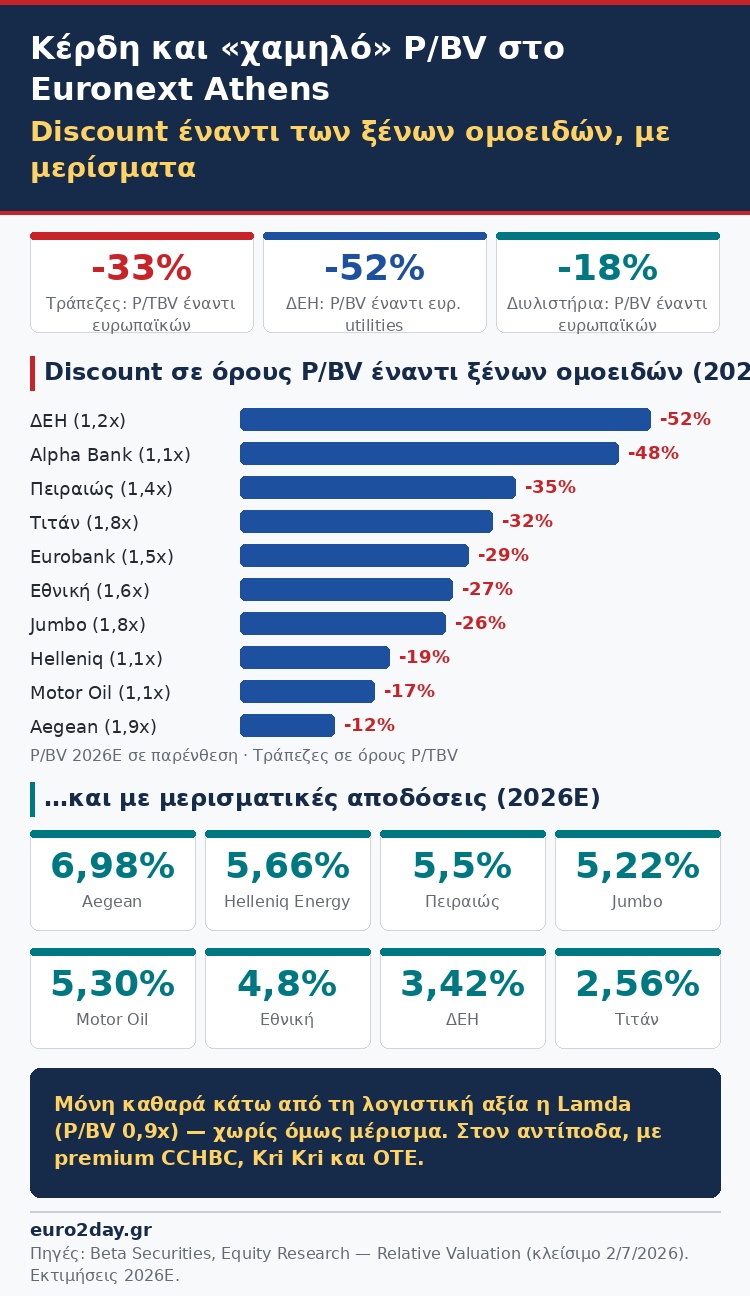
Despite the strong rally in the first half of the year, a significant number of companies listed on Euronext Athens continue to trade at price-to-book (P/BV) ratios that remain low both in absolute terms and—most importantly— compared to their foreign competitors. This is evident from valuation data provided by Beta Securities (as of the close of July 2, 2026), which compares the Greek “landscape” with European and international peer groups by sector.
What is interesting is that this discount does not apply to troubled or loss-making companies. On the contrary, most of the standout companies have single-digit or low double-digit P/E ratios and offer dividend yields ranging from 2.5% to nearly 7%.
Banks: The Market’s Biggest Discount
The four systemic banks remain the most notable example. With a weighted average P/TBV of 1.5 for 2026, they are trading at a 33% discount to the average for European banks (2.2), while in terms of P/E, the discount stands at 14% (10.2 versus 11.9).
Alpha Bank has the lowest P/TBV in the sector (1.1 for 2026), with a 48% discount compared to its European peers, and an estimated dividend yield of 3.8% this year, rising to 5.5% in 2028.
Piraeus Bank (P/TBV 1.4) combines a 35% discount with the sector’s highest dividend yield: 5.5% for 2026 and 7.5% for 2028. Next are Eurobank (1.5 and a yield of 3.8%) and National Bank of Greece (1.6 and a yield of 4.8%), with discounts of 29% and 27%, respectively.
It should be noted that the average dividend yield of Greek systemic banks is estimated to exceed that of their European counterparts starting in 2027 (5.5% versus 5.1%).
Refining: Single-digit P/E ratios and yields above 5%
In the refining sector, both Helleniq Energy and Motor Oil are valued at 1.1x their book value for 2026—with Helleniq falling to 0.8x by 2028, i.e., below book value.
The discount relative to European refineries reaches 18% on a P/BV basis and 27% on a P/E basis, as the two Greek groups are trading at profitability ratios of 6.7 and 5.9, respectively, for this year. Dividend yields are among the highest on the market: 5.66% for Helleniq and 5.30% for Motor Oil.
PPC: Half the Valuation of European Utilities
PPC is perhaps the most striking example of relative undervaluation in terms of book value: with a P/BV of 1.2 for 2026, it is trading at a 52% discount to the average for European utilities (2.5). The discount in terms of P/E is more moderate (13%), while the dividend yield is estimated at 3.42% this year, with the prospect of exceeding 5% in 2028—at a time when the stock has already risen 28% since the beginning of the year.
Jumbo, Aegean, and Titan: Profitability at a Discount
Three other companies with strong fundamentals are following a similar pattern. Jumbo, with a P/BV of 1.8 (a 26% discount compared to international discount retailers) and a P/E of just 9.6 (a 39% discount), offers a dividend yield of 5.22% while maintaining net cash — its net debt-to-EBITDA ratio is negative (-1.5). The stock’s underperformance this year (-17.6% year-to-date) makes its valuation even more attractive.
Aegean Airlines is trading at a P/E of 8.7 and a P/BV of 1.9, representing a discount of 23% and 12%, respectively, compared to European airlines, while the estimated dividend yield of nearly 7% for this year (and over 9% for 2028) is by far the highest in the industry, where several competitors do not pay any dividends at all.
Finally, Titan is valued at a P/BV of 1.8 compared to 2.6 for international cement companies (a 32% discount), while in terms of P/E, the discount reaches 47% (12.0 versus 22.7)—the largest in the sample. The dividend yield stands at 2.56%, exceeding the average of foreign peers by approximately 100 basis points.
The Lamda exception — and the other side of the picture
The only company in the sample currently trading well below its book value is Lamda Development (P/BV 0.9), which, however, is not paying a substantial dividend at present, as it is still in the investment maturation phase of the Elliniko project.
On the other hand, the Greek stock market also includes companies that are valued at a significant premium relative to their peers, reflecting stronger profitability or growth momentum: Coca-Cola HBC (P/BV 4.9, 127% premium), KRI KRI (5.7, 118% premium), and OTE (4.2, 120% premium relative to European telecommunications companies).