The landscape changed within just a few days. Eurostat announced today that inflation in the eurozone accelerated in August to 3.3%, from 2.9% in July -in Greece the increase was even steeper, to 3.7% from 2.7%.
Behind the numbers lies one and only one driver: energy, with an annual rate of 14.3% versus 10.3% the previous month. It is no coincidence that this acceleration comes at a time when oil is once again hitting multi-month highs and bonds around the world are being sold at a pace we have not seen in years.
The cause has a name and a geography: the Strait of Hormuz. After about a month of relative calm, the US-Iran conflict flared up again over the weekend, with American strikes on Iranian positions on Larak Island and an Iranian response with missiles and drones against American facilities in the region.
Strikes were reported on targets in Jordan and the United Arab Emirates, while two tankers carrying Saudi oil were hit by unidentified projectiles as they were crossing the Strait, in incidents that maritime monitoring companies described as a sign of further deterioration. Subsequently the US proceeded with new attacks.
Iran continues to insist that it does not allow passage to ships that do not seek its own approval, with the result that the passage is operating de facto in a limited way, while the US has imposed a blockade on Iranian Gulf ports.
About one-fifth of global oil consumption passes through this strait, so with every new episode the price is directly affected: Brent is moving at the level of $95 per barrel, with officials on both sides now admitting that the conflict could drag on for months.
The reflection in bonds is perhaps the most worrying part of the picture, because it shows that the market is not merely pricing in a geopolitical shock but a more permanent shift in expectations for interest rates.
The German 10-year reached 3.3%, a level we had not seen since 2011, while Bloomberg’s global government debt index recorded a fourth consecutive losing session, with the average yield climbing to 3.72% -the highest point since mid-2008.
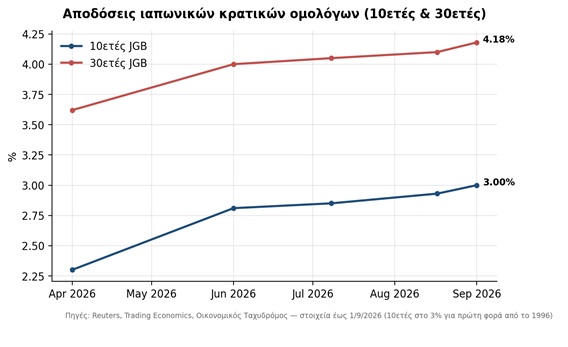
In Japan the 10-year touched 3% for the first time since 1996, in Australia the corresponding bond exceeded 5.1% and in France yields are now approaching 5%, with the spread versus Germany widening due to fiscal concerns and political uncertainty ahead of 2027.
It is not only inflation risk that is pressuring bond prices, it is also the increased supply of debt from states that are borrowing more and more at a time when investors are demanding higher compensation to hold it.
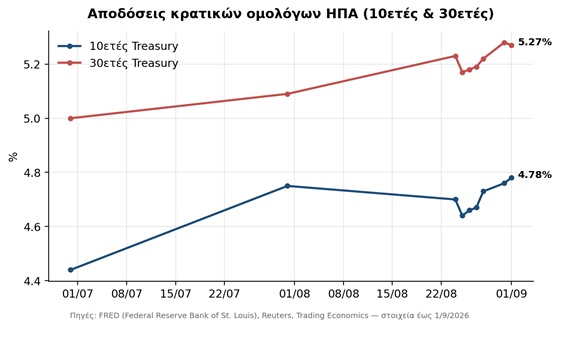
On the other side of the Atlantic, the message delivered by the new Fed chairman, Kevin Warsh, left no room for misinterpretation: central bankers still have work ahead of them to contain inflation, which remains persistent.
Money markets reacted immediately, raising the probability of an interest-rate increase by 25 basis points in September to 60%, from about 35% just one week earlier. It is a striking reversal of estimates: until a few months ago the discussion was about when the Fed would start cutting rates, now the discussion is whether it needs to raise them again.
The European Central Bank is already on this path. In June it proceeded with the first interest-rate increase since 2023, raising the deposit facility rate to 2.25%, citing precisely inflation, which the ECB itself saw remaining close to 3% for the whole year because of the war.
Its chief economist, Philip Lane, recently repeated it without equivocation: consumers must get used to the idea of inflation around 3% until the end of the year, with the course depending to a large extent on whether the crisis in the Middle East de-escalates.
He neither committed to nor ruled out another increase, but markets are already pricing in at least one more move by the end of 2026. Yesterday’s acceleration to 3.3% will clearly strengthen this scenario.
The dilemma facing both central banks is classic in essence but difficult in implementation: an oil supply shock raises inflation, but at the same time slows growth, something that in theory would justify looser monetary policy.
The ECB had already acknowledged this in June, revising downward its growth forecasts for 2026 and 2027 precisely because of this effect on key commodities, real incomes and the confidence of consumers and businesses.
But when inflation deviates markedly from the target, as is happening now, central banks tend to give priority to price stability, even if that means “tolerating” weaker growth in the short term.
It is the same dilemma that had plagued markets in 2022, except that now the trigger is not post-pandemic demand but an energy passage that closes and opens depending on military developments.
For stocks, the combined message is unpleasant: higher benchmark rates mean a higher discount rate for every valuation, while uncertainty around inflation makes planning more difficult for both businesses and investors.
It is no coincidence that the greatest pressures in recent sessions have been seen in the sectors with the greatest sensitivity to interest rates -banks, companies with high borrowing- while energy companies are enjoying, at least temporarily, the opposite trend.
The question that will determine the coming weeks is not so much whether the ECB and the Fed will move in September -both seem to be seriously considering it- as whether tensions in the Gulf will de-escalate before they manage to entrench inflation expectations.
As long as the Strait of Hormuz remains a point of friction, every effort by central bankers to “read” inflation will collide with a variable they do not control: the price of oil. And as long as this variable remains unstable, so too will bond markets -with all that this implies for the cost of money everywhere, from Frankfurt to Athens.