A sum of actions on all fronts which, while indeed moving in the right direction, are nevertheless accompanied by asterisks and reservations from the market as to how effectively they will be implemented, without delays, as happened in the case of batteries, is included in the Roadmap presented yesterday by the Ministry of Environment and Energy for 30% cheaper energy costs over the three-year period.
Although the mix of interventions concerns every possible sector that the government can influence, from accelerating the penetration of RES and storage, to increasing investments in networks, the new “Save” programs, generous programs for replacing old appliances with new ones, together with addressing distortions in the electricity market, nevertheless the key question is how exactly this policy mix will be turned into 30% cheaper bills.
In reality, with the Roadmap announced yesterday by the ministry’s leadership, it itself raised the bar high, creating expectations that it is now called upon to fulfill: From the drastic reduction of electricity theft (450 million euros per year) and the containment of overdue debts (about 3 billion euros), burdens both borne by the consistent consumers, to the transfer of more and more cheap energy from RES to consumers, through the faster penetration of batteries, each one of the 6 axes of the plan also constitutes a separate announcement for which the government will be judged.
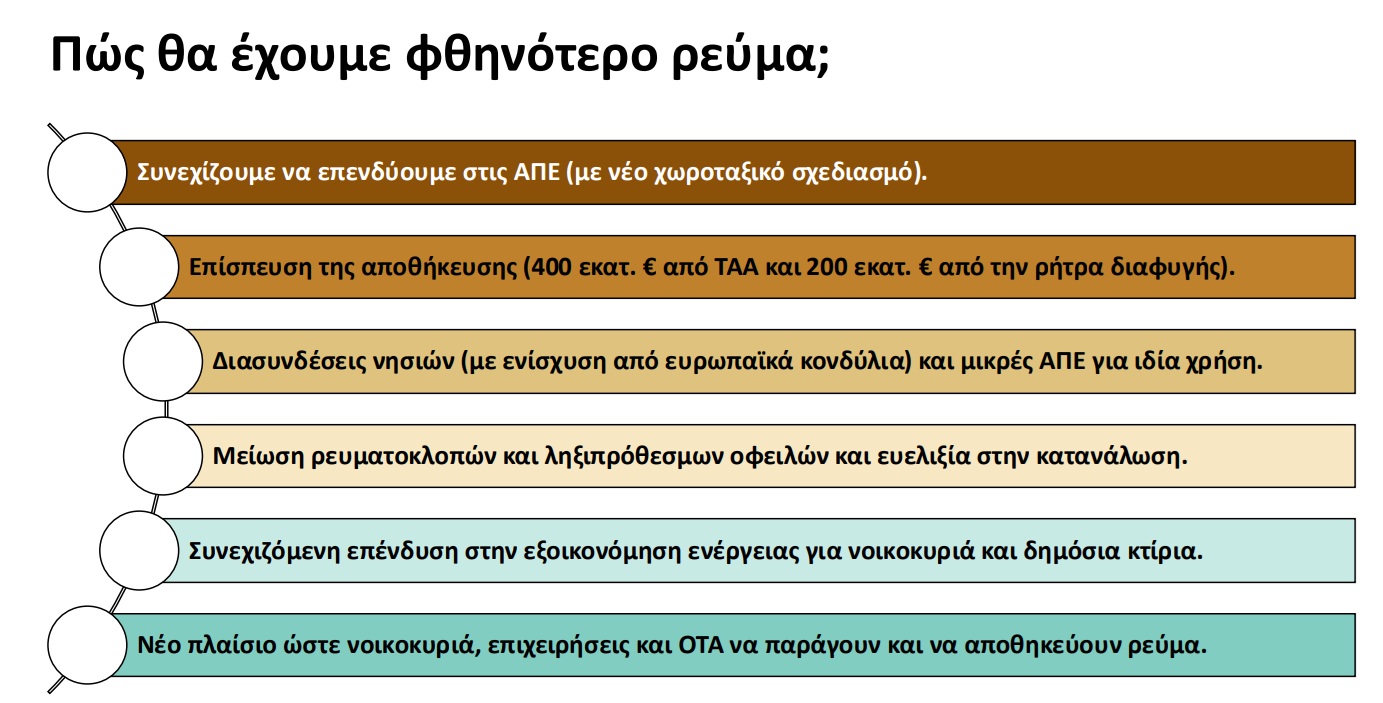
Every month from now on, when the European energy price index HEPI (Household Energy Price Index) is published, any progress will be evaluated, as yesterday the Ministry of Environment and Energy set a quantitative target for the total energy cost.
The reference point is the average price of 237.8 euros / MWh paid in the first half of 2026 by the Greek consumer according to Eurostat data.
And the target is for this price, which includes all the energy charges of a bill, to be gradually reduced by 30%, to 166 euros/ MWh, by the first half of 2029. That is, from about 24 cents / KWh to fall to about 17 cents/ KWh.
To the question about the breakdown of the above percentage, that is, how much each individual intervention included in yesterday’s announcements will contribute to achieving the target, the ministry did not provide detailed data.
Looking at the big picture, the plan does not include measures with immediate returns on bills, apart from a very small reduction in charges for Public Utility Services (YKO), and attempts to “build” the reduction in energy costs on two axes, more and cheaper energy in the system and lower consumption, having as firepower 5 billion euros from national and community resources (Social Climate Fund, Islands Decarbonization Fund, national Escape Clause) .
The bet described yesterday by the Minister of Environment and Energy Stavros Papastavrou, saying that “we want to erase over a three-year horizon the 50% increase that household electricity has received since 2019, both in Greece and in the EU,” is not easy, as it presupposes a holistic approach through a program of permanent structural changes.
Structural measures, however, yield results over time, and not always based on planning on paper, all the more so when the government plan also needs the assistance of luck.
“We understand that there is an international environment which we do not control. We therefore focus our actions on the fronts we do control,” Deputy Minister of Environment and Energy N. Tsafos said regarding the geopolitical factor, with all that this implies should new and long-lasting energy crises arise along the way.
The bet on RES and batteries
On the front line of the undertaking is the faster penetration of RES, which the more they participate in the mix, the more they lower the wholesale price, and the big bet here goes by the name of batteries, where the mistakes in the design of the first tenders, the delays and the distortions so far must not be repeated.
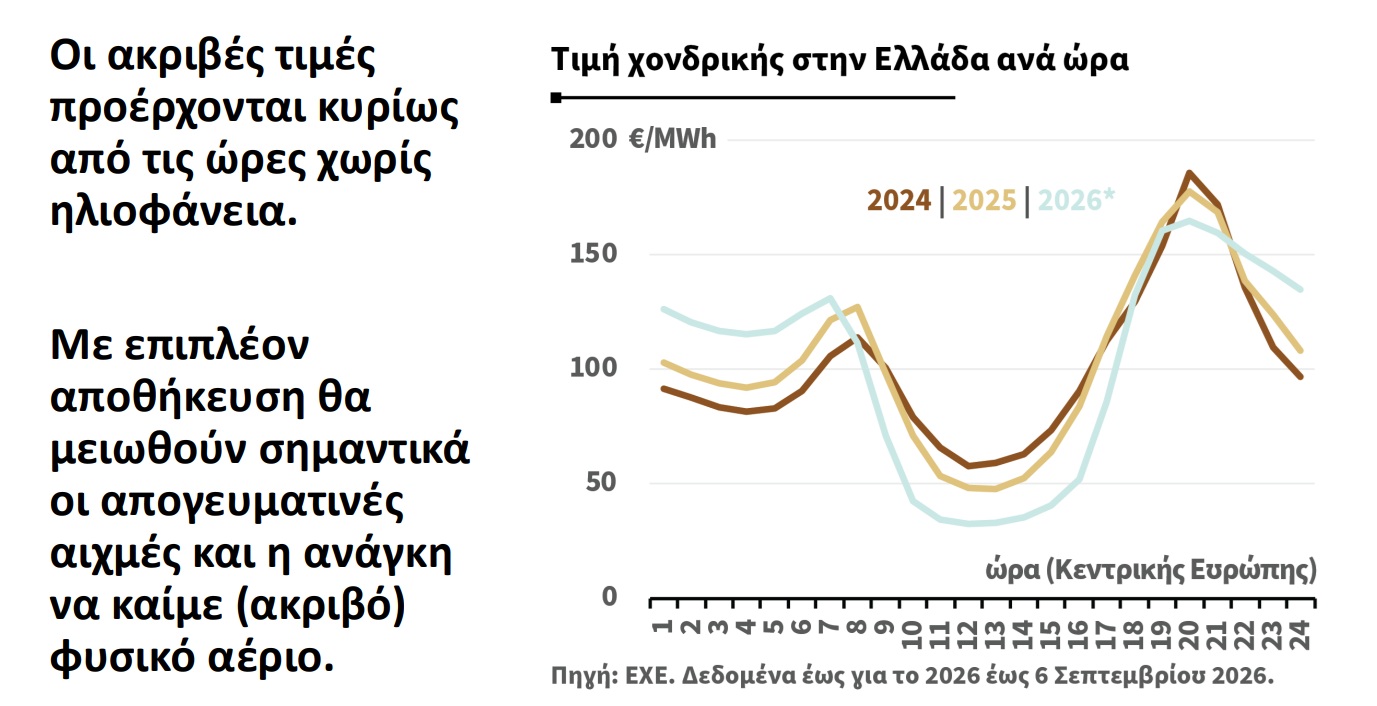
The goal is for the cheap production of the midday hours to be transferred to the expensive evening hours, so that the low wholesale price, such as the 73 euros/ Megawatt-hour recorded in the last eight months during periods of high RES penetration, may if possible be extended to the longest duration of the day.
It is noted that in the same period, when RES participation was low, the average wholesale price “hovered” at 127 euros/ MWh.
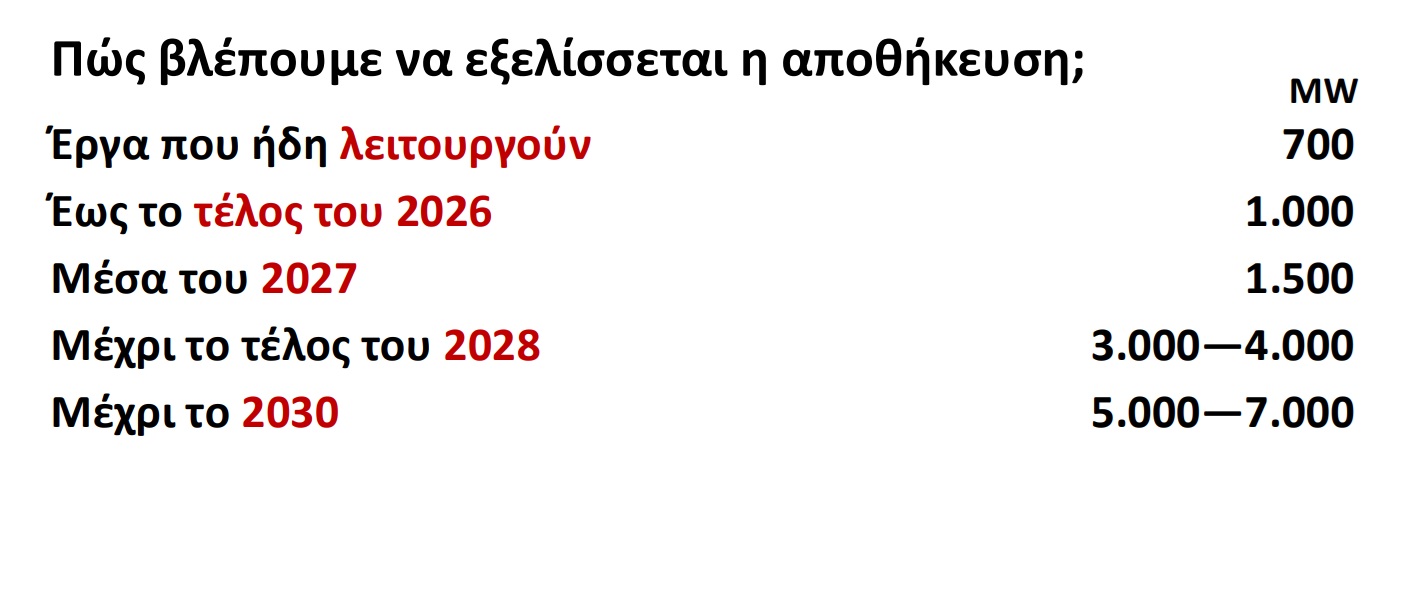
The Greek system, with a delay of many years, recently acquired its first batteries; by the end of 2026 they will have reached 1 GW, while according to the Ministry of Environment and Energy they are expected to have increased to 1.5 GW by mid-2027, to 3–4 GW by the end of 2028 and to 5-7 GW in 2030.
Critical is the financing contribution from the national Escape Clause, which is going to allocate 200 million euros for capital support to storage systems, 50 million to local authorities and an additional 50 million for self-consumption by non-household consumers
Island interconnections and the paradox with YKO
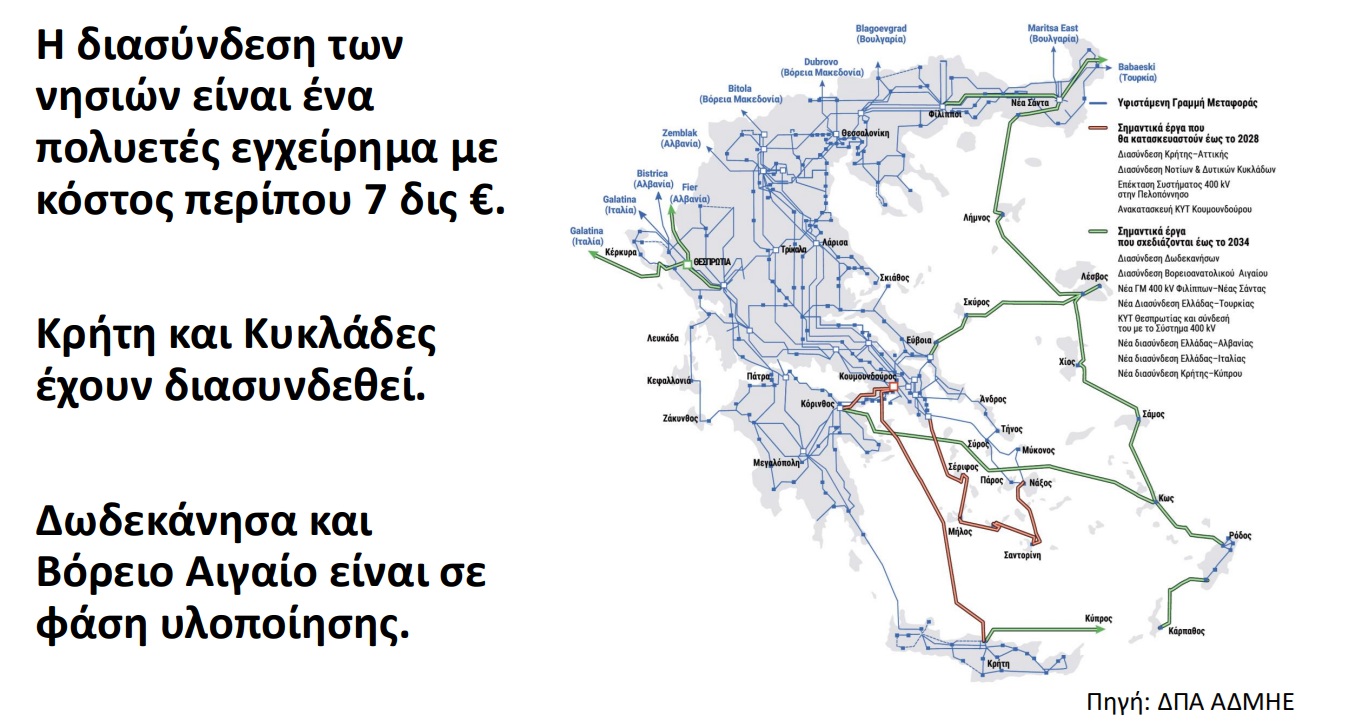
The next bet concerns accelerating island interconnections, also a multi-year undertaking with a cost of about 7 billion euros. Both Crete and the Cyclades have been interconnected and the logic is that the more islands are connected to the mainland system, the more the charges for Public Utility Services (YKO), which are paid by every consumer through their monthly bill, are reduced.
Through these, vulnerable groups and islanders supplied with expensive oil-fired units pay the same electricity price as the rest of Greece.
The government package, however, provides for a reduction only for the first tier of the household supply category up to 400 KWh per month, which is also the only direct intervention in the bill: This specific charge is reduced by 50% from January 2027.
In practice this means that from 6.9 €/MWh, the cost falls to 3.45 €/MWh or from 0.0069 euros / KWh it is reduced to 0.00345 euros/ KWh. Therefore a typical household which, with average consumption of 300 kilowatts per month, paid 2.07 euros, from January will pay 1.035 euros. That is, the relief is 1 euro per month or 12 euros per year.
The paradox is that based on the consumption of this specific category, the savings are estimated at 50 million euros per year, when the benefit entailed for consumers by the completed Crete-Attica electrical interconnection is estimated by ADMIE at between 400-600 million euros per year.
At the same time, at the very moment when consumers are being called on to replace oil and gas heating systems with heat pumps, YKO charges for all other categories remain unchanged. This in turn means for those who turn to electrification that they will have increased electricity consumption, therefore they will move to a higher YKO charge tier.
"On the one hand these consumers are subsidized and on the other they are punished," as a market person characteristically comments.
Electricity theft, overdue debts
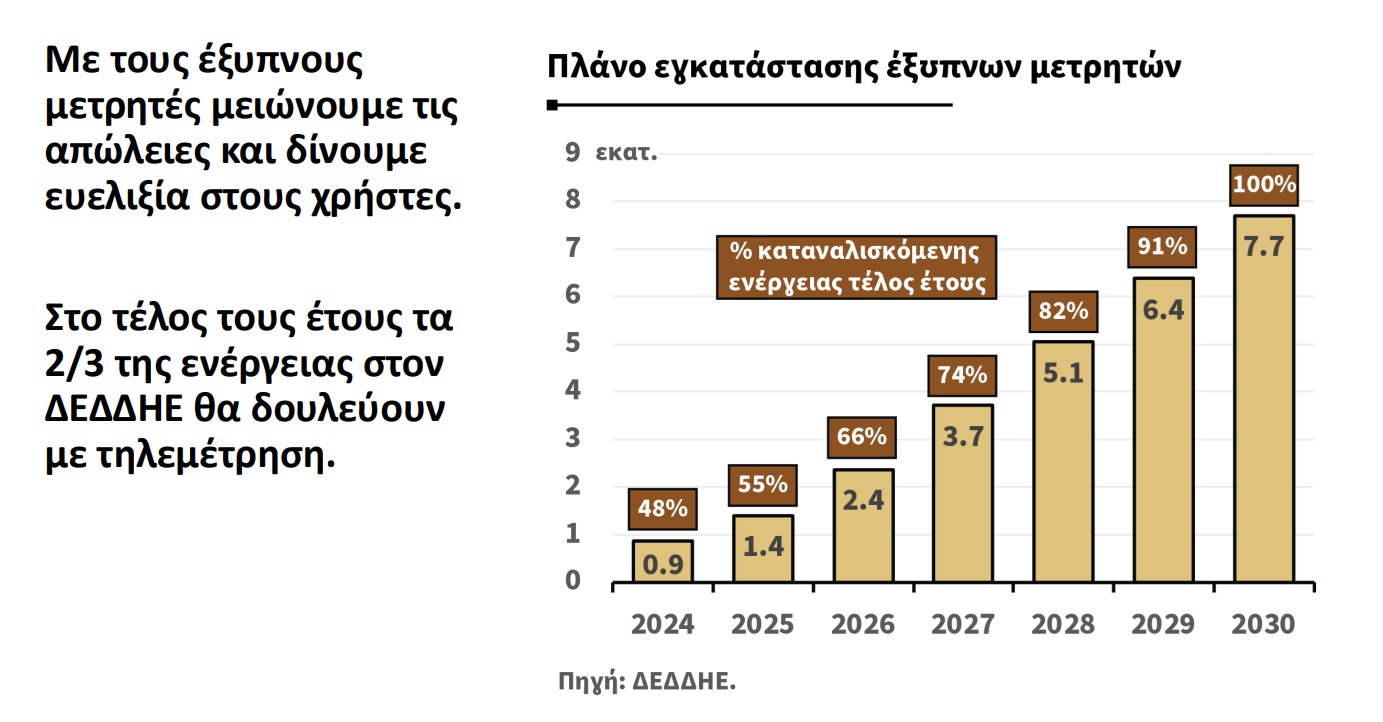
On the front of electricity theft, the leadership of the Ministry of Environment and Energy commits that by the end of 2026, 2/3 of the energy moved through the HEDNO network will be remotely metered, that is, supported by smart meters.
Consequently, it will become easier to detect electricity theft, which burdens the electricity bills of consistent consumers by 450 million euros per year.
An equally major cancer continues to be overdue debts in the electricity market, which at the end of 2025 amounted to 3 billion euros and also burden consistent customers.
In this sector too, the ministry leadership commits that the new framework for overdue debts will contribute to the end of energy tourism, as after the completion of three notices the bad payer will not be able to change provider without settling their debt. The effectiveness of the measure remains to be seen.
A barrage of programs for savings, pumps, water heaters
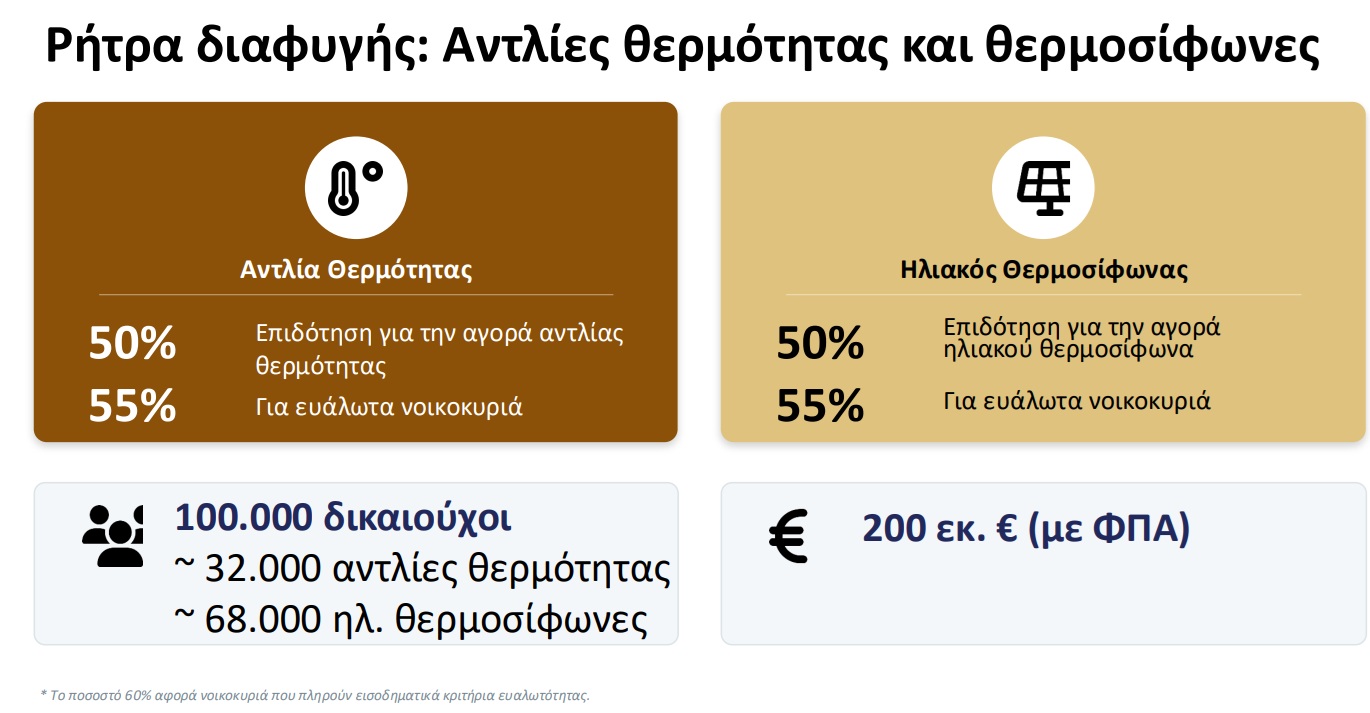
The recipe for cheaper electricity in the coming years is complemented by the barrage of savings programs. The 200 million euros from the national Escape Clause will finance, among other things, 32,000 heat pumps and about 68,000 solar water heaters, for about 100,000 beneficiaries.
At the same time the Social Climate Fund, which concerns only the vulnerable, corresponds to about 2.1 billion euros, with 1.7 billion euros directed to energy upgrade actions, change of heating systems and water heaters and 324 million euros to heating allowance.
The above are certainly expected over time to lead to a reduction in energy consumption, therefore also to easing electricity bills, however, as market executives observe, they concern only the beneficiaries of the programs, not all consumers.
The new self-consumption framework is also soon entering the game, which according to Mr. Tsafos is expected within the week, while the regulation for balcony photovoltaics is awaited with interest, which is estimated to have been simplified in order to become attractive, and is said to include far fewer obligations for the owner of such a system compared to the initial text.