On September 21, 2026, the Athens Stock Exchange officially changes category. After thirteen years under the Advanced Emerging Market status, it returns to the group of Developed Markets — that is, where it stood before the 2013 debt crisis.
This is the first time a major international index provider has decided to “correct” such a downgrade. It is something that has never happened before in any other Eurozone market. The event is not merely symbolic: it substantially changes who “sees” and who buys Greek stocks in the coming years — and, as the market’s course in recent days already shows, its impact has begun to be reflected long before the official date.
The timetable: An upgrade in five steps
The process began in October 2025, when the advisory committee of FTSE Russell decided on the upgrade with an adjustment period for the Greek market, giving twelve months to the investment community.
Since then, the sequence has taken its final form, as “4 plus 1” upgrades within about nine months: by September 21, 2026, the change is implemented simultaneously by FTSE Russell, STOXX Europe 600 and S&P Dow Jones Indices, while in May 2027 MSCI follows, the largest and most influential index provider for passive funds.
In June 2027 comes inclusion in STOXX DM World, making Greek stocks eligible for future reviews of the EURO STOXX 50 as well.
The composition of this year’s FTSE Russell review was already finalized on September 7, as expected: changes could be modified until the close of Friday, September 4, and as of yesterday they are considered practically final, with any possible changes now to be examined only in exceptional cases.
We are, therefore, already in the final stretch before September 21.
In the meantime, the practical aspect of the implementation was also clarified: the change is made in one go, within the framework of the semiannual review of the FTSE Global Equity Index Series (GEIS), with the results already announced by FTSE Russell on August 21.
The actual rebalancing of portfolios will take place at the close of Friday, September 18, so that the new weightings are active from the market opening on Monday, September 21 — this is where the largest part of the mandatory moves by index funds is expected to be reflected, although part of the adjustment has already been priced in, as the market has known for months the date and the basic characteristics of the new weighting.
Why it is happening now
The Greek market was the only one in the Eurozone that, in 2013, amid the fiscal crisis, was downgraded from Developed to Emerging Markets. Its return now is interpreted as recognition of the gradual institutional reconstruction of the last decade: upgrading trading mechanisms, strengthening supervision, but also a broader improvement in the macroeconomic and fiscal environment.
General government debt has fallen from 207% of GDP in 2020 to 146.1% in 2025, with a forecast for further easing to 136.8% this year — the speed of this decline was, moreover, the main argument behind the upgrade of the country’s outlook from stable to positive announced by DBRS on September 4, while at the same time maintaining the credit rating at BBB.
The agency notes, however, that Greek debt remains the highest in the Eurozone and identifies as downside risks a possible escalation of geopolitical tensions and the expected weakening of investment once the disbursements from the Recovery Fund are completed.
Two parallel “baskets”: FTSE Russell and STOXX Europe 600
The upgrade concerns in practice two separate events, which are worth not confusing. The first and broader is the FTSE Russell reclassification into the Developed Europe Mid, Small and Micro Cap indices, which concerns a total of 63 Greek stocks.
The second, narrower but more immediate in impact, is the inclusion of nine Greek stocks in the STOXX Europe 600 (and in the broader EURO STOXX) from September 21: National Bank, Eurobank, Piraeus Bank, Alpha Bank, PPC, Metlen Energy & Metals, GEK Terna, Motor Oil and Jumbo.
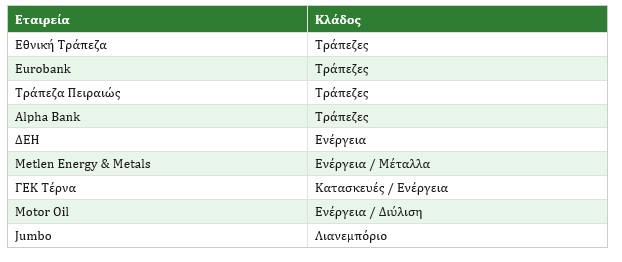
JPMorgan recently revised upward its estimate for total flows into these nine stocks, from $957 million to more than $1.1 billion, with the four systemic banks attracting the greatest interest. Yesterday it issued a new report raising the amount to $2.8 billion.
Deutsche Bank, however, characterizes the immediate impact of inclusion in the STOXX Europe 600 as “not a game changer” and places the truly decisive step in May 2027, in the upgrade by MSCI — given that about 70% of international funds follow MSCI indices, far more than those following FTSE or STOXX.
The most recent indicative calculations by FTSE Russell, based on the closing prices of August 21, place the weight of the Athens Stock Exchange at 0.072% of the FTSE Developed Index, 0.091% of the FTSE Developed All Cap, 0.082% of the FTSE Global All Cap and 0.065% of the FTSE All-World — small percentages, but ones that reflect the Greek market’s new position in the global investment universe.
As regards the size of the funds, Reuters estimates that the transfer to FTSE Russell in itself could trigger net passive inflows of around $400 million, while other market estimates give a broader range, from $250 million up to $1 billion, depending on the number of funds that ultimately adjust their positions.
Inflows or outflows? An estimate that changed sign along the way
The upgrade does not automatically mean “more money comes in than goes out”. It means that Greece exits the “pool” of Emerging Markets, where about $2 trillion is traded, and enters a much larger but also much more “diluted” pool, that of Developed Markets.
The difference in scale is enormous: in developed markets, assets under management reach $52 trillion, compared with just $6.3 trillion in emerging markets, with passive funds allocating about 88% to developed and only 12% to emerging markets — that is, Greece enters a much larger overall “pie”, but with a much smaller relative share within it.
The first estimates, when the upgrade was initially announced in the autumn of 2025, were quite cautious. JP Morgan then calculated that there would be outflows of about $2.84 billion from FTSE Emerging Markets indices, which would be partly offset by inflows of about $2.7 billion from the corresponding Developed Markets indices — resulting in a marginally negative net passive flow, around $113 million.
Another bank, a few months later, gave a similar picture of marginal balance: outflows of about $1.83 billion against inflows of about $1.75 billion.
As the implementation date approached, however, estimates gradually began to become more optimistic. One analysis was now speaking of three scenarios of net inflows, as summarized in the table below; JP Morgan revised its own estimate to passive inflows of around $1 billion, with the banks again at the center; and, as mentioned above, its most recent revision for the narrower STOXX Europe 600 “basket” has now reached $1.1 billion.

The conclusion from this sequence of estimates is twofold. First, there is no unanimity among analysts on the exact size — estimates range from marginally negative to more than $1 billion positive, depending on the assumptions about which stocks ultimately “lock in” to the indices and at what weight.
Second, the trend of revisions is clearly upward as the date approaches, something interpreted as an indication that the market is “digesting” the event better than initially expected. In any case, in the short term the transition is expected to be accompanied by increased trading activity and volatility, as the two opposing flows — entry and exit — “collide” within a short period of time.
Who is leaving and why
The outflows do not stem from any devaluation of the Greek market, but from a purely mechanical reason: funds and ETFs that are committed to following Emerging Markets indices are obliged, by definition of their mandate, to sell their Greek positions the moment the country exits those indices. It is not a manager’s choice, it is a rule of passive management. This concerns especially the FTSE Emerging Market All Cap index, in which about 33 Greek companies had until recently participated.
An additional complexity arises from the fact that the various providers do not move simultaneously. FTSE Russell, S&P Dow Jones and STOXX are set to upgrade Greece this September, but MSCI will proceed with its own upgrade only in May 2027.
This means that for about eight months the Greek market will be in an intermediate, “split” state: outside FTSE’s Emerging Markets indices, but still inside the corresponding MSCI indices.
In practice, outflows from funds following MSCI EM will be delayed in appearing, while inflows from FTSE/STOXX/S&P DM begin earlier — something that explains why the first phases of the transition appear more favorable than negative.
Who is entering and why the size of the “pool” matters
Conversely, entry into Developed Markets indices opens access to a category of investors much larger in absolute size — although with a smaller relative weighting for Greece — since far more capital is traded there compared with Emerging Markets.
These are funds, pension funds and ETFs that, because of their statutes or investment mandate, are not even allowed to invest in emerging markets, but can now “see” Greek stocks through their own benchmarks for Europe’s Developed Markets.
Beyond the purely passive flows, a substantial increase in coverage by analysts from international houses is also expected, something that historically is accompanied by greater visibility of listed companies among active (not only passive) portfolio managers.
Which stocks it concerns
The FTSE Russell review for September 2026 includes a total of 63 Greek stocks in the “developed universe” (10 Mid Cap, 22 Small Cap and 30 Micro Cap), distributed across three capitalization categories — a much broader set than the nine stocks in the STOXX Europe 600.
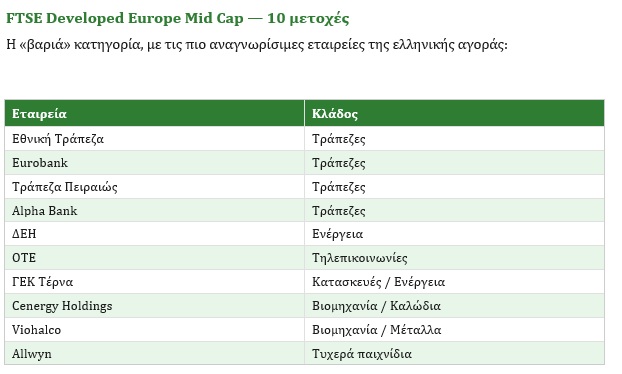
The four systemic banks together with PPC and OTE essentially form the core weight of the Greek market within the new indices — and are, as mentioned above, the point where the largest part of passive inflows is expected to concentrate.
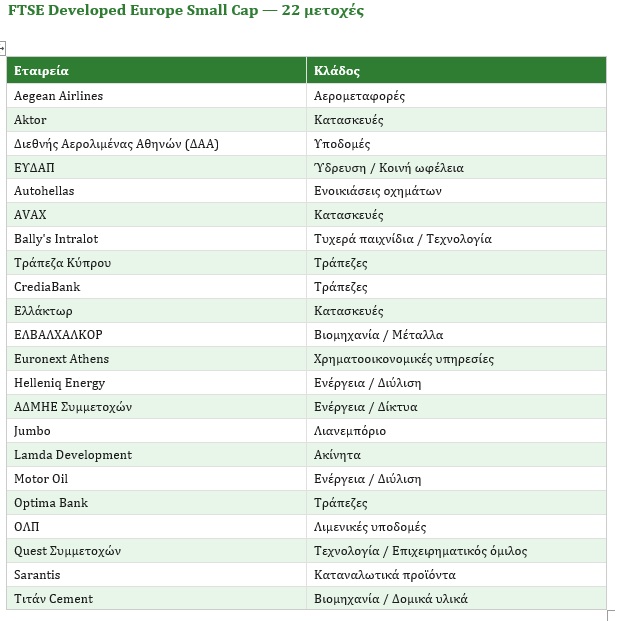
This category is the most sectorally diversified: it combines energy, construction, transport, retail, real estate and financial services, showing that the upgrade is not limited to the “usual suspects”.
FTSE Developed Europe Micro Cap - 30 stocks
Here lies the most populous but also less “visible” group of companies, which for the first time gains a direct bridge to international investors: Alter Ego Media, Alumil, Austriacard Holdings, Bank of Greece, BriQ Properties, Motodynamics, Dimand, Ektor, Evropi Holdings, Fais Holdings, Fourlis, Ideal Holdings, Ilyda, Interlife, Intracom Holdings, Kri-Kri, Lavipharm, Mevaco, Noval Property, Orilina Properties, Papoutsanis, Performance Technologies, Premia Properties, Profile Systems, Qualco Group, Real Consulting, Technical Olympic, OLTH, Thrace Plastics and Trade Estates.
The sectoral picture of the category is already clear: air transport, construction, energy, banks, retail, real estate, infrastructure, tourism, information technology, pharmaceuticals and industry — almost the entire productive spectrum of the country.
The breadth of this list is in itself indicative: this is not an upgrade that concerns only the five or six largest listed companies, but a change of status that touches almost the entire productive spectrum of the country, with the banks remaining its heaviest and most visible part.
The scale of the recovery in numbers
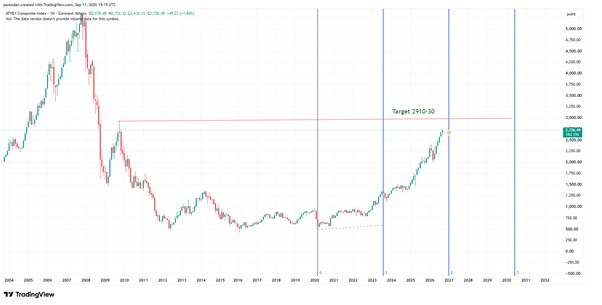
The scale of the recovery helps one understand why the upgrade is considered a turning point and not a simple technical process. The STOXX Greece Total Market index had collapsed by 95.4% from its October 2007 high to its February 2016 bottom, and still remains about two-thirds lower than that historic high.
In the last five years, however, it has risen by 280% versus 64% for the STOXX Europe 600, while since the recovery of investment grade in 2023 the General Index has posted a rise of 186% versus 52% for the European benchmark index.
The total market capitalization of the ATHEX nevertheless remains small on an international scale — about $213 billion versus nearly $19 trillion for the entire STOXX 600 — something that shows how large the growth margin still is, but also how small Greece remains within the European investment universe.
The market is already “pricing in” the event
The anticipation of the upgrade is not only a theoretical exercise — it is already reflected in prices, and today’s session confirms it. The Athens Stock Exchange had reached seventeen-year highs at the close of September 7 (2,702.54 points), edged down slightly on Thursday, September 10 (-0.15%, to 2,697.58 points) and on Friday, September 11, closed with a strong rise of 1.07%, at 2,726.49 points — a new seventeen-year high, the best level since November 2009. This was followed yesterday by a correction of 1.16% to 2,694 points on the back of international developments.
In any case, the previous week was the eighth consecutive rising week for the General Index (+0.9% on a weekly basis), with the market’s total capitalization at 196.2 billion euros.
Support also came from the improved international climate, after the announcement of U.S. August inflation at 3.4% and the partial easing of the price of Brent oil, with the market’s attention now turning to the Fed meeting on September 16.
At the same time, it is worth noting that the positive climate is supported by reports from foreign houses: Deutsche Bank raised target prices for all Greek systemic banks, maintaining a Buy recommendation and estimating that the banking rally “still has fuel”, Jefferies described Greek banks as among the most attractive in Europe, with new Buy recommendations for Optima Bank and CrediaBank, while recently Morgan Stanley also took a bullish stance, estimating that the story of the transition from emerging to developed markets is still “halfway through” and upgrading Greek banks in its European model, with a preference for banks, PPC and Metlen.
It is no coincidence that these moves are coming exactly on the days when the composition of the review is being locked in: the four systemic banks form the core of both the FTSE Russell Mid Cap index and the STOXX Europe 600 “basket”, and are the point where the largest part of passive inflows from the entire upgrade process is expected to concentrate.
What it means in the long term
Beyond the short-term “who wins the inflow-outflow balance”, the essence of the upgrade lies elsewhere: for the first time in many years, the Greek market is no longer treated as a high-risk trade or a regional opportunity of limited duration, but is included on the normal map of investment choices for large international portfolios.
This, in turn, improves the market’s depth and liquidity, strengthens the ability of Greek businesses to raise capital and may gradually compress their cost of capital.
The final bet, however, is not decided by the first weeks of flows, but by whether the Greek market will manage to remain attractive within a much more demanding and competitive international environment, where it is no longer compared only with other emerging markets, but with mature European markets with a much broader range of companies and greater liquidity.
The next major test will be the reclassification by MSCI in May 2027, followed by inclusion in STOXX DM World in June of the same year — two steps expected to bring the largest and most decisive wave of passive flows, given the size of the capital that follows especially MSCI indices.
* Director of Research at Solidus Securities SA, he leads portfolio analysis and asset allocation optimization, developing integrated financial models for risk assessment and market trend forecasting. President of EEPAMA - HACSA.
** This article is for informational and educational purposes and does not constitute investment, tax, or legal advice. The figures are indicative, based on publicly available historical data, and do not guarantee future returns. Before making any investment decision, consult a certified investment advisor.