In the 1970s, Konstantinos Karamanlis had stated that Greece is a poor country with rich inhabitants, capturing a structural contradiction of Greek society and economy. On the one hand, the state budget was almost permanently in deficit, as was the current account balance, and the size of Gross Domestic Product (GDP) was relatively small. On the other hand, many citizens had a high standard of living, as consumption showed, due to the large shadow economy.
The late Karamanlis used the phrase to highlight tax evasion, which deprived the state budget of revenue, contributing to the state's empty coffers, and the high demands of citizens from the state, which they themselves did not support financially.
Of course, Konstantinos Karamanlis had also used other expressions that contained sincerity and cynicism together to describe what was going wrong. Greece is a boundless madhouse is one of them.
All this came to mind as we looked at Eurostat data showing that 87.1% of the Greek population is struggling to make ends meet, which is the highest percentage in the European Union (EU). In addition, the median annual disposable income, adjusted for price differences between EU countries, amounted to 13,612 purchasing power standards (PPS) in 2025 compared with 22,630, which was the EU average.
Even more astonishing and indicative that something is wrong is the “subjective poverty” index, i.e. the extent to which citizens themselves consider themselves poor. Here the percentage reached 67.2% in Greece compared with 36.1% in second-place Bulgaria (!).
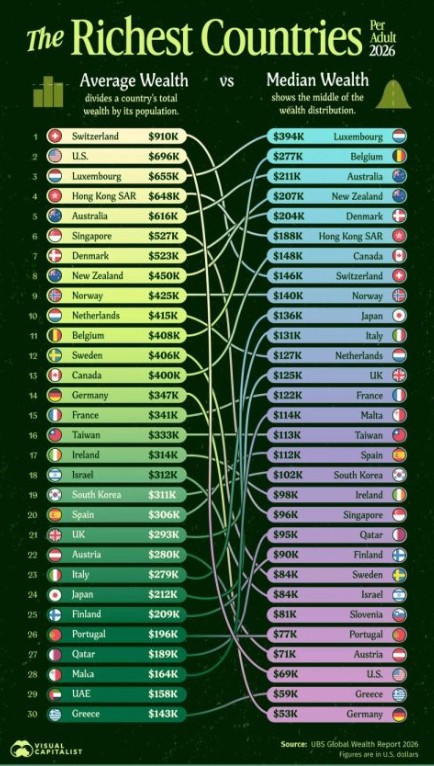
And all this in a country whose inhabitants appear to be among the 30 richest peoples in the world based on the real estate and movable property (savings, shares, bonds, etc.) they possess according to the two Visual Capitalist tables (via Bratu Capital), which are based on UBS data.
Greeks occupy 30th place based on average wealth, which results from dividing total wealth by the population, with $143 thousand, and 29th place based on median per capita wealth with $59 thousand, surpassing Germany, which occupies 30th place with $53 thousand. Obviously, the rate of property ownership makes the difference between Greece and Germany, as a significant part of the German population rents and does not own property.
The average largely reflects the concentration of wealth since a few billionaires with great fortunes are enough to raise the average. This explains the dramatic fall of the US, which from 2nd worldwide based on average per capita wealth, about $700 thousand, falls to 28th place with just $69 thousand based on median per capita wealth. Median wealth is more representative.
Of course, there are some methodological issues as many have acquired property through mortgage loans. Ideally, the latter should be subtracted from the value of the properties with which they were purchased so that the net value results. If such a thing were done, we estimate that Greece would rise in the overall ranking as mortgage loans relative to GDP are lower here compared with other countries.
In addition, perhaps costs should be subtracted, e.g. taxes, related to the ownership of property, shares, etc.
Here, however, we have a paradox of Greek society. High per capita wealth based on the data cited and low income flow based on Eurostat data, which are based on declared incomes that everyone knows are lower than the real ones. This is partly explained, but we will stop here today.
In closing, Konstantinos Karamanlis was probably right when he spoke of a madhouse.