There is a number that does not appear in press releases. In 2010, Greece’s GDP per capita — adjusted for price differences, that is, in real purchasing power — amounted to 84% of the European Union average. In 2025 it amounted to 68%.
Greece did not return to pre-crisis levels of prosperity. It moved further away. And it did so while, for example, Bulgaria, from 49% in 2015, rose to the same 68%. Today, the two countries share the last place in the European Union.
This is a real framework through which every positive piece of news about the Greek economy must be read, when the main aim is for this progress to embrace the average Greek.
There is recovery. But not prosperity.
The macroeconomic picture has improved substantially and this should not be underestimated.
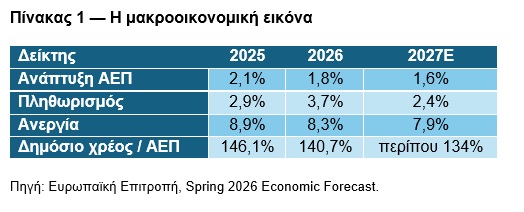
Three consecutive years of growth above the European average. Debt in steady de-escalation. Unemployment at the lowest levels of the decade. Investment grade from all the major agencies.
And yet.
GDP measures how much economic activity is produced. It does not measure progress at the base of society, that is, how much remains with the worker, whether the household saves, whether a thirty-year-old can rent a home without the help of his parents.
The recovery of the economy is not the same thing as the enrichment of society. Greece in 2026 is a tangible example of the distance between the two.
Greek wage: Second lowest in Europe
In 2024, the average annual full-time salary in Greece was about €18,000. In the European Union, €39,800.
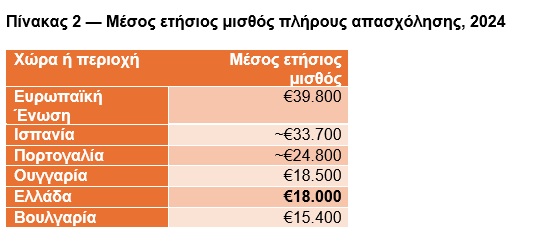
The average European salary is at a level more than twice the Greek one.
And arithmetic does not forgive: a nominal increase of 3.7% on a salary of €18,000 adds about €665 per year. The gap from the European average is €21,800. At this rate, convergence is not a matter of years. It is a matter of generations.
Greece does not simply have a wage problem. It mainly has a value-creation problem.
Cheap labor, poor country
In 2024, Greek GDP per worker stood at about 57% of the EU average. In terms of GDP per hour worked, the distance is even greater.
The usual reading is that wages are low because productivity is low. That is correct — but it is half the truth.
The reverse also applies: when labor is cheap, investment is not worth it. Why automate a process that costs €18,000 per year in human labor? Why train staff whom you can replace cheaply? Why scale up when your competitive advantage is cost?
Thus the cycle closes: Low productivity → low wages → low investment → low productivity.
The low wage is not only a consequence of low productivity. It is also a mechanism that sustains it.
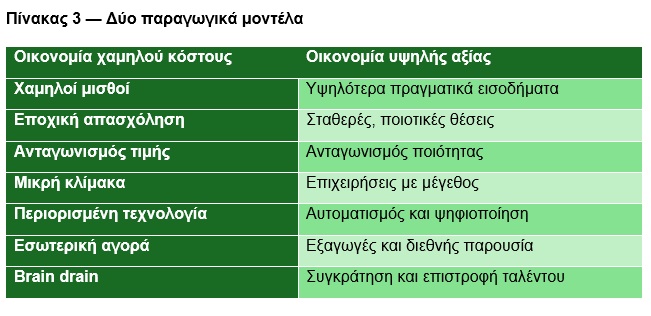
Greece will not escape the trap by offering even cheaper labor.
The state: A collector that never fails
The discussion should not stop at wages.
Because between what the worker costs the business and what he can ultimately spend, a third player intervenes who collects at every stage.
For a single worker without children on the average wage, the tax and social security burden on labor in Greece was 39.3% of total labor cost in 2025, compared with 35.1% in the OECD.
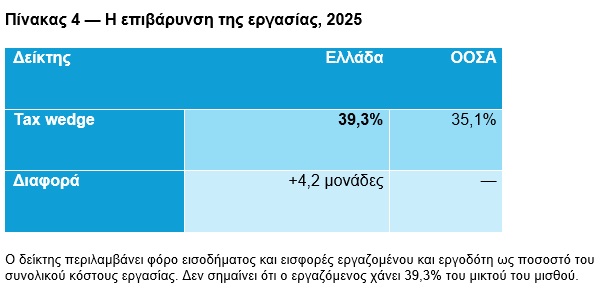
And it does not stop there. Whatever remains is taxed heavily again when it is spent: the standard VAT rate is 24%, compared with an average of about 21.9% in the EU. Excise taxes, property taxes, energy charges and so on are added.
Greece does not have the heaviest overall taxation in Europe — that is not accurate. But it does have an equally important negative: multiple points of burden on one of the lowest incomes in Europe. The same percentage does not have the same weight on a salary of €18,000 and on a salary of €40,000. The low-paid worker has no room for absorption.
There is also a second dimension, which is rarely discussed honestly. The state is not only a collector. It is also a bad provider. When the household pays taxes and contributions to the state and then is forced, for reasons of adequacy, to pay privately for healthcare, education, childcare and insurance, then it pays twice: once to the state and once to the market.
Society judges taxation not only by how much it pays to the state, but also by how much it pays again because the state does not provide it with adequate services.
And the tax philosophy is not based on real tax-paying capacity, but on calculations that do not correspond to reality and lead to crushing overtaxation.
Energy and housing: The “Houdinis” that make wages disappear
In the second half of 2025, the average electricity price for the typical Greek household was about €0.238 per kWh. Nominally, it is not an extreme price.
In terms of purchasing power, however, the picture is reversed: Greece ranks among the most expensive countries in the EU, and according to analysis by Green Tank, in the most expensive position for 2025.
The same electricity bill is a different fact on a salary of €18,000 and on a salary of €40,000.
The same applies, but multiplied, to housing.
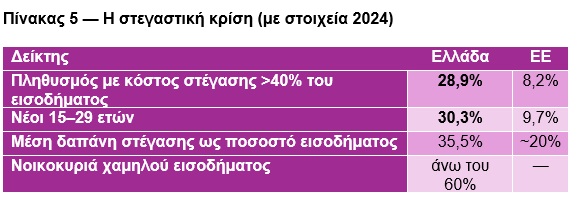
Almost one in three residents of Greece — and certainly one in three young people — lives with housing costs that swallow more than two-fifths of their income. In Europe, the corresponding number is one in twelve.
This is not a real estate problem. It is a problem of productivity, mobility and demographics all at once.
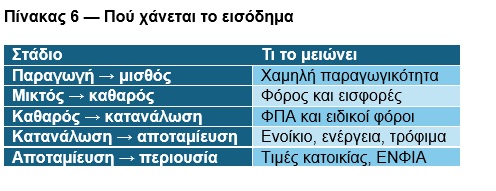
Five stages. At each one, something is taken away. That is why growth can be entirely nominal in the national accounts and almost invisible in the citizen’s bank account.
Birth rate and Brain Drain: The bill that is visible nowhere
In 2024, fertility in Greece was 1.24 children per woman, compared with 1.34 in the EU.
The chain is direct and everyone knows it: low income → expensive housing → delayed independence → delayed family formation → fewer births.
Greece does not only have a demographic problem. It has a problem of vision and expectations. A generation that cannot plan its own life will not build the country’s demographic future.
And there is one part that, as a country, we have already paid for dearly. The Bank of Greece estimates that more than 467,000 people aged 25–44 emigrated between 2008 and 2017.
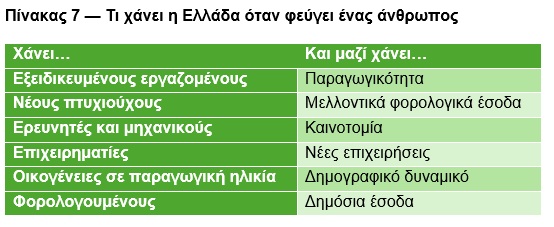
Brain drain is not a demographic event. It has a very significant fiscal impact. Every person who leaves takes with them decades of tax revenues that the state had already invested in their education.
And the return will not come with slogans about “brain regain.” It will come when the country offers pay, meritocracy, advancement and quality of life that it does not offer today.
After all, the point is not simply for them to return. It is for them not to need to leave.
What must finally change
The solution is not a wage by government order, nor an uncontrolled increase in labor costs. What is needed is a new productive contract between the state, businesses and workers — and all three sides have obligations.
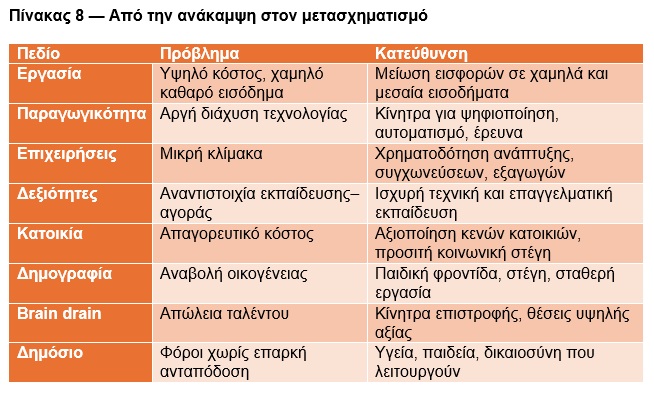
The state must reduce the wedge between employer cost and net income — and stop measuring its success only by revenues. Businesses must move from the “low cost” model to the “high value” model, sharing the benefits of productivity.
And the country must broaden what it measures.
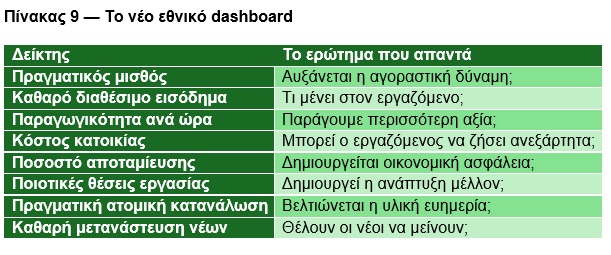
Survival may have been won. Life is still being claimed
Greece solved the problem of macroeconomic survival. That was a great achievement and it came at a high cost.
It has not solved the problem of microeconomic prosperity. And that is now the only thing that matters.
Because the citizen does not live inside GDP.
He lives in his home. He pays the rent. He buys food. He pays the electricity bill. He looks for a doctor. He thinks about his children’s school. He tries to save.
And at some point he decides whether he will stay.
That is where growth is judged. Not when the economy grows on paper, but when the horizons of citizens’ lives expand.
In 2010 Greece was at 84% of Europe. Today it is at 68%. The question of the next decade is not whether the country will grow.
It is whether it will grow in a way that is visible in the lives of those who produce it.
Greece does not need to become the cheapest country in Europe. It needs to become the country where it is more worthwhile to work, create and stay.
That is not an economic goal. It is a national plan.
Sources: European Commission, European Economic Forecast, Spring 2026, Economic forecast for Greece, Spring 2026, Country Report: Greece, 2026 — housing annex, Eurostat, Purchasing power parities and GDP per capita — preliminary estimate, 2025, National accounts and GDP — historical series of GDP per capita in PPS, 2010–2025, Annual full-time adjusted salary in the EU, 2024, Housing cost overburden rate, 2024, Housing conditions of young people, 2024, Electricity price statistics, 2nd half of 2025, Fertility indicators, 2024, OECD, Taxing Wages 2026 — Greece country note, OECD Economic Surveys: Greece
Greek institutions: Bank of Greece — Annual Report 2024, Bank of Greece — analysis of brain drain and the labor market, KEPE / National Productivity Council — Annual Report 2025, ELSTAT — Household Budget Survey 2024
Other: The Green Tank — retail electricity market report, 2025, Tax Foundation Europe — VAT Rates in Europe, 2026
Methodological note: The average annual full-time salary is gross and is neither a median nor a net salary. The wage, housing and fertility data concern 2024, the latest full comparable year. The 2026–2027 forecasts are estimates and are subject to revision. The indicators of GDP, wages, tax burden and cost of living measure different aspects of the economy and are not interchangeable with one another.
* Nicholas Havoutis has many years of experience in leading strategic financial units, having served as an executive at JPMorgan (New York), Chase Manhattan Bank (London) and Eurobank (Athens). At the same time, he has a significant presence in the media sector. Today, as head of SoZone Limited, he advises businesses and investors on international growth, organic optimization and merger and acquisition strategies.