An economy may be growing faster than others, and yet its citizens may be dissatisfied. This is perhaps not strange, nor worrying, if it happens for some transitional period.
But when it lasts for many years, it turns into an acute political problem. This is precisely the threat that the expected new wave of high prices in Europe, and even more so in Greece, will intensify.
Because this time the energy shock is not finding consumers after a period of prosperity, but already dissatisfied by the huge price increases of previous years.
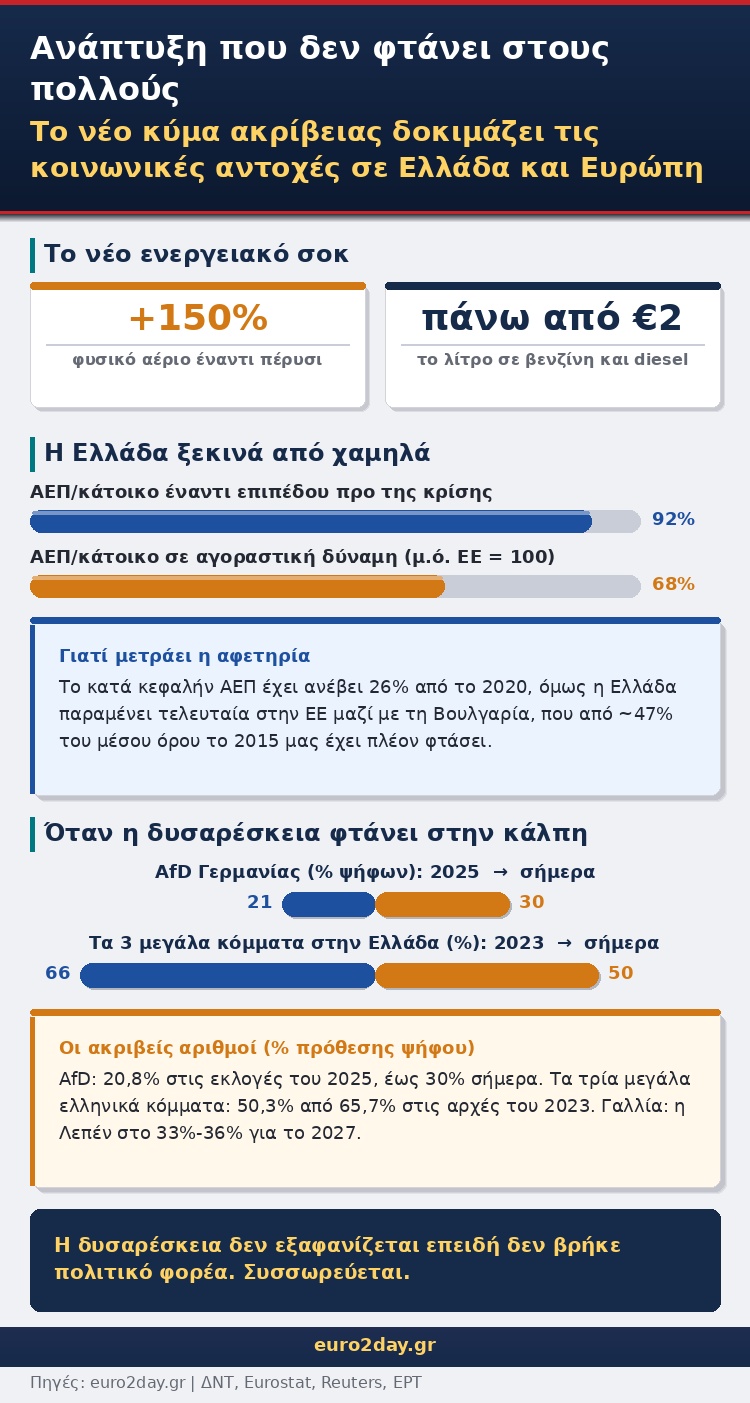
Today natural gas costs about 150% more than a year ago, with the risk of rising even further if the winter proves harsh (also due to reduced reserves), while fuels have risen to unbearable levels, with unleaded and diesel above 2 euros per liter.
The ECB forecasts that inflation will peak at the end of 2026, as it then expects energy prices to decline. However, the gradual effect on most products and services, and progressively on food, is expected to continue into 2027.
In the face of this oncoming storm, the government's measures are beginning to look like an aspirin.
The new wave of high prices finds Greece vulnerable
This is of particular importance for Greece, which is once again proving more vulnerable to high prices. It is indicative that from March to August it had higher inflation than the eurozone in five of the six months.
Some will focus on the counterargument of stronger growth, reduced unemployment and increases in the minimum wage. But there is a critical detail that is often lost in the public discussion: Greece started from a very low position.
The IMF notes that per capita GDP has increased cumulatively by 26% since 2020. Despite this impressive rise, it is still only at 92% of the level before the global financial crisis.
In other words, Greece is still trying to recover part of the huge distance it lost. Based on Eurostat data for 2025, per capita GDP in purchasing power units is only 68% of the EU average, in last place together with Bulgaria, which from about 47% in 2015 has now caught up with us.
In this light, faster growth is certainly valuable, but it does not by itself constitute a political vaccine against dissatisfaction. And if in the first years after the Greek crisis it was easy to explain that healing requires time, today things are different.
As time passes, the citizen compares his current situation less with the past and more with what he hears around him about growth, investment grade, new investments and record corporate profits.
The question he has, a question that is beginning to haunt Europe as a whole, is when he will see this improvement in his standard of living.
Acemoglu and the crack in prosperity
Nobel laureate economist Daron Acemoglu seems to have captured exactly this dimension in his latest book, What Happened to Liberal Democracy? Remaking a Politics of Shared Prosperity.
His basic position is that liberal democracy flourished as long as it managed to connect freedoms and growth with the diffusion of prosperity. That is, when the working and middle classes had reason to believe that progress concerned them as well.
Gradually, however, deindustrialization in the West and the widening of inequalities began to alienate these segments of society from the institutions they traditionally supported.
That is why Acemoglu proposes a return to a liberalism that concerns the working class, with greater emphasis on jobs, public services and “shared prosperity”.
The solutions he proposes are neither easy nor do they sound easy. In summary, he proposes more good jobs, institutionally stronger labor, AI that empowers workers instead of replacing them, better public services, more power to local communities and less top-down cultural imposition.
It is not certain that he has the absolute recipe for the solution, in a period of great uncertainties and successive crises. What can happen, however, if the bond between a large part of society and the “system” is lost, we are already seeing before us.
France-Germany: When dissatisfaction reaches the ballot box
In France, Marine Le Pen is leading in polls for the 2027 presidential elections with 33% to 36%, while Jean-Luc Mélenchon advances to the second round in three of the five scenarios and is tied for second place in a fourth. Pressure on the French political center is now coming from both sides.
Germany is also sending a loud message. In the 2025 elections AfD had won 20.8%. Today recent polls place it between 27% and 30%, while in the latest GMS survey AfD recorded 30%, CDU/CSU 20% and SPD 11%. That is, AfD alone gathers almost as much as the two parties that dominated postwar Germany combined.
The latest blow was the results of Sunday's elections in two German states, which showed a new rise for AfD and a plunge for CDU.
For years, the impressive rise of anti-system forces, mainly on the right, was attributed primarily to migration, security, identity issues and cultural conflict. All these still matter, but today they constitute part of the picture.
Alongside them has been added the continuous pressure on living standards, housing costs, expensive energy. And above all, the sense among a significant part of societies that the economic system produces wealth for one part of society, leaving many out.
Greece: Fragmentation is not a lasting shield
For the time being the Greek political scene, and especially the government, seems to be complacent, with various theories that the era of the memoranda has left an indelible mark on the electorate.
After all, the polls offer a sense of relative safety, as all three major parties, ND, EL.A.S. and PASOK, move, despite their differences, within the basic European framework.
Nevertheless, in the six recent polls the three largest parties add up on average to about 50% in voting intention. In the corresponding “poll of polls” of eight companies in January-February 2023, ND, SYRIZA and PASOK totaled 65.7%.
The difference is more than 15 points. Today this large remainder is reflected in fragmentation into smaller parties and the so-called “gray zone”.
But social dissatisfaction does not disappear because it has not found a dominant political vehicle to express it. It simply accumulates and… awaits the leader who will manage to express it effectively.
And as the years pass since the crisis, the demand for growth to pass into disposable income, purchasing power and the everyday life of the many will become ever greater.
In short, growth cannot happen for long with the many being in a greater or lesser crisis, at least in genuine democratic regimes, where every citizen, poor or rich, educated or not, also has one vote.
The alarm bell is already ringing in France and perhaps even louder in Germany. It would be very dangerous to assume that in Greece it will not be heard again.