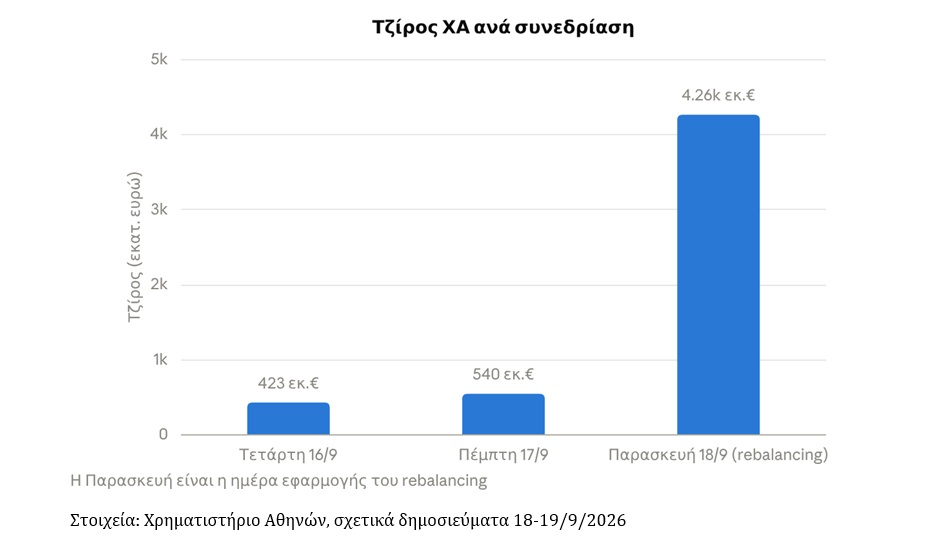
Friday's session, September 18, will remain recorded in stock market history, not because of the drop in the General Index, but because of an unprecedented trading volume of 4.26 billion euros, with the largest part of it completed in just a few minutes at the close.
Behind this figure lies a scheduled move: Greece's upgrade to Developed Market status by FTSE Russell, effective from today.
Three questions are worth answering: how this enormous volume was distributed throughout the day, which stocks absorbed the largest part of passive demand from foreign funds, and what remains to be seen now that the mechanical stage of the restructuring has been completed.
A historic high that “lived” for just a few minutes
Friday's total turnover exceeded 4.26 billion euros, far surpassing the previous record of May 2008 (3.03 billion euros), with 489 million shares changing hands. Indicative of the scale: only between 17:00 and 17:20, shortly before the close, shares worth 3.84 billion euros were traded — an amount greater than what moved during an entire session at the time of the previous record.
The cause is known: the rebalancing. From Monday, September 21, FTSE Russell's new classifications for 62 Greek stocks (10 Mid Caps, 22 Small Caps and 30 Micro Caps) come into effect, forcing almost all major foreign passive funds that track the indices to simultaneously readjust their positions. Because the same day coincided with derivatives expiry (triple witching), the opening of the auction was delayed by 10 minutes, with the session ending at 17:30 instead of 17:20.
Despite the unprecedented turnover, the General Index closed at 2,661.30 points, with a daily drop of 0.99% and a weekly drop of 2.39%, having moved intraday between 2,650 and 2,694 points. The banking index remained almost unchanged (+0.05%), indicating that the banking “leg”, despite the individual losses of some stocks, supported the market overall against the broader index.
Which stocks absorbed the greatest passive demand
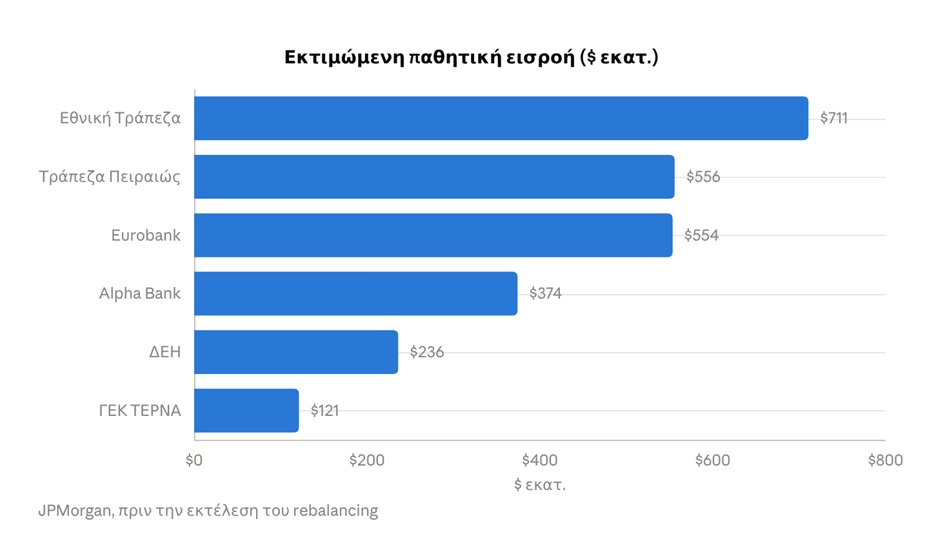
JPMorgan had budgeted in advance the scale of the matter: about 2.8 billion dollars of new passive capital toward Greek stocks, within the framework of a European reallocation (two-way trade) of more than 35 billion dollars. The interesting element is the distribution of this amount: the four systemic banks alone absorbed about 2.19 billion dollars, that is, close to 80% of the total estimate.
At the top was National Bank, with an estimated inflow of 710.7 million dollars — something that was also reflected on the board, as the stock alone posted turnover of 816.5 million euros, with about 42.6 million shares changing hands. It was followed by Piraeus Bank (555.9 million dollars estimated, 655.5 million euros turnover), Eurobank (553.6 million dollars, 616 million euros turnover) and Alpha Bank (374.2 million dollars, 462 million euros turnover).
The list of the biggest “beneficiaries” in absolute numbers was completed by PPC and GEK TERNA.
It is worth noting that, despite the strong demand, bank stocks ultimately closed with small to moderate losses (National -2.03%, Piraeus -2.71%, Alpha -0.71%, Eurobank -0.24%). This confirms that high turnover does not automatically imply rising prices: in several cases it was simply the moment when earlier holders exited, covering the mandatory inflow of the new capital.
The smaller stocks with the greatest relative impact
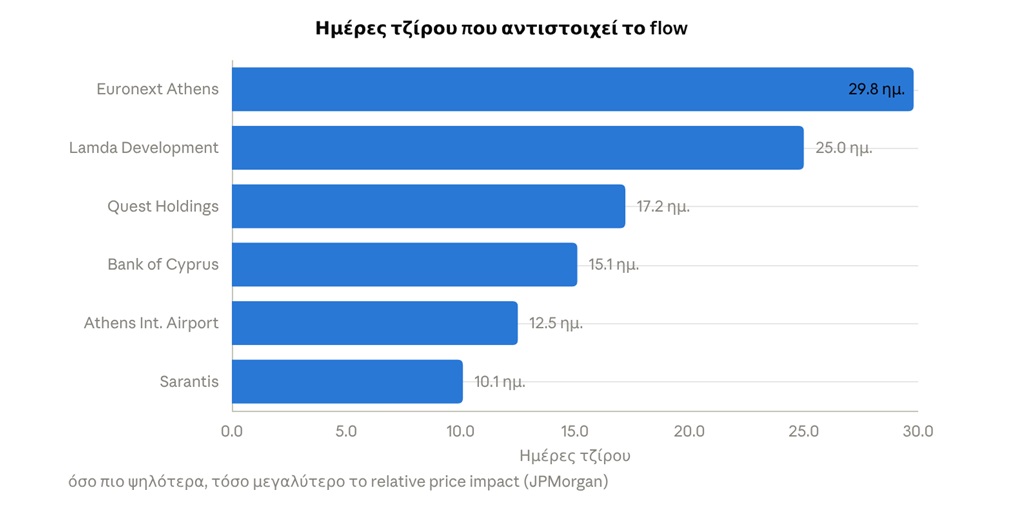
The most interesting element of the day does not concern the banks, but the smaller stocks, where the same buy order is equivalent to a multiple of the usual daily turnover. Lamda Development received an estimated inflow of 43.1 million dollars — an amount corresponding to about 25 normal trading days.
Even more pronounced is the example of Euronext Athens, with an estimate of just 2.2 million dollars that nevertheless corresponds to almost 30 days of turnover. A similar picture is also shown by Quest Holdings, with 3 million dollars equivalent to 17 days.
The conclusion for the investor is that the absolute amount in dollars, by itself, is not enough to assess the impact of such an inflow. What is decisive is how many “normal” days of average turnover the order corresponds to — and at this point the less liquid stocks can show more intense price fluctuation than one might assume based only on the size of the capital.
Block trades: 63 packages, 1.07 billion euros
A separate chapter of the session was the pre-agreed transactions (packages). On Friday, 63 such transactions were recorded, with a total value of 1.07 billion euros — about one quarter of the entire daily turnover was traded outside the open order book, through closed, pre-agreed moves.
In this way, large institutional portfolios usually transfer or restructure significant positions without burdening the price on the board, and the size of the packages shows how much the move of foreign funds had been pre-decided before the market even opened. In a session where every previous record was broken, a large part of the “battle” for the new weightings had already been fought before anyone even entered the classic supply-demand book.
The closing auction: before and after 17:00
The most detailed picture of the day emerges from the comparison of turnover and prices before and after 17:00, the time at which the scheduled capital of the rebalancing essentially began to be activated. Up to 17:00, turnover stood at 390.77 million euros.
During the closing auction, another 3.74 billion euros were added, raising total daily turnover to 4.26 billion euros — the historic record mentioned above. In other words, more than 85% of the total daily trading value was traded within a few minutes, exclusively during the closing auction — and not throughout the session as a whole.
The major banks showed a characteristic contrast: enormous trading volume in the auction, with prices practically unchanged. National saw its turnover rise from 64.46 million to 816.54 million euros, with the price remaining almost stable (17.53→17.50 euros).
Similarly, Piraeus moved from 62.64 to 655.50 million euros, Eurobank from 35.44 to 616.13 million euros and Alpha Bank from 57.59 to 462.15 million euros, with the prices of the four securities differing only minimally despite the multiplication of turnover.
On the opposite side were stocks where the auction caused a noticeable price change. DAA (Athens International Airport) stood out, rising from 11.17 to 12.27 euros (+9.85%). It was followed by smaller gains in CrediaBank (+3.02%), Optima Bank (+2.61%), ELPE (+2.11%) and ELHA (+2%). At the opposite pole, Titan recorded the biggest decline, from 49.94 to 48.30 euros (-3.28%).
The conclusion that emerges is that in the major banks, where passive demand was proportionally greater relative to their capitalization, the impact on price remained limited, while in smaller and less liquid stocks, or in securities with a change in index category, the impact on price was noticeably more intense.
The next chapter: what changes after Monday
The mechanical stage of the rebalancing has been completed. From today, FTSE Russell's new classifications officially come into effect, while nine Greek stocks — National, Eurobank, Piraeus, Alpha Bank, GEK TERNA, Jumbo, Motor Oil, PPC and Metlen — are also joining the pan-European STOXX Europe 600 index, further broadening the base of international investors who will follow them.
The issue that remains open is no longer technical, but substantive: how much of this new foreign capital will remain in the Greek market after the completion of the mechanical orders. For the banks, the question is whether the level of international institutional turnover will be maintained.
For the smaller stocks — Lamda, Euronext Athens, Bank of Cyprus, Quest — the bet is whether the temporary surge in demand will be transformed into permanently higher liquidity or whether the market will soon return to the older, lower trading rhythms.
For anyone following the Greek market, the useful conclusion is not to confuse the turnover of a single session with the long-term intention of investors. The real test of endurance will become apparent in the coming weeks: whether turnover in the major banks returns to more “normal” levels, whether the smaller stocks that saw temporary demand retain part of their additional liquidity, and whether the 62 stocks that changed category continue to attract the interest of foreign institutional investors after the end of the initial “noise”.