In the grip of the polycrisis, with wholesale in Greece exceeding 200 €/ MWh after a year and a half, half of Europe “hitting” in the evening 500s-600s and the big picture pointing to 2022 conditions, the electricity market is also being drawn in.
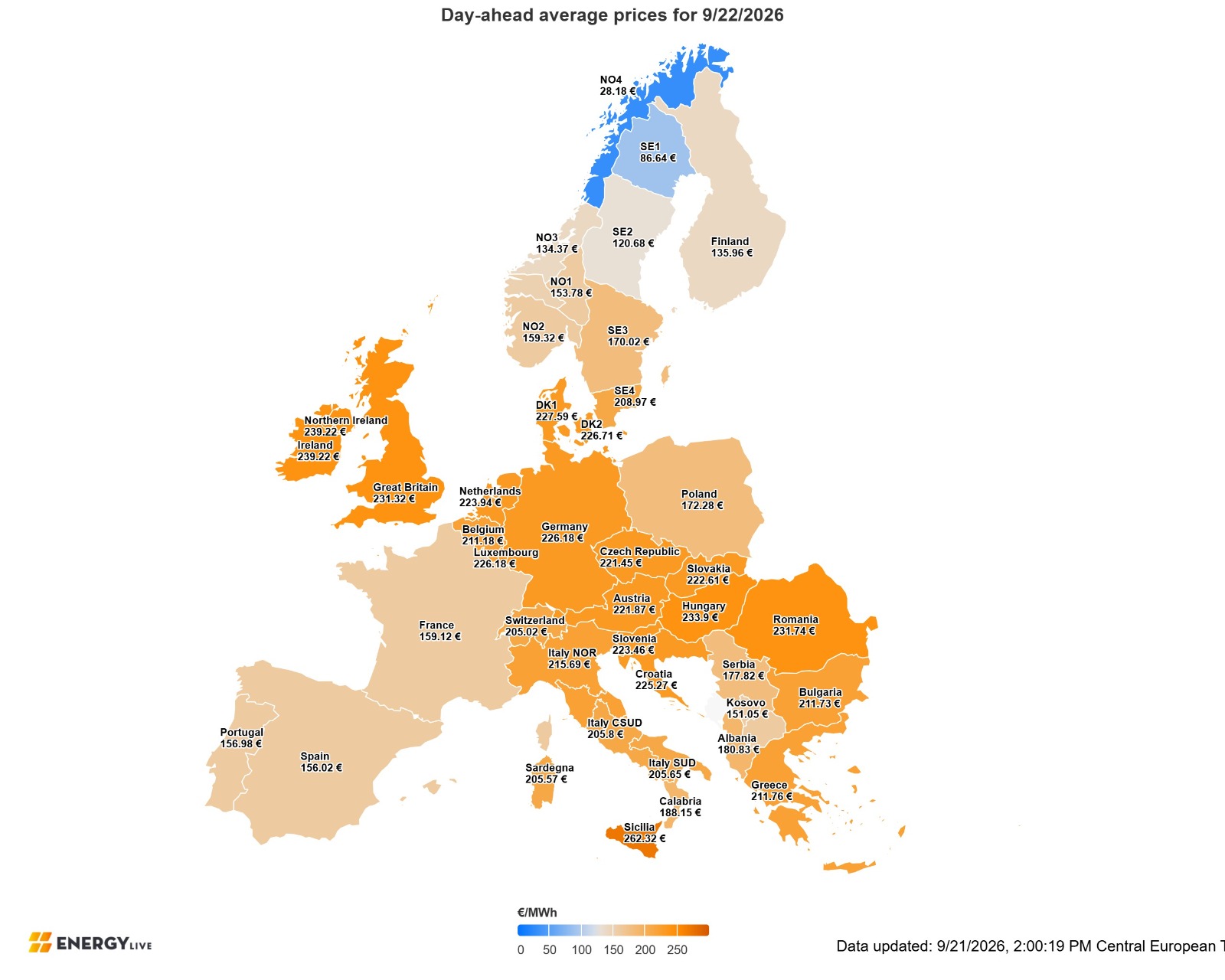
If one looks at today’s European map, at least 18 countries not only were not affected by yesterday’s plunge in gas to 73 euros, but moved sharply upward, with the peak being Germany which, with the contribution of the latest political developments as well, saw the average price soar by 134%.
In Greece’s case, this is only the tenth time since 2024 that the wholesale market has a two in front (211.8 €/MWh today), with the evening peak however braking at 340 euros, far from the unreal for the season price levels in Central and Western Europe. We had not seen a similar price in Greece since February 2025.
From Romania however to Croatia and from Austria, to the Czech Republic, Germany and the Netherlands, electricity markets are “hitting” today after eight in the evening up to 610 €/ MWh, levels that are justified neither by September’s low demand, nor by the combination of reduced hydroelectric and nuclear production that plagues many countries.
In the grip of the multiple energy crisis spreading from one end of the continent to the other and functioning like a domino effect, electricity markets appear to be dragged along by broader developments, ignoring even fundamentals, that is, the factor of limited seasonal consumption.
They are moving upward, even when TTF falls 8% and Brent falls below 100 dollars, as happened yesterday for the first time since September 9, reasonably raising questions about what will happen in winter when radiators will be running at full blast.
And if there is something capable of changing the balance, it seems that this will be nothing other than the weather, as all analysts agree, namely a warm winter due to El Niño, which translates into lower heating needs, therefore lower demand for natural gas and LNG.
Especially since the phenomenon is expected to peak between November - January, that is when energy demand for Europe reaches its zenith.
The signals from futures
Things could in fact be even worse judging by the electricity futures contracts for the last quarter, which although they also moved upward yesterday, are still far from the levels of today’s European map.
In Germany, the futures contract for the last quarter rose by 4.5% to 176.93 €/ MWh, in Austria by 4% (202.03 €/ MWh) and in neighboring Hungary, which as a benchmark for Southeastern Europe also affects Greece, by 3% (209.61 €/ MWh).
In Greece, the electricity future for the same period rose yesterday by 3% to 185.9 euros per MWh, as did Italy (214.14 €/ MWh), as well as Spain (146.83).
The cocktail of low hydroelectric output, drought, and natural gas is what leads analysts who spoke yesterday to the well-known European data provider, Montel, to forecast increases of up to 66% in Southeastern Europe’s electricity prices for the last quarter.
Germany: Prices will hit 2022 highs
Looking however at the big picture, based on the summary of the reports published yesterday by Montel for the fourth quarter (Q4), gathering analysts’ estimates for prices, risks and forecasts related to weather, supply and geopolitical developments, the estimates by country ahead of winter are more or less the same.
In Germany, the wholesale market in the heart of winter is estimated to reach the highest levels since December 2022. The good news is that it will move lower than current futures levels, with forecasts speaking of 151-152 €/ MWh in October and 163-164 €/ MWh in November. The explosive mix is made up of low natural gas inventories and concerns about LNG supply, together with reduced nuclear production in France, low water levels in the Alps and navigation restrictions on the Rhine.
Scandinavia: Double the prices of last year
Always-cheap Scandinavia is not escaping the picture. Estimates for spot prices in the heart of winter point to a doubling compared to last year’s levels, (90 to 122 €/ MWh), due to reduced hydroelectric production, low availability of nuclear units and increased import costs due to natural gas.
UK: Electricity up because of gas
Estimates also point upward for electricity prices in the UK, as natural gas has pushed futures above 200 pence per thermal unit (p/th) for the period through 2027. Today the country has the fourth most expensive electricity market in Europe (231.32 €/ MWh), behind Ireland, Hungary and Romania.
The forecasts will be disproved if autumn proves mild, the winter warm and the country significantly increases LNG flows that could ease the pressure.
Spain: Risk of a jump
Precisely because photovoltaic production declines in winter and interconnections with France are weak, a bad scenario in the natural gas market could send electricity prices in Spain soaring in December even to 200 €/ MWh. Today the market is “playing” at 156 €/MWh. Prices would fall below 200 euros only under the scenario of surplus RES production for at least 20% of operating hours.
Southeastern Europe: Scenarios for a price explosion
Our wider neighborhood has still not recovered from the summer’s “nuclear” price crisis due to the drop in the Danube’s water level to historically low levels, a fact that led to the shutdown of a series of reactors.
A catalyst for the course from here on will be the autumn rains, however a drop in temperature by 2°C below normal levels or any unplanned outages at nuclear plants could send wholesale price levels in the region soaring by as much as 66%.
Although the Paks nuclear plant in Hungary has returned to operation, the same does not apply to Cernavoda in Romania, with autumn finding reactor availability in the region at around 4.2 GW, that is at 70% of their total capacity.