The well-known popular phrase “where there is a poor man, there is his fate” means that the weak are condemned to live constantly with difficulties and hardships. If, moreover, the poor person is also overindebted, the situation becomes even more unbearable. However, by taking a look at the tables with public debt and total debt, private and public, corresponding to the citizens of rich and poor countries, one notices two things.
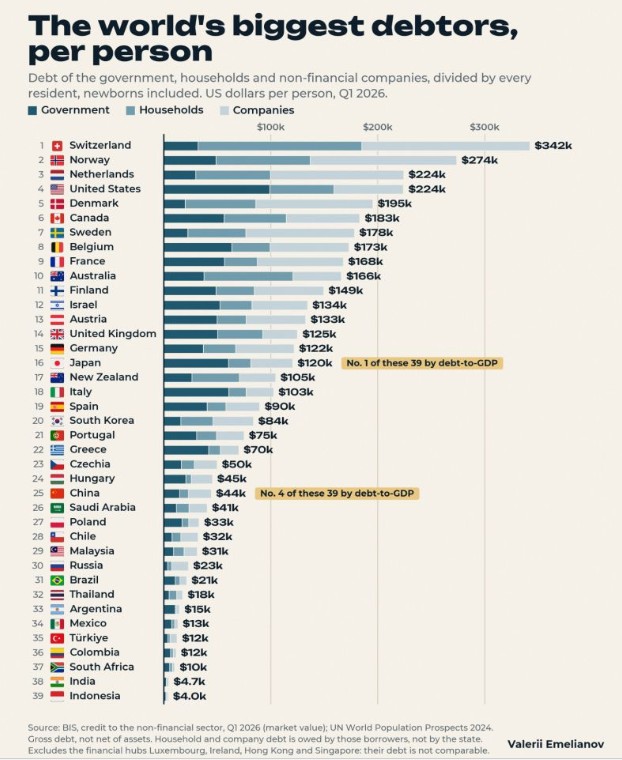
First, the countries with the highest debt do not look so extreme when their debt is converted into per capita terms. It is characteristic that Japan occupies 1st place based on debt to GDP but falls to 16th place in per capita terms, while China drops to 25th place from 4th.
Second, the debt corresponding to the residents of the richest countries is greater compared with the debt of poor countries. This is to some extent normal because rich countries can borrow in capital markets without restrictions at lower interest rates, while poor countries have more limited access and at more expensive interest rates.
Moreover, if we compare each citizen’s debt with the average annual income of each country, then we see that each citizen’s debt in rich countries is 3 times and more greater than the average income, e.g. France, Japan, the USA, etc. On the contrary, in poorer countries, per capita debt is one or two times greater than their average annual income. In the case of Greece, debt is more than 2 times greater than the average income.
Of course, this does not mean that the debts of rich countries are not creditworthy because they are larger per capita and those of poor countries sustainable because they are lower. Creditworthiness is a function of various other factors, e.g. deficits or not, healthy balance sheets or not, incomes, etc.
What do we observe from the relevant table with total per capita debt in dollars that we cite below, prepared by Valerii Evelianov based on data from the 1st quarter of 2026 from international organizations?
The average Swiss person “carries” the largest debt with 342 thousand dollars, followed by the Norwegian with 274 thousand, the Dutch and the American with 224 thousand, and the Dane with 195 thousand.
Each Greek corresponds to debt of 70 thousand dollars versus 75 thousand for the Portuguese, occupying 22nd and 21st place among 39 countries respectively.
At the opposite end, Indonesia, India and South Africa are the countries with the lowest per capita debt amounting to 4 thousand dollars, 4.7 thousand and 10 thousand dollars. In 35th place with just 12 thousand dollars in per capita debt is Turkey.
In short, the residents of Greece appear not to be among the most overindebted among the 39 countries based on total per capita debt.