Known defenses of doubtful effectiveness, such as urging households to consume less electricity or limiting lighting in state buildings and on the streets, are once again being recommended by the Commission ahead of winter, in order to reduce demand for natural gas and save energy.
These very measures that had been applied in the 2022 crisis and that the Commission had also recommended last April are more or less included in the letter sent on Friday to the 27 energy ministers by Commissioner Dan Jorgensen, ahead of tomorrow’s informal Council of Ministers meeting taking place in Dublin in the context of the Irish presidency.
Although a key chapter of the discussion will be the policies aimed at easing the pressure on households and businesses in the face of the current crisis, as the council agenda shows, as well as Jorgensen’s letter, the proposed interventions refer to the familiar "AccelerateEU" package of measures and do not appear to indicate any alarm on the part of Brussels.
“I call on you to consider taking or continuing measures that can contain [gas] inflows or reduce demand for natural gas and electricity,” the EU official characteristically writes to the 27, according to Euractiv, something also confirmed by government sources in Athens.
According to the letter, which is similar to Jorgensen’s one last March, national governments are being called on, as they had done in 2022, to encourage households to consume less electricity when demand is high, to limit heating in public buildings and to “turn off unnecessary public lighting at night,” so that demand for natural gas for electricity generation is drastically reduced.
In essence, “the EU is moving as if sleepwalking,” as a government source characteristically says, even though natural gas remains above 70 euros/MWh (+122% compared to last year) and the orange alert is daily, with half of Europe once again flirting today with prices close to or above 200 euros/MWh for electricity.
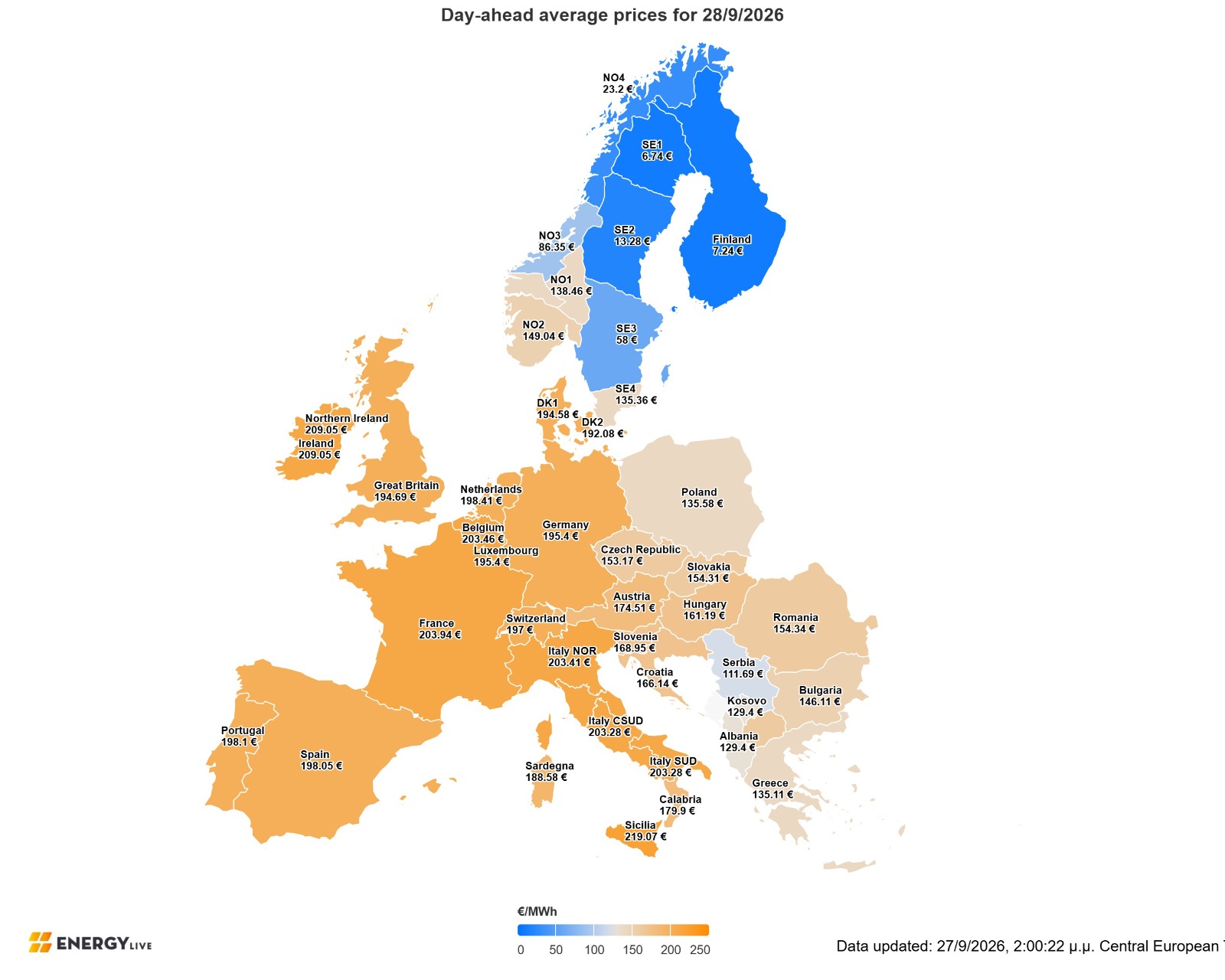
“At the same time that one after another governments are announcing measures and wholesale electricity prices have been out of control for a month and a half now, as today’s map also shows, the broader discussion emanating from the Commission is disproportionate to the levels of seriousness,” as our interlocutors say, not hiding the dissatisfaction of the Greek side.
Alliances or will everyone go their own way?
The big question of course is to what extent Greece’s concern is shared by other countries as well and to what extent this will be reflected in the alliances that will be formed at Tuesday’s Energy Ministers’ Council, where in the good scenario we may see the formation of a strong front to exert pressure on the Commission for a change of direction.
Indicative is the recent move by the Netherlands, which unilaterally announced a few days ago that it is reducing to 64% the national target for gas storage fullness by November 1, versus 90% under the European rule, in order to contain pressure on prices. The Dutch move (their storage level was at 57.47% yesterday) opens the door for other countries to move similarly.
In the bad scenario, however, the usual scene will be repeated, with everyone going their own way on major issues, such as that of reducing taxes on fuels (it is not related to tomorrow’s council, however it cannot be ruled out that it will be raised), where the major issue for Greece is that the corresponding loss of tax revenues should not be counted in the level of expenditures.
This specific issue, however, which the Prime Minister is expected to raise at the upcoming European Council (15-16 October), does not “burn” all countries to the same degree. And this, because 16 governments out of 27 have already temporarily reduced the Special Consumption Tax on fuels, with the only exceptions so far being France, the Scandinavian countries, the Netherlands and us.
The fact that Athens decided to distribute the available fiscal space to other kinds of relief measures - to proceed with allowances, fuel pass, etc. - was our own choice, with whatever that may mean also for how the EU centrally views the Greek request.
It is noted that, as Finance Minister Kyr. Pierrakakis said a few days ago, the excise tax amounts to 4 billion euros per year in revenues for the state budget.
What issues the Ministry of Environment and Energy will raise
In any case, information says that at tomorrow’s council, the Greek side will insist on a series of issues, such as the need to release part of the strategic oil reserves of the G7 countries, which President Macron recently raised, without any further discussion having since taken place within Europe.
In the same direction, the Greek side will repeat that the pursuit of the 90% fullness target in European natural gas storage facilities by November 1 (today it stands at 70.84% versus 80% at this time last year), on the one hand is unfeasible, and on the other hand is unnecessary and the only thing it does is fuel price speculation, as Deputy Minister of Environment and Energy Nikos Tsafos has often pointed out, as have European officials.
And this, because with the current rate of replenishment of European reserves (3 TWh/day or 90 TWh per month), it is estimated that fullness on November 1 will exceed the historical highs of winter demand in Europe, (930 TWh versus 850 TWh in the most difficult winter of the last decade), therefore the picture is better than that indicated by the fullness index of European storage facilities, something that the Dutch government obviously also weighed.
The fact that Europe is facing a price crisis, but not an “immediate risk to security of supply,” is also pointed out by Commissioner Jorgensen in his letter to the 27.
It is worth noting that the current natural gas price for the October contract (70.69 euros/MWh at Friday’s close) is moving paradoxically higher than that shown by futures contracts for the coming months (70.3 euros/MWh for January 2027 or 69.5 euros/MWh for the whole winter of 2026), even though demand will certainly be higher then.