The government rejects the possibility of cutting or limiting the duration of the unemployment benefit, however the model that will apply in the coming years has already changed.
Throughout the previous period and until the end of the year, in the competent directorates of the Public Employment Service (DYPA), in cooperation with OECD officials, the pilot program of 15,000 unemployed people, which linked the benefit to salary and work experience, is being evaluated.
Any improvements deemed necessary to be taken into account will be institutionalized, and the new more contributory and front-loaded unemployment benefit system will apply universally, to all new unemployed people. This, moreover, has already been voted, since 2022.
The political discussion on the unemployment benefit was closed – at least at the level of government intentions – by Labor Minister Niki Kerameus, who yesterday, from the floor of Parliament, described as “closed” the issue caused by the statement of government spokesperson Pavlos Marinakis, while Prime Minister Kyriakos Mitsotakis had already stated that “no unemployment benefit is going to be cut”.
However, behind the political confrontation over whether the benefit could be limited to two months, there is a different and already set-in-motion development: the unemployment benefit system itself is undergoing a major overhaul.
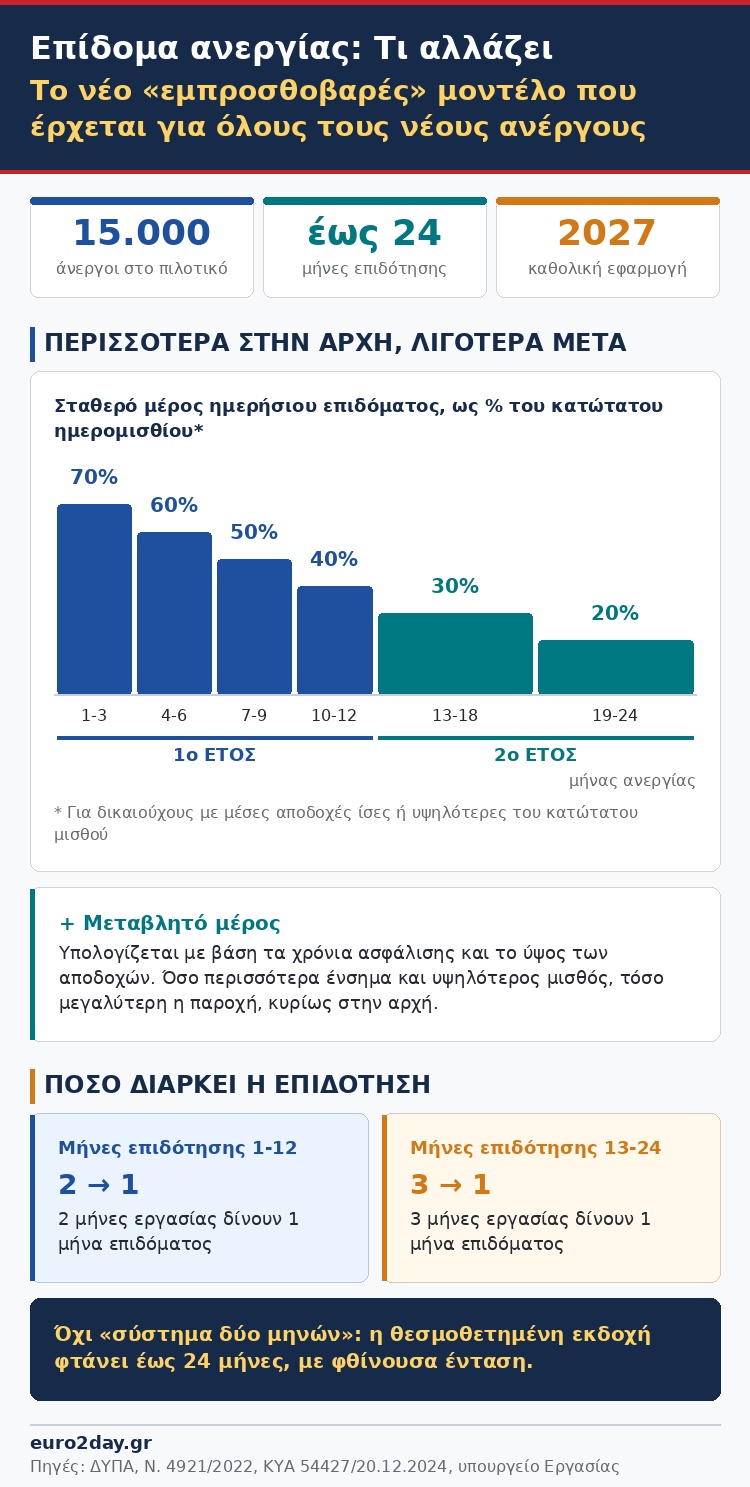
This is not a new scenario that emerged after Marinakis's statements. The change has its roots in the 2022 reform, has been included in the Recovery Fund, was specified by ministerial decision at the end of 2024 and is already being applied on a pilot basis to about 15,000 unemployed people. The issue now is the evaluation of the pilot model and the transition to the new system on a broad scale, with the planning placing universal implementation within 2027.
The new discussion began in early September, when government spokesperson Pavlos Marinakis expressed a personal opinion and argued that its payment should not exceed two months. He later clarified, after strong reactions from the opposition, that this was a personal political opinion and not a government decision or an adopted plan.
The statement caused political confrontation, with PASOK raising the issue of a government “hidden agenda” and asking for clarifications on the duration and amount of the benefit. The response initially came from the prime minister.
In an interview with ERT, Kyriakos Mitsotakis made it clear that the unemployment benefit is not going to be cut, while at the same time reminding that a significant reform of the system has already been carried out.
Yesterday, the competent Labor Minister Niki Kerameus repeated the same line in Parliament, describing the issue as “closed” and attributing the relevant proposal exclusively to Pavlos Marinakis.
That of course does not mean that the benefit will remain the same.
The major change has already been institutionalized. The reform of the unemployment benefit system is part of the 2022 reform and specifically Law 4921/2022, known as the Hatzidakis law. Subsequently, in December 2024, Joint Ministerial Decision 54427/20.12.2024 was issued, which set the terms and conditions of the pilot action.
The new model no longer treats unemployment exclusively with a single, flat amount. Instead, it attempts to link the benefit to the previous earnings of the beneficiary, their insurance history and the duration of unemployment.
The pilot program started with about 15,000 beneficiaries and was designed to last 16 months. It has already been completed and has moved to the evaluation stage.
The most important difference of the new model is that the benefit becomes more individualized. The subsidy consists of different parts, and links the amount of the benefit to the unemployed person's earnings and insurance history.
In the fixed part, the amount is front-loaded: it is higher at the beginning of the unemployment period and decreases as time passes. For beneficiaries with an average monthly earnings equal to or higher than the minimum wage, the fixed part of the daily benefit is provided to correspond to:
- 70% of the statutory minimum daily wage in the first quarter,
- 60% in the second quarter,
- 50% in the third quarter,
- 40% in the fourth quarter,
- 30% in the first half of the second year,
- 20% in the last half-year.
At the same time, there is also a variable part, which is calculated on the basis of insurance history and the level of earnings. Thus, a worker with many years of insurance and higher earnings may receive a higher benefit, especially at the beginning of unemployment.
The logic of the system is clear: greater protection in the first period after the loss of work and gradual de-escalation of the benefit as unemployment is prolonged.
One of the elements that differentiates the new model from the political discussion about “two months” is that the pilot system provides for a potentially much longer duration of benefit. Based on the Joint Ministerial Decision, the benefit can reach up to 24 months, depending on the beneficiary's insurance period.
The mechanism links the employment period with the benefit period. For the first 12 months, one month of benefit is provided for every two full months of employment, while for the period beyond 12 months, three full months of employment are required for each additional month of benefit.
It is therefore clear that the new system is not a two-month system. On the contrary, the institutionalized pilot version provides for a duration of up to 24 months, with different intensity of the benefit during this period.
The real change, of course, lies not so much in abolishing the long duration, as in the way the financial support is distributed over time. From the “same amount for everyone” to a system that links the benefit to salary and work experience. And this, because the benefit is a contributory benefit, directly linked to the contributions that are paid.
The new calculation takes into account:
A) previous earnings. The salary before the loss of work affects the amount of the benefit.
B) insurance history. Years of work and insurance days acquire greater weight in the calculation.
C) duration of unemployment. The benefit starts higher and decreases gradually.
D) family characteristics. The model provides for increases for dependent members and single-parent families, as well as support linked to holiday bonuses.
The major “thorn”
As long as the new benefit was applied on a pilot basis, the amount did not “fall” below current levels. The program was financed by the Recovery Fund with a total of 100 million euros and ran until June 30. In its universal application, however, there will be no such protection.
In cases of unemployed people with few years of insurance and a low salary during employment, the benefit – which will be a function of these – may fall even below the current level of 565 euros, as it was shaped from April 1, from 540 euros previously, due to the increase in the minimum wage.