The government bond market is once again in the spotlight. On September 10, the European Central Bank proceeded with a second consecutive interest rate increase of 25 basis points, effective from 16/9/2026, raising the deposit facility rate to 2.50% from 2.25%.
Inflation in the Eurozone remains above the 2% target for a sixth consecutive month (3.3% in August), with pressure mainly from energy due to tensions in the Middle East, and the swaps market is pricing in a probability above 90% for a third increase within 2026, with a further rise also expected by mid-2027.
The transmission of this tightening to the Greek bond market is already visible. The Greek 10-year closed on 24/9/2026 at 4.408%, from 4.045% on September 1 — an increase of about 36 basis points within three weeks.
The corresponding German Bund moved to 3.574% from 3.357%, resulting in the Greece-Germany spread widening from 69 to 83 basis points. In other words, this is not only a pass-through of the ECB’s monetary policy; there is also a component of heightened alertness in the market regarding Greek risk, which tends to strengthen in an environment of generalized rising yields.
In the rest of the analysis, we examine the mechanism through which rising yields affect listed companies, build three scenarios for the path of ECB interest rates and the yield of the Greek 10-year through the end of 2027, and proceed to a detailed sectoral assessment of the effects on the Athens Stock Exchange, with specific company examples.
The transmission mechanism: Why it matters for stocks
The yield of the long-term government bond acts as the “risk-free” leg of the discount rate with which markets value every future cash flow of a business. When this rate rises, four mechanisms apply simultaneously:
- First, the cost of capital increases, which reduces the present value of future profits and compresses valuation multiples (P/E, EV/EBITDA), with the greatest pressure borne by “growth” stocks with a distant profitability horizon.
- Second, borrowing costs rise immediately for any company with floating-rate bank or bond debt or with a need for refinancing, hitting high-leverage sectors harder.
- Third, the relative attractiveness of dividend yield versus the “safe” bond declines — a stock with a 5% dividend yield loses its attractiveness when the bond approaches 4.5-5%, which particularly affects “bond-like” stocks (bond proxies).
- Fourth, for the banking sector the opposite logic applies in the short term: higher interest rates mean widening net interest margins, at least up to the point where the burden on borrowers begins to create credit risk.
The net effect on each stock is a function of the combination of leverage, cash flow duration, dividend policy, and exposure to cyclicality. With this framework, we move on to the scenarios.
The three ECB scenarios and the projection of the Greek 10-year
As a starting point for all three scenarios, we assume one more ECB interest rate increase of 25 basis points by the end of 2026 (to 2.75%), something that is in line with current market pricing. The differentiation of the scenarios concerns exclusively the number of increases within 2027:
- Scenario 1 – Mild: 2 additional increases in 2027 (+50 bps) => deposit rate 3.25% at the end of 2027
- Scenario 2 – Base: 3 additional increases in 2027 (+75 bps) => deposit rate 3.50% at the end of 2027
- Scenario 3 – Aggressive: 4 additional increases in 2027 (+100 bps) =>deposit rate 3.75% at the end of 2027
For the translation of ECB policy into the yield of the 10-year bond, we do not adopt a mechanical 1:1 pass-through — the long end of the curve reacts partially, as it incorporates expectations that are already partly priced in.
We use a pass-through coefficient (beta) that scales from about 45% in the mild scenario to about 65% in the aggressive one, as greater cumulative tightening tends to be accompanied by a widening of the term premium and, in the Greek case, a possible partial widening of the spread versus the Bund due to increased sensitivity regarding debt sustainability. The result is summarized in the table below and in the chart that follows.
Greek 10-year bond yield (current: 4.41% on 24/9/2026)
| Point in time | Scenario 1 (Mild) | Scenario 2 (Base) | Scenario 3 (Aggressive) |
|---|
| End of 2026 | 4.55% | 4.55% | 4.55% |
| End of 2027 | 4.80% | 5.10% | 5.45% |
| Change from today (4.41%) | +39 bps | +69 bps | +104 bps |
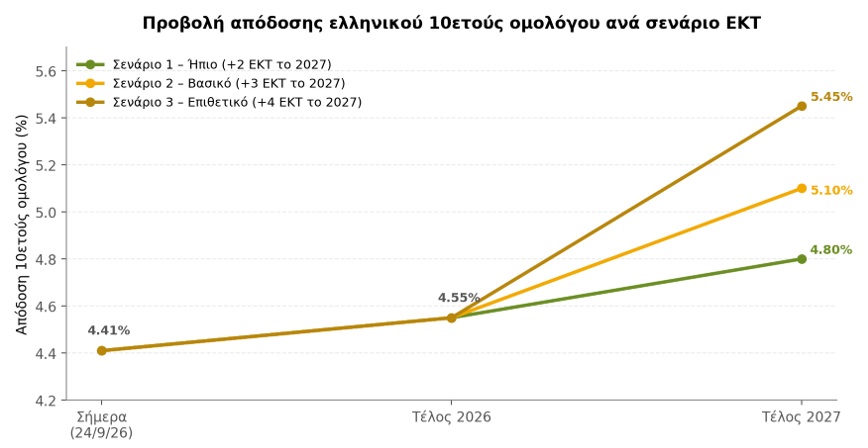
Our base estimate (Scenario 2) places the Greek 10-year around 5.10% at the end of 2027 — a level that is not unprecedented for the Greek bond on a historical basis, but signals a noticeable repricing relative to the low financing cost environment of the last three years.
Sector analysis: Which sectors benefit, which pay the cost
Banks (Alpha Bank, Piraeus Bank, National Bank, Eurobank, Optima, Credia): The sector is the most “ambiguous” in the face of rising yields. In the short term, Greek banks benefit from the widening of the net interest margin (NIM), as a large part of their loan portfolio is floating-rate (linked to Euribor), while deposit costs remain relatively “stuck” low due to abundant liquidity in the domestic banking system.
In Scenario 1 this remains clearly positive. In Scenarios 2 and 3, however, two offsetting forces begin to operate: first, the cost of term deposits eventually starts to rise, compressing NIM; second, the higher debt servicing cost for households (floating-rate mortgages) and small and medium-sized enterprises increases the risk of creating new non-performing exposures, an issue particularly sensitive after the recent “clean-up” of balance sheets.
In addition, the bond portfolios held by banks (mainly Greek government bonds) undergo an accounting markdown in valuation as yields rise, with a different impact on regulatory capital depending on the accounting classification followed by each bank.
Energy and networks (PPC, ELPE/HELLENiQ Energy). PPC is among the stocks most exposed to rising yields due to its huge investment program in distribution networks, RES and network digitalization, which is financed to a large extent with borrowing.
Higher refinancing costs mean immediate pressure on financial expenses and on the discount rate used to value the regulated asset base (RAB) of the networks. HELLENiQ Energy has lower relative leverage and its results are driven more by refining margins than by the interest rate environment, but its ambitious green transition program (hydrogen, RES, biofuels) will face a higher cost of capital, which puts pressure on the internal rate of return (IRR) of new investment decisions.
Telecommunications (OTE). OTE is the classic example of a “bond-like” stock (bond proxy) on the Greek stock market, with stable, predictable cash flow and a high dividend yield that traditionally attracted investors seeking permanent income.
As the government bond yield approaches OTE’s dividend yield levels, part of this investor base tends to rebalance its portfolio in favor of bonds, putting pressure on the share price regardless of operating performance.
At the same time, the financing cost of expanding fiber-optic networks (FTTH) increases, although OTE does not face any substantial refinancing risk due to the conservative structure of its balance sheet.
Real estate and land development. The sector is by nature the most sensitive to bond yields, as property valuation is based on discounting future rents/revenues with “cap rates” that are closely linked to the risk-free rate.
Lamda Development, with the Hellinikon project in a phase of intensive investment and borrowing of many billions of euros, is particularly exposed both to the higher financing cost of the project and to a possible widening of cap rates that would compress the net asset value (NAV) of the commercial real estate portfolio.
Construction and concessions (GEK Terna,AVAX,AKTOR). Concession companies value long-term infrastructure projects (motorways, airports, energy) by discounting cash flows over 20-30 years, making them particularly sensitive to changes in the discount rate.
In addition, financing for new projects (project finance) becomes more expensive, which may reduce profit margins on new awards or delay the maturation of investment decisions. GEK TERNA, with significant exposure to RES and concessions, and AKTOR, after its recent restructuring, will be closely monitored regarding the course of their borrowing costs in the coming quarters.
Metals, industry and energy cables (Metlen, Viohalco, ElvalHalcor, Cenergy Holdings, Titan). This is a highly capital-intensive sector where profitability is determined mainly by the global economic cycle and raw material prices, but the financing cost of investment programs remains an important variable.
Metlen, with its ambitious investment program in RES, energy storage and “green” metals, and Cenergy Holdings, with its international expansion in the production of submarine cables for wind farms, are the most exposed to the cost of capital within the sector, as their projects have a long investment horizon.
By contrast, Titan, with a significant presence in the US and a historically conservative balance sheet, has greater “defense” against the Greek/European interest rate environment.
Refining and energy (Motor Oil). Motor Oil has relatively limited direct sensitivity to bond yields, as its profitability is determined primarily by international refining margins, but its growing investment program in RES and green energy (through Motor Oil Renewables) will see financing costs rise, without this being a critical factor in the investment case in the short term.
Consumer goods and retail (Jumbo, Coca-Cola Coca Cola HBC, EYDAP). Jumbo, with essentially zero net debt, is among the most “immune” stocks on the Athens Stock Exchange to rising interest rates — any impact is limited to compression of the valuation multiple due to a higher discount rate, not to borrowing costs.
Coca-Cola HBC, as a multinational with broader borrowing exposure, is affected more by eurozone yields overall than by the Greek spread specifically, while maintaining a defensive profile thanks to the stability of demand.
EYDAP, as a regulated utility with stable cash flows and an attractive dividend policy, is operationally similar to OTE in terms of “bond proxy” sensitivity — its dividend yield will be constantly compared with the bond.
Air transport and transport infrastructure (Aegean Airlines, Athens International Airport). Aegean carries significant aircraft lease obligations, which accounting-wise function as debt under IFRS 16, while fleet renewal requires continuous access to cheap financing — a higher interest rate environment increases the cost of this renewal.
Athens International Airport, as a regulated infrastructure asset with a long-term concession agreement, is valued by discounting cash flows over many decades and is therefore particularly sensitive to changes in the discount rate, in a manner analogous to concession companies.
| Sector | Sensitivity | Main mechanism |
|---|
| Banks | Positive → Neutral | Widening NIM initially; risk from deposit costs and NPEs in aggressive scenarios |
| Energy/Networks (PPC) | Negative | High refinancing cost of network capex; pressure on RAB valuation |
| Telecommunications (OTE) | Negative | Bond-proxy; dividend yield competition with the bond |
| Real estate | Very negative | Cap rate expansion; more expensive financing of projects and of Hellinikon as well |
| Concessions/Construction | Negative | Discount rate on long-term project cash flows |
| Industry/Metals | Neutral → Negative | Cost of capital in RES/green metals investment programs |
| Refining (Motor Oil) | Neutral | Limited direct sensitivity; spreads are the dominant factor |
| Consumer (Jumbo) | Neutral | Low/zero leverage; only valuation multiple effect |
| Air transport/Infrastructure | Negative | Cost of finance leases and concession discount rate |
Conclusion and portfolio structure
In Scenario 1 (Mild), the market will likely continue to favor banks, as the widening of NIM marginally outweighs any credit burden, while “bond-like” stocks (OTE, EYDAP) maintain their relative attractiveness.
In Scenario 2 (Base), we expect increasing differentiation within the banking sector depending on the composition of each bank’s loan portfolio, and the beginning of pressure on highly leveraged/long-duration investment companies (Lamda Development, PPC, GEK TERNA, etc.)
In Scenario 3 (Aggressive), we would expect a substantial valuation repricing in the real estate and concessions sector, increased vigilance regarding banks’ asset quality, and a shift in investor preference toward low-leverage companies with strong cash positions, such as Jumbo.
In any case, we emphasize that the above scenarios are a sensitivity analysis tool and not a certainty forecast — the path of yields will ultimately depend on the evolution of inflation in the Eurozone, geopolitical developments in energy, and Greece’s fiscal trajectory. We will continue to closely monitor the evolution of the Greek 10-year spread and will update our analysis after each ECB decision.
* Director of Research at Solidus Securities S.A., he leads portfolio analysis and asset allocation optimization, developing integrated financial models for risk assessment and market trend forecasting. President of President EEPAMA - HACSA.
** This article is for informational and educational purposes and does not constitute investment, tax, or legal advice. The data are indicative, based on publicly available historical data, and do not guarantee future returns. Before making any investment decision, consult a certified investment advisor.