Historically, France is a large, wealthy country but it has a bad habit. Bankruptcies. Greece also has the same bad habit, with the important difference that the French state goes back several centuries while the modern Greek one was founded only in the 19th century. Therefore, French bankruptcies reach as far back as the 18th century.
In the book by Reinhart & Rogoff titled “This time is different”, France appears to have defaulted 8 times from the 15th century until today, not counting the defaults during the Middle Ages. Its last official default took place in 1797. From then on, France pays its debts, even if it borrows additionally and uses inflation to reduce the value of the debt.
Greece has defaulted 5 or 6 times since the founding of the modern state in the 19th century. The 6th time refers to the non-timely payment to the IMF in 2015, which some consider a credit event and others do not.
If you are wondering which country is the champion in sovereign defaults since the 19th century, it is Argentina with 9 defaults.
We made this introduction to show that the slogan “Greece-France Alliance”, which was first heard in 1974 after the restoration of Democracy in Greece under the presidency of Valéry Giscard d’Estaing and the premiership of Konstantinos Karamanlis, has one more common element. The two countries do not hesitate to default history.
Why do we say this?
The yields on long-term government bonds issued by countries with high debt have risen quite a bit lately, but especially France’s stands out in the eurozone.
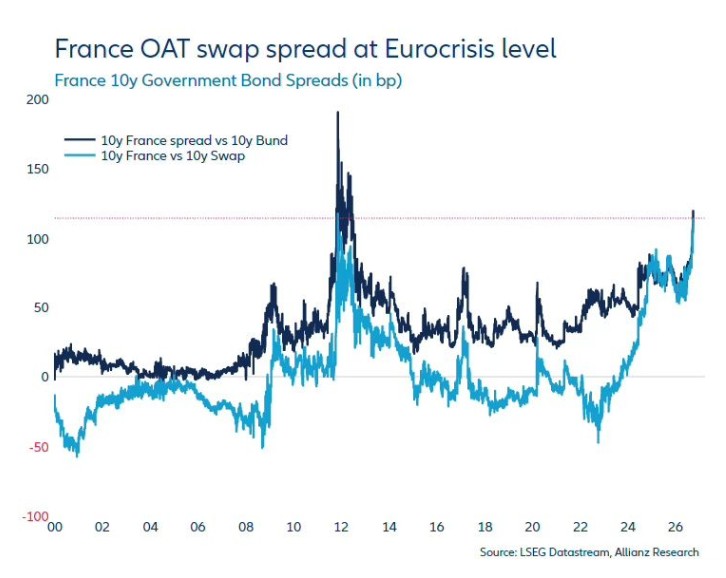
And this is because the yield spread of the 10-year French bond over the corresponding German one widened to 120 basis points and versus the 10-year Greek one to 36 basis points.
Furthermore, the spread of the 10-year French bond over the 10-year interbank market rate (swap) has risen to the record level it was at in 2012 during the euro debt crisis, as shown in the Allianz chart presented below. One percentage point equals 100 basis points.
Even the yield spread of the 2-year French bond over the German and Greek bond widened to 62 basis points and 22 basis points respectively, as Mohamed El-Erian pointed out. This is important because the market prices the fiscal policy of each country and its central bank.
In practical terms, the bond market has begun to price in the possibility of a credit event in France. This is because the fiscal deficit is estimated at 5.4% of GDP and public debt at 119% of GDP, with upward trends. And all this amid the refusal of opposition parties to agree to the adoption of austerity measures as the presidential elections approach, with the two most likely candidates being people the markets do not like.
Nevertheless, it would be unrealistic for someone to assume that the ECB would let the eurozone’s second-largest economy go bankrupt. Simply, the more the 10-year spread and others in France increase over Germany, the closer an ECB intervention comes.
To justify it, the spreads of French yields will have to widen even more so that Frankfurt can invoke the threat to the euro from the risk of “financial fragmentation,” as it did in the past.
At this point, the similarities between France and Greece on the front of bankruptcies end. France is too large an economy to be allowed to go bankrupt, while the other is too small.