Political thought over the past three centuries has been shaped largely by five major currents, which answer — often in opposing ways — three basic questions: who should control economic power, how large should the state be, and what role collective identity (nation, class, individual) plays in organising society.
In this article, we attempt a comparative map of liberalism, neoliberalism, socialism, communism and nationalism — not as absolute, monolithic systems, but as currents with internal divisions and a history of development.
Liberalism: The primacy of the individual
Liberalism emerged in the 17th and 18th centuries, with thinkers such as John Locke and, later, Adam Smith and John Stuart Mill, as a reaction against absolutism and inherited privilege. At its core is individual freedom: every person has natural rights — to life, liberty and property — which the state must protect, not violate. From this follow the principles of equality before the law, parliamentary government, freedom of speech and religion, and the market as a space in which individuals exchange freely.
Liberalism, however, is not a single bloc. Classical liberalism (Smith, and later Hayek and von Mises) emphasises a minimal state and the self-regulation of markets. The social or progressive liberalism of the 20th century (Keynes, Rawls) recognises that formal freedom is not enough when accompanied by extreme inequalities, and accepts an active welfare state as a precondition for substantive — not merely formal — freedom.
The common thread, however, remains the individual as the unit of analysis, rather than class or nation.
Neoliberalism: The economic shift of the late 20th century
If liberalism is a broad political philosophy, neoliberalism is a much more specific economic programme. It emerged in the 1970s and 1980s, with Thatcher and Reagan as its political symbols and a theoretical foundation provided by economists such as Milton Friedman. It was a response to the crisis of the Keynesian welfare state at the time (stagflation, budget deficits).
Its main tenets are the deregulation of markets (in the financial system, labour and trade), the privatisation of public enterprises and services, fiscal discipline and limits on government spending, and the promotion of free trade and the globalisation of capital.
The central idea is that the market, not the state, is the most efficient mechanism for allocating resources — even in areas traditionally considered public, such as health or education.
Its relationship with liberalism is one of lineage, but the two are not identical: neoliberalism draws on classical liberalism’s faith in the market, but is much narrower in scope and more specific to a particular historical period. The term is also often used critically by its opponents, making it more politically “charged” than the broader term liberalism.
Socialism: The collective management of wealth
Socialism emerged in the 19th century in response to the social inequalities of the Industrial Revolution. Its basic premise is that the means of production — factories, land and capital — should not belong exclusively to private owners, but should be subject to some form of social or state control so that wealth is distributed more fairly. In contrast with liberalism, the unit of analysis is not the individual but social class — particularly the relationship between those who own capital and those who sell their labour.
Socialism, however, covers a vast spectrum: from democratic socialism and social democracy (which accept the market and parliamentary democracy but seek extensive redistribution through taxation, public health and education, and collective bargaining — the model, for example, of the Scandinavian countries) to revolutionary socialism, which regards the parliamentary route as inadequate and seeks a more radical transformation of the structure of ownership.
In practice, social democracy today functions more as a corrective than as an overthrow of capitalism.
Communism: The total abolition of private property
Communism, as formulated by Marx and Engels and put into practice (in a way very different from the theory) in the Soviet Union, China and elsewhere, can be regarded as the most radical form of the socialist current. In theory, it aims for the complete abolition of private ownership of the means of production and, ultimately, the disappearance of social classes and the state itself, through a transitional stage of “dictatorship of the proletariat”.
In historical practice, regimes that defined themselves as communist were led to centralised state control of the economy, the abolition of multiparty politics and the concentration of political power in a single party. The fundamental conceptual difference from socialism is therefore one of degree and method: while democratic socialism seeks redistribution within a pluralist, parliamentary framework, communism seeks a radical transformation of the structure of ownership, historically through a revolutionary process and a centralised state.
Nationalism: Identity as an organising principle
Nationalism differs qualitatively from the previous currents, since it is not primarily a theory about the economy, but about identity and political legitimacy. It too emerged mainly in the 18th and 19th centuries. Its central premise is that the nation — a community sharing a language, history, culture or ancestry — is the natural and legitimate basis for organising a state, and that every nation has the right to self-determination.
Historically, nationalism can be combined with almost any economic ideology: there have been liberal nationalisms, socialist/populist nationalisms, and even state-controlled economies with a strong nationalist character.
At the other extreme, radical nationalism — particularly in its fascist forms in the 20th century — combined the idea of national superiority with an authoritarian, totalitarian state and the rejection of both liberal individualism and socialism’s/communism’s class-based internationalism. Today, the term covers a broad spectrum, from moderate patriotism to more extreme, exclusionary forms.
The five ideologies compared
| Ideology | Unit of analysis | Private property | Size of the state | Period of emergence |
|---|
| Liberalism | The individual | A fundamental right | Varies: from minimal state to welfare state | 17th–18th century |
| Neoliberalism | The market as a mechanism | Expanded through privatisation | Limited in the economy | 1970s–80s |
| Socialism | Social class | Limited/controlled; varies | Active, redistributive | 19th century |
| Communism | Social class (radically) | Abolished (in theory) | Centralised (in transition) | 19th century (Marx); 20th (implementation) |
| Nationalism | The nation | A secondary issue; varies | Varies, often strong around sovereignty | 18th–19th century |
Where they overlap and where they clash
It is useful to see these currents not as five isolated boxes, but as responses to different dimensions that can be combined. The liberalism-socialism-communism axis is mainly concerned with the question of “who controls the economy, and to what extent”; neoliberalism is a specific, more extreme position at the liberal end of this axis; nationalism, by contrast, operates on an entirely different axis — that of identity and legitimacy — and can therefore historically be “dressed up” in almost any economic model.
This also explains why the terms are often confused in public debate: a party can be economically neoliberal and culturally nationalist at the same time, or socialist and strongly internationalist, or combine elements that seem to contradict one another.
Historical experience also shows that the gap between the theory and practical application of each ideology — particularly communism and extreme forms of nationalism — has often been vast, with outcomes very different from the original declarations.
A less obvious pairing: Why capitalism and communism often have the same opponents
There is an observation that does not fit easily into the basic “capitalism versus communism” framework: in their pure theoretical forms, both are internationalist currents. Marx called on workers of the world to unite, viewing the nation-state as a tool of the bourgeoisie; capital, for its part, seeks by definition to move freely across borders, currencies and tariffs.
The result is that, historically, both currents have clashed with the same local, traditional institutions — simply for different reasons and with different ultimate aims.
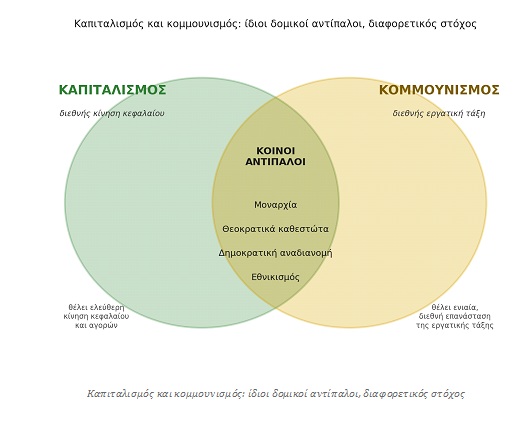
Monarchy was the first obstacle for both: an absolute monarch could write off debts, redistribute land, impose monopolies or ban activities with a single signature — in other words, intervene arbitrarily in property and the market, without any institutional constraints. The French Revolution of 1789, which brought down the old regime, paved the way not only for liberalism but, a generation later, for the very ideas that would lead to Marxism.
Theocratic regimes operated in a similar way, albeit from a different starting point: for centuries, the Catholic Church banned usury, regarding profit from interest as sinful — something that significantly delayed the development of banking capital in medieval Europe.
Where theological priorities prevail over material ones, money ceases to be the central organising principle of society — something equally unwelcome to capitalism and to Marx’s materialism, which saw religion as “the opium of the people”, a mechanism that distracts the masses from their material conditions.
Democracy is the more complex case, because it is not an external opponent but a source of internal friction: through elections, parliament can raise taxes on the wealthy, expand the welfare state and redistribute wealth — in other words, operate as a mild, gradual form of socialism within a capitalist framework.
Thomas Piketty’s case for progressive taxation of capital falls squarely within this framework. For communism, however, democracy is equally problematic, but for the opposite reason: the classical Leninist view holds that the party knows the working class’s “objective interest” better than voters themselves, who are seen as victims of the ruling class’s “ideology” — so the parliamentary route is considered inadequate or even a trap.
Finally, nationalism is an obstacle to both because it places the nation above class or the market: tariffs, capital controls and “buy national” block the free movement of capital, while national identity fragments the “united international working class” envisaged by Marxism. It is no coincidence that today’s debate over tariffs and protectionism is often described as a clash between globalised capital and economic nationalism.
China as an example
The most striking historical example of this dynamic is China’s rapid transition from Maoist communism to one of the most dynamic capitalist economies on the planet.
This does not mean that capitalism and communism were, from the outset, “on the same side” — it means something simpler and just as interesting: the Cultural Revolution and the Great Leap Forward largely destroyed China’s traditional structures — family ties, religious institutions, Confucian hierarchies and local elites.
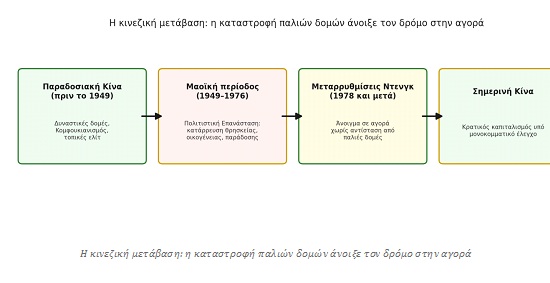
When Deng Xiaoping, after Mao’s death in 1976, decided to gradually open the economy to market mechanisms, he found himself facing ground that offered almost no resistance: there were no longer any strong traditional structures to block the reforms, precisely because the previous regime had already eliminated them.
The same pattern was repeated, to varying degrees, in former Eastern Europe after the fall of the USSR: decades of state control had already dismantled the previous economic and social order, and capital flowed in quickly once the way was clear.
It is worth noting, however, that today’s China has not abandoned its communist political system — the Communist Party remains in power under one-party rule; what changed was the economic mechanism, not the political structure, which the Chinese leadership itself describes as “socialism with Chinese characteristics”.
The current revival of nationalism: The US and Europe
This theoretical framework is not confined to history books — it has direct relevance today. In the US, Donald Trump represents a mix that does not fit easily into old categories: explicitly nationalist rhetoric and policy (“America First”), combined with pro-capital policies at home (privatisations, tax cuts, deregulation) and strongly protectionist policies abroad (tariffs, restrictions on trade and immigration).
In other words, this is a form of economic nationalism that borrows tools from capitalism at home, but turns them against the free movement of capital and people across borders — precisely the point of friction described above.
In Europe, this current is not marginal. In France, Marine Le Pen’s National Rally consistently leads the polls, with support of around 30-33% — a substantial lead over the runner-up.
In Germany, the Alternative for Germany (AfD) has established itself as a powerful force at regional and national level, something unthinkable a decade ago. Similar trends are evident in other large and smaller EU countries, where nationalist or national-populist parties are gaining ground at a pace that is difficult to ignore.
Supporters of these parties attribute their rise mainly to social factors: uncontrolled migration from countries with very different customs and traditions, whose migrants are difficult to integrate; concerns about public safety; and the pressure that cheap labour puts on low-skilled wages.
These arguments do indeed dominate nationalist parties’ public discourse and go a long way towards explaining their electoral momentum. It is worth noting, however, that the empirical literature on these issues — the relationship between migration and crime, and its effect on wages — remains the subject of sharp disagreement among economists and criminologists, with studies reaching quite different conclusions depending on the country, period and methodology.
Beyond migration, analysts attribute the rise of nationalism to other factors: disillusionment with globalisation and its effects on traditional industrial regions, rising inequality, and a broader crisis of confidence in traditional centrist political groupings.
In any case, the phenomenon bears out the framework described above: whenever the globalisation of capital (or, historically, the internationalist vision of communism) advances faster than society can absorb, nationalism re-emerges as the most immediate political response.
These five ideologies are not merely academic categories; they continue to shape the way economies, states and societies are organised today. Understanding what each one means — its core principles, its historical origins, where it converges and where it clashes with the others — gives us a more precise tool for making sense of contemporary political and economic debate, rather than relying on simplistic labels.