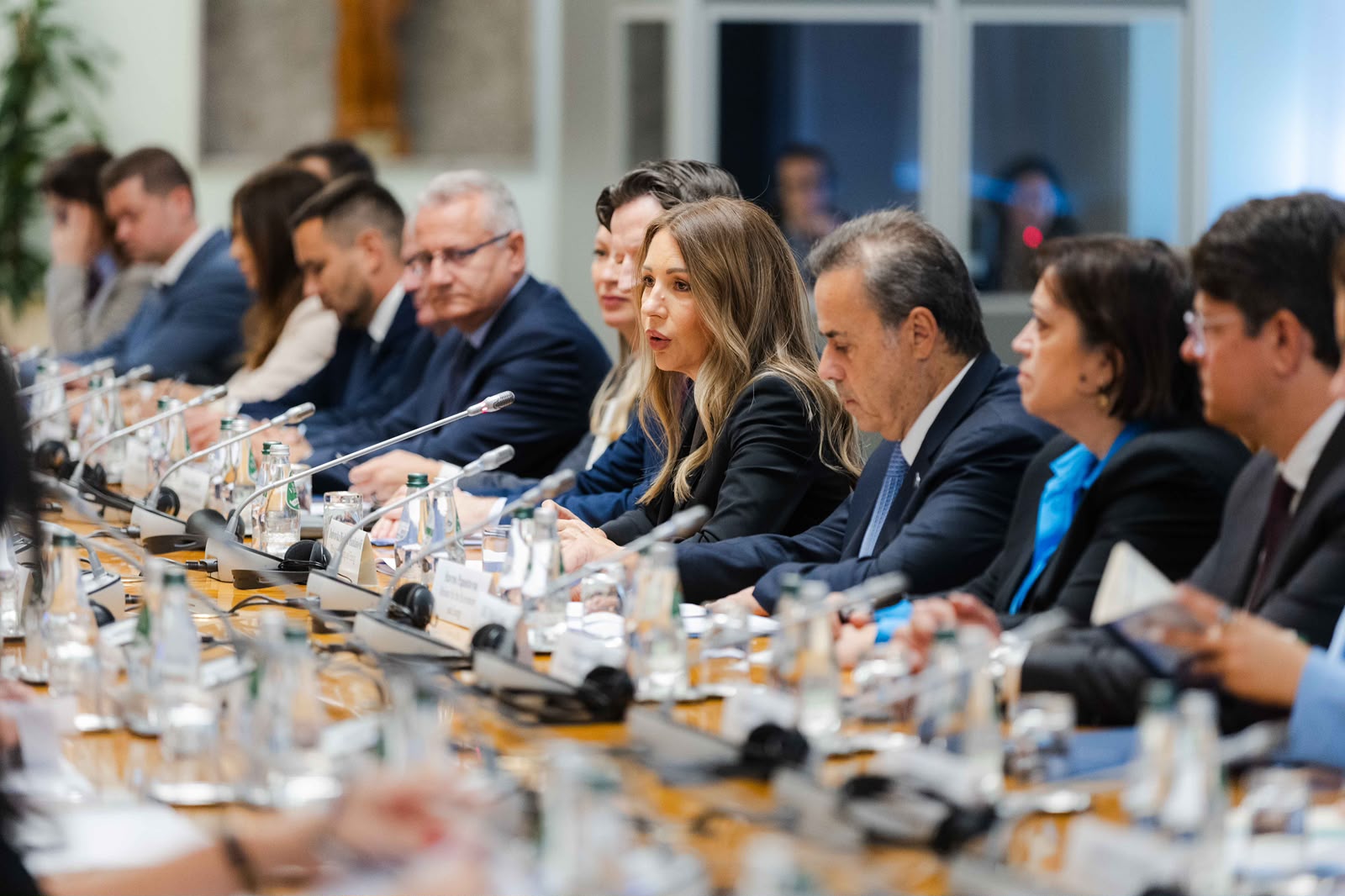
The Minister of Environment and Energy Stavros Papastavrou participated in the 2nd Quadrilateral Ministerial Meeting on Energy and Connectivity in Southeastern Europe, which took place in Belgrade.
The meeting was attended by Serbia’s Minister of Energy Dubravka Handanović, North Macedonia’s Minister of Energy, Mining and Mineral Resources Sanja Božinovska, Bulgaria’s Minister of Energy Iva Petrova, as well as the heads of the Natural Gas and Electricity Transmission System Operators from the four countries.
The meeting followed the first Quadrilateral meeting held in Athens last May on Greek initiative, confirming the willingness of the four countries to strengthen regional energy coordination. The discussions focused on strengthening energy security, diversifying sources and supply routes, developing energy interconnections, and further integration of the markets for electricity and natural gas.
Particular emphasis was placed on the development of the Vertical Natural Gas Corridor, with the ministers confirming their commitment to strengthening its role as a reliable energy gateway to Southeastern and Central Europe and the Western Balkans. In this context, the participation of Serbia and North Macedonia in the Vertical Corridor was welcomed, as was the imminent start of construction of the natural gas interconnection between the two countries.
At the same time, the ministers discussed strengthening electricity interconnections and transmission networks, the development of Renewable Energy Sources (RES), storage and pumped storage projects, as well as the further integration of the electricity markets of the Energy Community countries with the single market of the European Union (EU).
At the conclusion of the meeting, the four countries reiterated their commitment to continuing regional cooperation and jointly strengthening the energy security, connectivity, and resilience of Southeastern Europe, with Greece playing a pivotal role as an energy gateway and transport corridor to Southeastern and Central Europe and the Western Balkans.
After the meeting, Mr. Papastavrou stressed: “Our countries face the same major challenge every day: ensuring affordable and reliable energy for their households and businesses. Regional energy interconnection and cooperation are an integral part of this effort”.
“Since our last meeting in Athens in May, significant progress has been made. On September 4, in Thessaloniki, 11 Transmission System Operators from 9 countries in Southern and Central Europe agreed to expand the Vertical Corridor, including Serbia and North Macedonia”, the minister said.
As he noted, “this development is of particular importance following the European Union’s decision to phase out dependence on Russian natural gas, as a need is expected to arise in Central Europe to replace approximately 20 billion cubic meters of natural gas”.
“Today, all the ministers once again confirmed our strong commitment to expanding the Vertical Corridor with the participation of Serbia and North Macedonia. Its expansion strengthens the capacity to transport natural gas from Greece to Central Europe, offering additional supply routes. It strengthens the strategic role of our country and shows what we can achieve together”, he added.
At the same time, he pointed out that “specific projects are underway in the fields of electricity and petroleum products. It is therefore useful for us to meet regularly, possibly every six months, to monitor their implementation. The next meeting will take place in Sofia, where we will have the opportunity to assess progress on all these issues”.
“For Greece, the importance of this initiative goes beyond the energy sector itself. Energy is a connecting link that brings our four countries closer together and creates a new culture of cooperation, so that we can jointly address challenges and promote common solutions”, Mr. Papastavrou stressed, concluding that “Greece supports Serbia’s integration into the European energy system. Together with my colleague from Bulgaria, we will strongly support this effort at the meetings of the European Union’s Energy Ministers”.
Joint Press Release
The Republic of Serbia hosted in Belgrade the second meeting of the Energy Ministers of Serbia, Bulgaria, Greece, and North Macedonia.
The ministers discussed ways to strengthen regional cooperation and enhance energy security in Southeastern and Central Europe, with particular emphasis on diversifying energy supply sources and routes, regional connectivity, and developing the region as an important energy transit corridor for Europe.
The participants discussed the utilization of existing natural gas infrastructure and the progress of natural gas infrastructure projects aimed at further interconnecting the participating countries and opening additional supply routes from new natural gas sources.
At the same time, they agreed that achieving these goals requires closer cooperation for the integration of electricity and natural gas markets, greater system flexibility and security of supply, continued investment in transmission networks and natural gas and oil infrastructure, as well as enhanced coordination among natural gas transmission system operators, in order to make better use of existing infrastructure and address the remaining regulatory problems and infrastructure bottlenecks.
The ministers welcomed the participation of Serbia and North Macedonia in the Vertical Natural Gas Corridor through their respective transmission system operators, as well as the imminent start of construction of the natural gas interconnection between the two countries. This project will be connected to the Greece–North Macedonia interconnection, which is currently under construction, with the Greek section expected to be completed by the end of 2026 and the North Macedonia section in 2027.
The first pipes for the Serbian section of the Serbia–North Macedonia natural gas interconnection have been delivered and work on their installation is expected to begin soon. This will open a new supply route for liquefied natural gas (LNG) from the terminal at the port of Alexandroupolis, in addition to the existing routes, for the diversification of natural gas supply via Bulgaria.
The strong commitment to the development of the Vertical Natural Gas Corridor and to strengthening its role as a reliable energy gateway to Southeastern and Central Europe and the Western Balkans was reaffirmed. Through the ongoing development of the natural gas transmission system, its interconnections with Bulgaria and North Macedonia, as well as LNG infrastructure, including the Alexandroupolis LNG Terminal, Greece is increasing its capacity to channel diversified quantities of natural gas northward.
Export capacity is expected to reach 9.5 bcm by 2027. This infrastructure, combined with additional LNG supplies, will facilitate natural gas flows to neighboring markets, including Serbia and North Macedonia, strengthening the region’s diversification and resilience and supporting the gradual phase-out by EU member states of Russian natural gas, in accordance with the REPowerEU regulation.
The ministers also examined the development of natural gas infrastructure with a view to its potential future use for the transport of hydrogen. In addition, they agreed to strengthen information exchange ahead of the winter period, including on the readiness of transmission systems and the possibilities for electricity exchanges. They also discussed renewable energy projects, the development of transmission networks, pumped storage projects, and battery projects, with the aim of increasing system flexibility and storage capacity.
Particular attention was given to the further integration of the electricity markets of the Contracting Parties of the Energy Community with those of the member states of the European Union. The ministers stressed that deeper integration of electricity markets would contribute significantly to the energy security and resilience of the region.
The ministers also discussed the stability of the electricity system in Southeastern Europe, including through cross-border interconnections and the integration of regional electricity markets, while Bulgaria presented progress regarding the East–West electricity corridor.
The potential development of the southeastern hub of the national petroleum products pipeline system along the Thessaloniki-Skopje-Niš route was also discussed, which could further connect Serbia, via North Macedonia, with the energy infrastructure and the port of Thessaloniki.
Finally, the ministers exchanged views on the just energy transition and the decarbonization of the Western Balkans, underlining the importance of coordinated action and adequate financial support from the European Union. They also exchanged information on initiatives concerning the EU regulatory framework, including the Carbon Border Adjustment Mechanism (CBAM), as well as on the need to support the region in adapting to the new requirements, repeatedly expressing their commitment to continuing regional cooperation.