Capital Maritime Finance (CMF) is expected to make its debut on the Main Market of Euronext Athens on Tuesday, 20 October.
It is the first shipping company to list its entire share capital exclusively on the Greek stock exchange, which alone is enough to attract market attention. A closer look at the figures presents a particularly interesting picture that is, for the most part, positive.
The company has high-quality earnings and near-complete revenue cover for more than a decade. It is smaller today than it will be in two years, and the valuation it is seeking reflects a fleet already being built, with its revenue secured under long-term contracts.
Investors taking part in the public offering from 13 to 15 October will acquire a stake in a growing fleet with a visible, contractually secured revenue stream.
What is on offer and on what terms
CMF is offering up to 42 million new shares at a maximum price of €7.84, targeting a raise of about €250 million, which could reach €300 million. Net proceeds are estimated at €239.3 million and are earmarked for the acquisition of 23 new vessels over 24 months. Any remaining funds will be used for general corporate purposes or to partially repay existing debt.
Its sole shareholder to date is Capital Maritime & Trading, which is controlled by Evangelos Marinakis. If the raise reaches €250 million at the maximum price, it will retain about 75.8% of the voting rights, leaving a free float of around 24%.
Commitments totalling €70 million have already been secured from four cornerstone investors: €20 million from companies linked to Evangelos Mytilineos and €20 million from companies linked to Socratis Kokkalis, as well as €15 million each from companies linked to Giannis Vardinogiannis and Giorgos Peristeris. That means about 28% of the €250 million target has been covered before the book opens.
The participation of such prominent business figures is a strong vote of confidence in the offering.
The binding price range will be announced on Monday, 12 October. The analysis that follows is based on the maximum price and will need to be revisited once the range is known.
Results: exceptional margins and strong cash generation
In 2025, CMF generated revenue of $122.85 million, EBITDA of $89.85 million (a 73% margin) and net profit of $64.94 million, with operating cash flow of $82.05 million. In the first half of 2026, the respective figures were $57.46 million, $39.73 million and $29.93 million, with cash flow of $50.37 million.
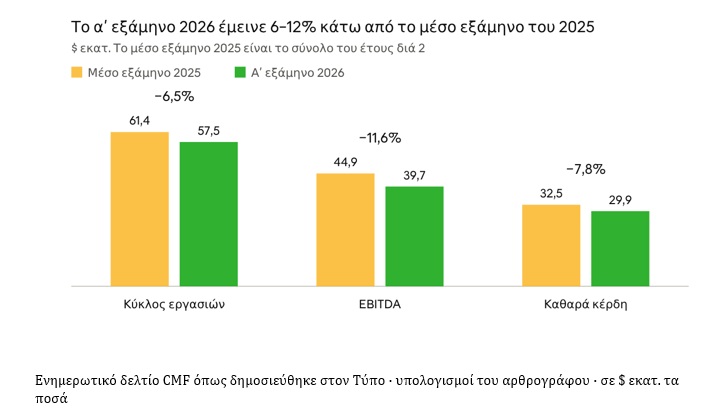
The EBITDA margin remains very high, at 69.1% compared with 73.1%, while the net margin was practically unchanged at 52.1% versus 52.9%. This means profitability per dollar of revenue remains exceptionally strong.
Operating cash flow in the first half exceeded EBITDA by 27%, indicating strong conversion of earnings into cash. Some of the outperformance is probably due to working capital, so we would not assume it will recur to the same extent.
The fleet and contracts: a fivefold increase in two years
CMF will add 23 vessels to its operating fleet of 13, with deliveries scheduled from the fourth quarter of 2026 to the fourth quarter of 2028. The expansion programme is worth about $1.8 billion.
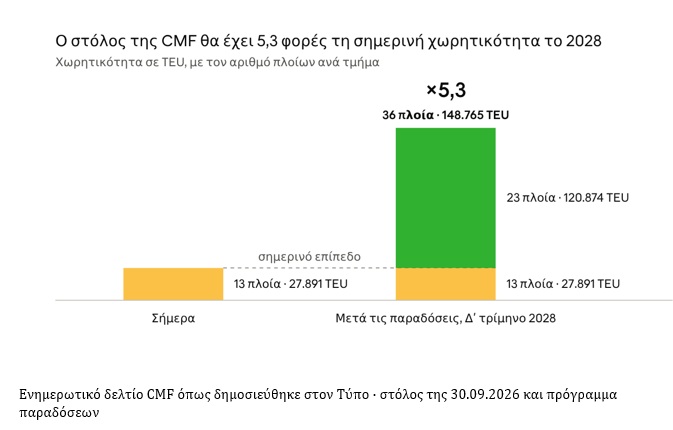
The final fleet will comprise 36 vessels: 26 feeder ships and 10 Neo-Panamax vessels of about 8,700 TEU, with the ten larger ships capable of running on dual fuel (LNG, bio-LNG and e-LNG). The entire fleet, including vessels yet to be delivered, is covered by long-term charters extending to 2038.
All available days are already locked in through 2034, the average remaining charter duration is 9.4 years and minimum secured revenue amounts to $3.9 billion ($4.9 billion including extension options).
This growth does not depend on expectations for freight rates, as the revenue is already contractually secured. The revenue stream is underpinned by two established charterers, which account for almost all of the contracted backlog: CMA CGM with 74.8% and Unifeeder with 24.9%.
Valuation, debt and dividends
At the maximum price, equity is valued at about €784 million before the raise and €1 billion afterwards. At the exchange rate of $1.12 to the euro used in the prospectus, this implies a price-to-earnings ratio of about 13.5 times 2025 earnings and 14.7 times first-half earnings if doubled.
The enterprise value-to-EBITDA ratio comes to around 12.4 and 14 times, respectively. For a company with an EBITDA margin above 69% and contracted revenue through 2034, these multiples look reasonable.
These ratios are based on a fleet of 13 vessels, while the price reflects a fleet of 36. This means the market will judge CMF on its future earnings, which is where the potential re-rating lies: with the fleet set to nearly triple and the new vessels already chartered, earnings growth has good visibility.
The company aims to distribute 60% to 70% of adjusted net profit quarterly, with the first payment in the first quarter of 2027. For the dividend yield to reach 6.5–7%, adjusted earnings will need to reach about $115–135 million, almost double the $64.94 million reported in 2025. The target appears achievable as the new vessels enter service, although it will also depend on financing costs.
The balance sheet starts from a strong position. At 30 June, net debt stood at $235.5 million, just under three times first-half EBITDA on an annualised basis and only 0.57 times equity. The remaining investment programme amounts to about $1.9 billion through 2028, of which $1.6 billion will be covered by bank borrowing, serviced by revenue already secured under contracts.
If the full amount is raised, net debt will be roughly $1.8–1.9 billion. This is a rough estimate that takes account of neither repayments nor operating cash flow. Contracted revenue of $3.9 billion equates to about $415 million a year, with an average charter duration of 9.4 years, providing predictable cash flows to service the debt.
At current margins, leverage at the peak of the programme will be around five to six times EBITDA, before repayments, and is expected to ease as the new vessels begin contributing. The information we have seen does not specify the mix of fixed- and floating-rate debt, which will be important for borrowing costs; we await clarification from management.
What we will be watching
First, the first-half earnings run rate. Doubling the first-half 2026 figures puts revenue 6.5% below 2025, EBITDA 11.6% lower and net profit 7.8% lower—a relatively limited shortfall before the first new vessels enter service. We do not have first-half 2025 figures to determine whether this reflects seasonality, a vessel sale or re-chartering, and expect the prospectus to explain the difference.
Second, concentration. CMA CGM accounts for 74.8% of the contracted backlog and Unifeeder for 24.9%. The contracts are take-or-pay and the charterers are strong. CMA CGM had a difficult first quarter, with net profit down 77.7% and EBITDA down 31.6%. However, weakness in the container market does not directly affect CMF’s revenue, which is locked in under long-term contracts.
The prospect of future re-chartering or renegotiation remains a point to watch, but is some way off, since all available days are already locked in through 2034.
Third, execution. Twenty-three deliveries over nine quarters, from the fourth quarter of 2026 to the fourth quarter of 2028, tie the 2027 dividend and the valuation to the shipyards and delivery schedule. Since every vessel already has a secured charter, the risk is primarily one of timing, rather than commercial performance.
Finally, control: the main shareholder’s 75.8% stake provides stability and alignment of interests, while we will examine related-party transactions in the prospectus closely.
Overall, CMF looks like an investment with limited freight-rate risk, a visible, contractually secured revenue stream through 2034, very high margins, strong cornerstone investors and a clear distribution policy. The potential upside in the shares comes from vessels due for delivery by 2028 and debt yet to be raised.
That is why the delivery schedule and loan terms will determine the upside that ultimately shows up in earnings and dividends.
* Director of Research at Solidus Securities S.A., leading portfolio analysis and asset allocation optimisation and developing integrated financial models to assess risk and forecast market trends. President of EEPAMA - HACSA.
** This article is for informational and educational purposes only and does not constitute investment, tax or legal advice. The figures are indicative, based on publicly available historical data, and do not guarantee future returns. Before making any investment decision, consult a certified investment adviser.