The list of 450 SKUs to be included in a new ‘gentlemen’s agreement’ between the government, suppliers and retailers to keep prices in check during the final two months of the year is now in the hands of supermarket chains.
The initiative comes at a time when the market is showing an intriguing paradox. Sales are rising and consumers are buying larger quantities, while promotional activity, which for years was a key tool for attracting customers, is being scaled back significantly.
“Sales are growing at around 5.5% and, so far, we have not seen price rises apart from dairy products. Of course, we do not know what will happen by the end of the year,” market sources told Euro2day.gr.
Sales and price trends
The question is how long this balance can be maintained. More importantly, will price cuts on the 450 SKUs translate into meaningful relief for household budgets, or will their impact be limited in a market with turnover running into billions of euros?
According to the latest data from NielsenIQ, supermarket sales rose by 6.4% in the nine months from January to September, reaching €12.864 billion. In other words, the market added €770 million to its turnover in nine months.
Growth in fast-moving consumer goods (FMCG) of 5.5% in the nine-month period was driven almost entirely by sales volumes, which rose by 4.6%, while the average value per unit increased by just 0.8%. This does not, of course, mean that shelf prices did not rise or have returned to previous levels, nor that all products have followed the same trend.
Even as consumption rises, the share of turnover generated by promotions is falling sharply. In 2023, 56% of FMCG sales were made on promotion. The figure stood at 54.4% in 2024, before falling to 37.5% in 2025 and declining further to 34.3% in the first nine months of 2026.
The shift has been even more pronounced for branded products. The share of sales made on promotion, which stood at 66.7% in 2023, has fallen to 39.5%.
But who is benefiting from the growth? Behind the overall increase of 6.4% is a market moving at different speeds. General merchandise — from toys and electrical appliances to clothing — recorded the fastest percentage growth, rising by 11.3% to sales of €818 million.
Next came fresh and unpackaged products, up 7.5% to turnover of €3.188 billion. The category, which includes meat, fish, cheese, fruit and vegetables, and bakery products, accounts for almost a quarter of total sales.
Sales of food and drink, which make up the core of the market with a 54.3% share, rose by 5.8% to €6.990 billion. Food sales increased by 6% and drink sales by 5.1%.
Slower growth was recorded by home care products, up 4.6% to sales of €1.045 billion, and personal care and beauty products, which rose by 5% to €822 million.
Another notable development concerns private-label products. Despite continued pressure on household budgets, their share is not increasing further. Instead, it edged down to 24% in the first nine months of 2026, from 24.4% in 2025.
It remains, however, above the 22.4% recorded in 2021. This is significant because it shows that market growth has not been accompanied by a further shift in share towards private-label products.
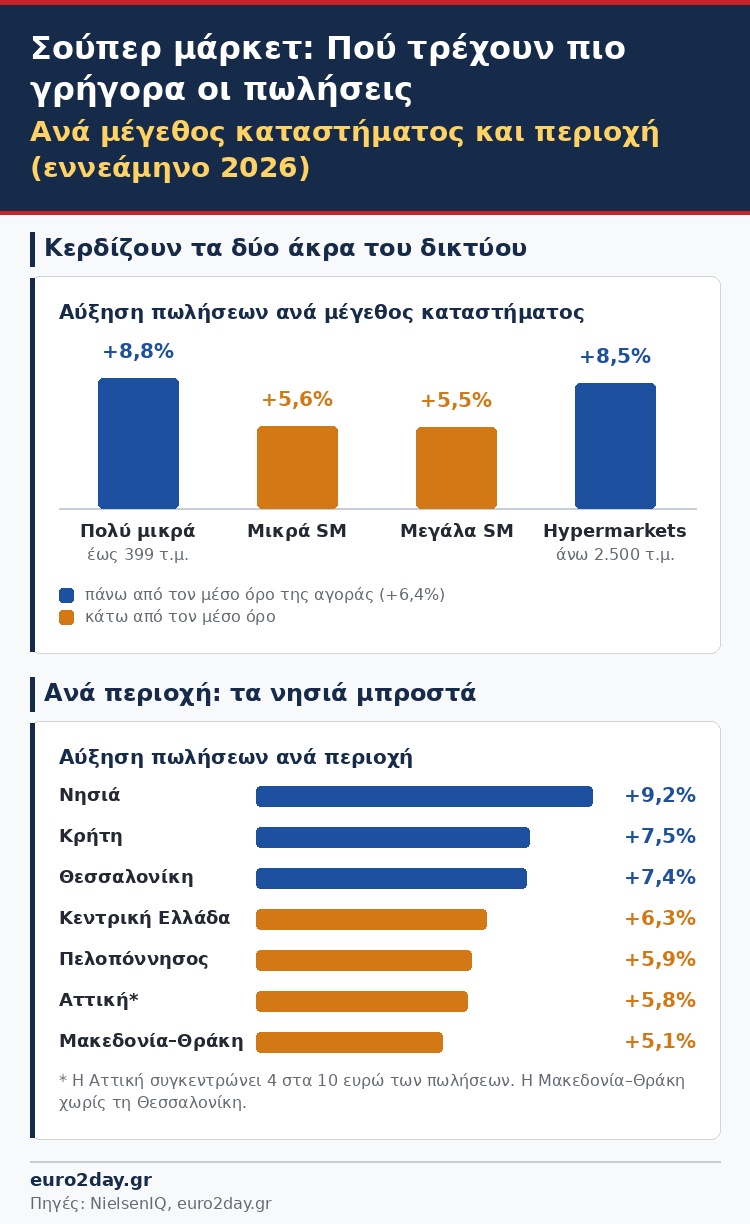
Two winners in the bricks-and-mortar channel
The fastest growth among bricks-and-mortar stores was recorded by very small outlets, with floor space of up to 399 sq m, where sales rose by 8.8%. Hypermarkets with floor space of more than 2,500 sq m grew at almost the same pace, 8.5%.
By contrast, conventional large and small supermarkets recorded slower growth, of 5.5% and 5.6%, respectively. The two ends of the bricks-and-mortar spectrum — small shops and very large outlets — are therefore showing stronger momentum than the formats in between.
The regional picture of consumer spending is similarly uneven. Attica, which accounts for four out of every 10 euros of total sales, recorded growth of 5.8%, below the national average. At the other end of the scale, the islands posted an increase of 9.2%.
Next came Crete, with 7.5%, and Thessaloniki, with 7.4%. Central Greece grew by 6.3%, the Peloponnese by 5.9%, while Macedonia and Thrace, excluding Thessaloniki, recorded the slowest growth, at 5.1%.