Workers will gain twice over, but the cut in social security contributions will not reduce non-wage labour costs for businesses, as it comes alongside an increase in the minimum wage.
As is now clear from the draft bill of the Ministry of National Economy and Finance, which sets out the measures announced by Prime Minister K. Mitsotakis at the Thessaloniki International Fair, private-sector employees will pay lower unemployment contributions from 1 April 2027, with the monthly gain reaching €10 on a gross salary of €2,000.
For the thousands of workers paid the minimum wage, the combination of a half-percentage-point cut in contributions and a €40 pay rise, from €920 to €960 gross, will provide a further, albeit modest, boost to take-home pay.
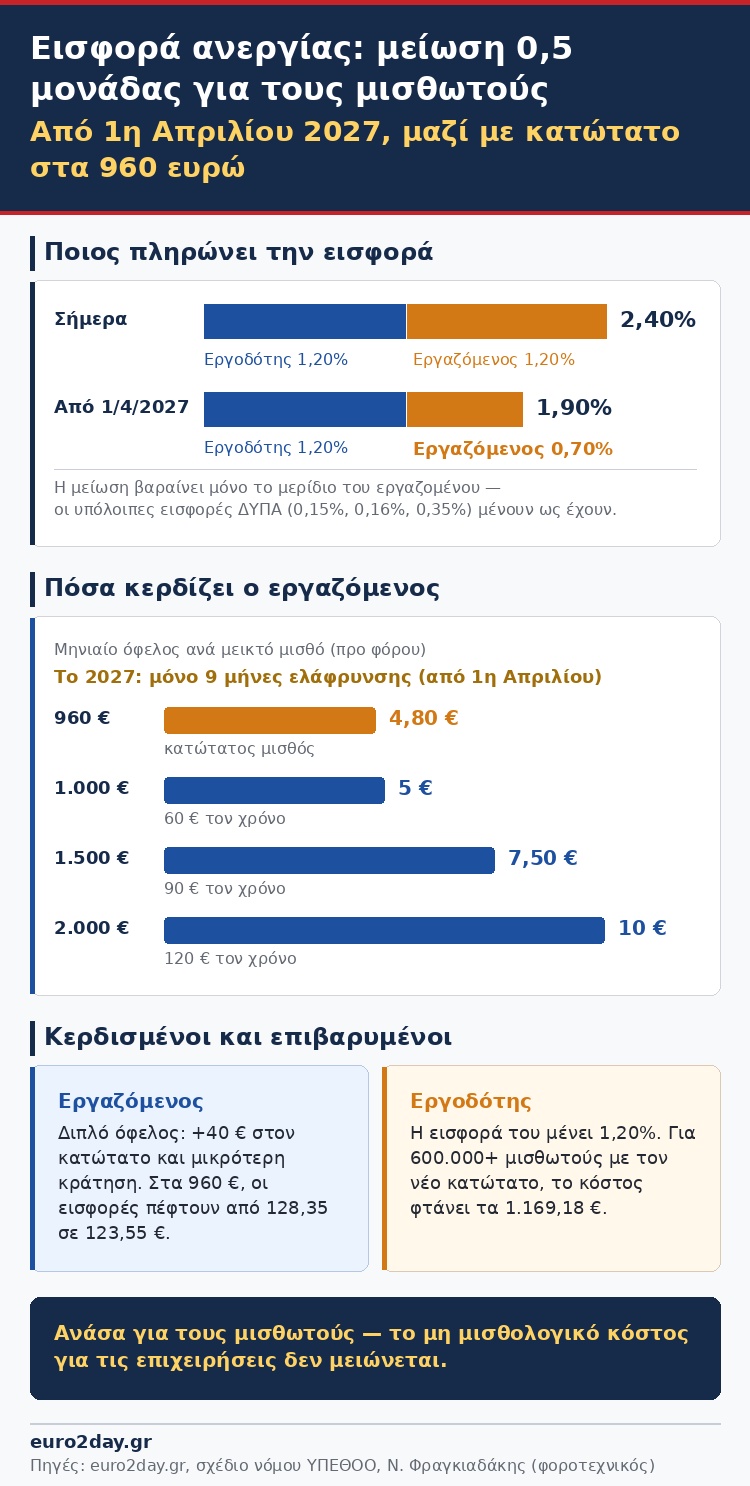
Under the relevant provision, from 1 April 2027 the total unemployment contribution will fall from 2.40% to 1.90% of earnings, a reduction of 0.50 percentage points. The employer contribution will remain at 1.20%, while the employee contribution will be cut from 1.20% to 0.70%.
As a result, the full 0.50-percentage-point reduction comes from the lower employee contribution, directly increasing take-home pay before income tax. The cut applies exclusively to the unemployment contribution.
The other contributions to DYPA remain unchanged: 0.15% for the Employee Protection Account against Employer Insolvency, 0.16% for the Single Account for the Implementation of Social Policies and 0.35% for the former Workers’ Housing Organisation. The change is therefore not a across-the-board cut in all social security contributions, but a targeted measure in favour of workers.
The actual benefit for each employee will depend on their insurable earnings, while the effect on final take-home pay after income tax may vary according to their tax liability.
According to tax accountant Nikos Fragiadakis, the financial benefit varies with the level of gross salary, since the reduction is calculated as a percentage of earnings.
For an employee with gross monthly earnings of €960, which also correspond to the new minimum wage (according to the draft budget), employee contributions will fall from 128.35 to 123.55 euros, giving a monthly gain of 4.80 euros.
For a salary of €1,000 gross, lower deductions will translate into a monthly increase of €5 in take-home pay before tax. The amount after these deductions will rise from 866.30 to 871.30 euros. At higher salary levels, the benefit is larger in absolute terms.
On a gross salary of €1,500, employee contributions will fall by 7.50 euros a month, while on earnings of €2,000 the monthly gain will reach €10.
On an annual basis, assuming earnings remain unchanged and the cut applies for the full year, the benefit amounts to 60 euros on a salary of 1,000 euros, 90 euros on a salary of 1,500 euros and 120 euros on a salary of 2,000 euros.
In 2027, however, because the measure takes effect on 1 April, the relief will apply for the final nine months of the year.
Although the measure reduces the overall social security burden on salaried work, it does not change the rate of the specific employer contribution for unemployment.
On the contrary, alongside the simultaneous increase in the minimum wage, total employer costs will rise for more than 600,000 employees, reaching 1,169.18 euros on a gross salary of 960 euros, 1,217.90 euros on a salary of 1,000 euros, 1,826.85 euros on a salary of 1,500 euros and 2,435.80 euros on a salary of 2,000 euros.
Comparison of employees’ social security contributions
Private sector, standard insurance coverage. Amounts before income tax.
Calculation assumptions
| Parameter | Value |
|---|
| Employee contribution before | 13,37% |
| Employee contribution after | 12,87% |
| Employer contribution | 21,79% |
| Payments per year | 14 |
| Cut takes effect | 01/04/2027 |
The 0.50-percentage-point cut applies to the employee contribution. The employer contribution remains unchanged. The cut was announced for 1.4.2027 and had not yet been enacted when the government set out the details.
Annual comparison based on 14 payments (in €)
| Gross monthly salary | Annual gross ×14 | Employee contributions before | Employee contributions after | Take-home pay before tax, before | Take-home pay before tax, after | Annual employee gain | Employer contributions | Total employer cost |
|---|
| 960,00 | 13.440,00 | 1.796,93 | 1.729,73 | 11.643,07 | 11.710,27 | 67,20 | 2.928,58 | 16.368,58 |
| 1.000,00 | 14.000,00 | 1.871,80 | 1.801,80 | 12.128,20 | 12.198,20 | 70,00 | 3.050,60 | 17.050,60 |
| 1.500,00 | 21.000,00 | 2.807,70 | 2.702,70 | 18.192,30 | 18.297,30 | 105,00 | 4.575,90 | 25.575,90 |
| 2.000,00 | 28.000,00 | 3.743,60 | 3.603,60 | 24.256,40 | 24.396,40 | 140,00 | 6.101,20 | 34.101,20 |
Annual benefit: a full year of implementation, with 14 equal payments. The actual benefit in 2027 will be proportionately lower, since the cut takes effect on 1.4.2027.
Monthly comparison (in €)
| Gross salary | Employee contributions before | Employee contributions after | Take-home pay before tax, before | Take-home pay before tax, after | Monthly employee gain | Employer contributions | Total employer cost |
|---|
| 960,00 | 128,35 | 123,55 | 831,65 | 836,45 | 4,80 | 209,18 | 1.169,18 |
| 1.000,00 | 133,70 | 128,70 | 866,30 | 871,30 | 5,00 | 217,90 | 1.217,90 |
| 1.500,00 | 200,55 | 193,05 | 1.299,45 | 1.306,95 | 7,50 | 326,85 | 1.826,85 |
| 2.000,00 | 267,40 | 257,40 | 1.732,60 | 1.742,60 | 10,00 | 435,80 | 2.435,80 |
“Take-home pay before tax” is calculated by subtracting employee contributions from gross pay. Tax withholding or a special KPK is not included.
NAF Accounting Tax Consulting