The Ministry of National Economy and Finance is moving ahead with key reforms to redefine transparency across major areas of business in the digital age, through provisions included in an omnibus bill now under public consultation until Thursday, 22 October 2026.
The proposed measures range from a digital record of all assessed debts owed by individuals to AADE and e-EFKA on the Unified Digital Payments Portal (ahead of the introduction of a new, improved debt arrangement of up to 120 instalments) to lifting restrictions on personal property transfers by company executives whose businesses have debts, as well as investigations into illicit funds.
The common thread running through these measures — which aim to strengthen social accountability, simplify procedures for citizens and boost economic freedom — is that oversight will now fall exclusively within the remit of the Independent Authority for Public Revenue (AADE).
Illicit funds
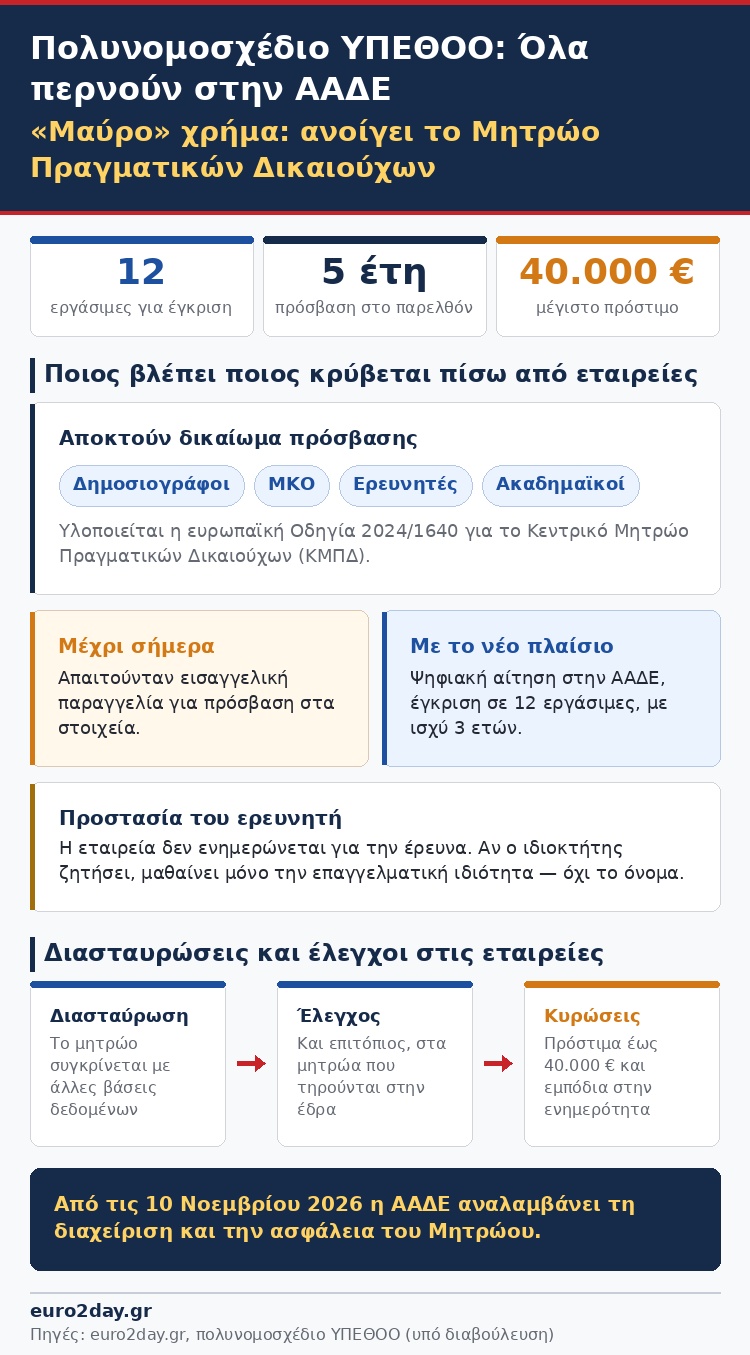
The omnibus bill incorporates European Directive 2024/1640, bringing sweeping changes to the Central Register of Beneficial Owners (CRBO), with the aim of combating illicit funds.
Journalists, non-governmental organisations (NGOs), researchers and academics will gain the right to access information on the individuals behind companies.
A prosecutor’s order will no longer be required, and requests will be reviewed and approved digitally by AADE within 12 working days. Approval will be valid for three years.
To protect the investigation, companies will not be informed of it. If an owner requests information, only the researcher’s professional status will be disclosed, not their name.
Access will extend back up to five years, including for dissolved companies.
AADE will take over the management and security of the Register from 10 November 2026.
Data matching and company checks
With the relevant responsibilities consolidated within AADE, the mechanism for verifying information declared by companies will also be strengthened. The competent authorities will be able to cross-check register entries against information from other available databases, identify discrepancies and carry out checks.
Provision is also made for on-site inspections of the special registers of beneficial owners that legal persons and entities are required to keep at their registered offices.
The aim is to establish whether the individuals who own or control a business have been declared, and whether their details remain accurate and up to date.
For violations such as failure to file a declaration, registering inaccurate information or failing to meet the requirements, the framework includes fines of up to €40,000, depending on the case and the size of the business.
The rules also provide for consequences affecting the issuance of tax clearance certificates until specific violations have been remedied.
Transfers without withholding from sale proceeds
Article 297 introduces significant easements for property transfers by people held liable for company debts. Managers and shareholders (with a stake of more than 5%, or more than 0.5% in listed companies) who are jointly and severally liable for companies’ tax debts can now transfer their personal property without having sale proceeds withheld or a charge placed on the property. To do so, four conditions must all be met cumulatively:
The company must have been established at least five years earlier.
All company debts must be covered by an arrangement, and the terms must be met.
There must be no debts dating back more than three years before the arrangement began.
The company must not have missed any instalment in the past five years.
The alternative provision for cases in which these conditions are not met is also of particular interest.
The bill provides that the withholding rate may be capped at 7% of the sale price, provided the remaining debts are secured by guarantees or collateral.
To determine the required security, the sums corresponding to 70% of the sale price for debts under an arrangement, or 50% for debts whose collection has been suspended, are taken into account, subject to the specific conditions set out in the provision. The value assigned to property offered as security is 80% of its tax-assessed value.
The measure is intended to facilitate transfers without removing the state’s ability to pursue the debts. If, after a tax clearance certificate has been issued, the debts fall out of good standing, the Tax Administration must prioritise collection from the person held jointly liable.
Digital debt tracker
To help citizens ahead of the new 120-instalment arrangement for debts incurred up to 31 December 2024, the omnibus bill provides for a comprehensive digital overview of debts.
All assessed debts owed by individuals to AADE and e-EFKA will now be displayed together and in real time on the Unified Digital Payments Portal.
The measure aims to make things easier for taxpayers and insured persons by giving them a consolidated view of their tax and social security obligations, without requiring them to search for the relevant information across different information systems.
Using their personal codes Taxisnet, individuals will be able to see all their debts to the tax authority and e-EFKA on a computer or mobile phone, find out how to pay them and access the existing payment systems.
Today, a citizen may have debts to different public-sector bodies without knowing about them, and must consult more than one online application to check or settle them.
With the new Portal, the relevant information will be brought together in a shared digital environment. This will give citizens a fuller picture of their debts and is expected to reduce bureaucracy, delays and errors in transactions.