METLEN: Evangelos Mytilineos revealed an interesting story from the listed company’s negotiations with a major US technology company over its first significant gallium supply deal, speaking at the Financial Times Energy Transition Summit.
He noted that, despite Metlen’s long experience in commodities, negotiating over critical and rare raw materials proved to be a new game, with different reference prices and other commercial terms.
The point on which the US side insisted most was a price cap, alongside the floor included in the agreement. What is interesting is that, according to Evangelos Mytilineos, this cap is well above even today’s elevated prices.
But he saved the best for last. Once the contracts had been signed, he asked the head of the US company why he had insisted so strongly on the cap.
“You’ll remember me in two or three years. It will cost $25,000,” was the reply he received, he said.
And he replied: “Thank you very much. I can live with this”.
GREEK EXCEPTION: Amid widespread uncertainty across Europe, there is one picture the government is entitled to present without caveats.
Even allowing for the fact that the improvement in Greece’s public finances was driven by higher indirect tax revenues as rising prices pushed up receipts, and by inflation, which also “inflated” GDP, the end result remains impressive. And by today’s European standards, it is enviable, as the chart shows:
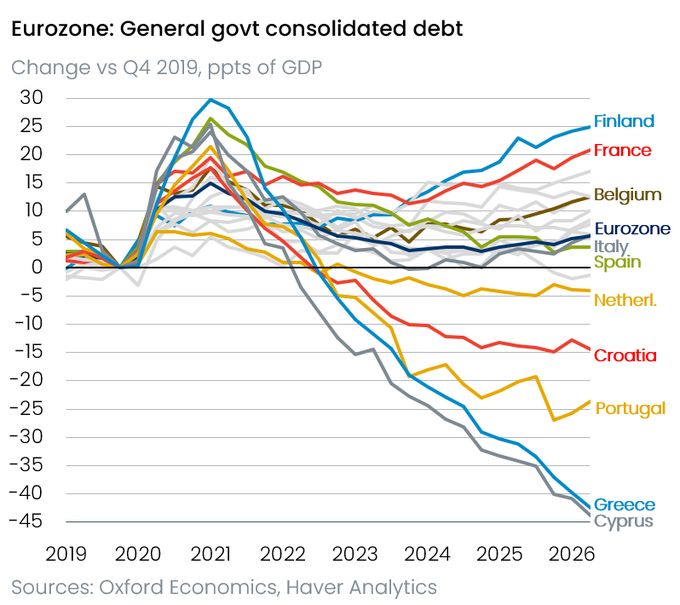
While debt is rising again in France, Belgium and Finland, and increasingly in Germany, Greece is among the few countries moving in the opposite direction.
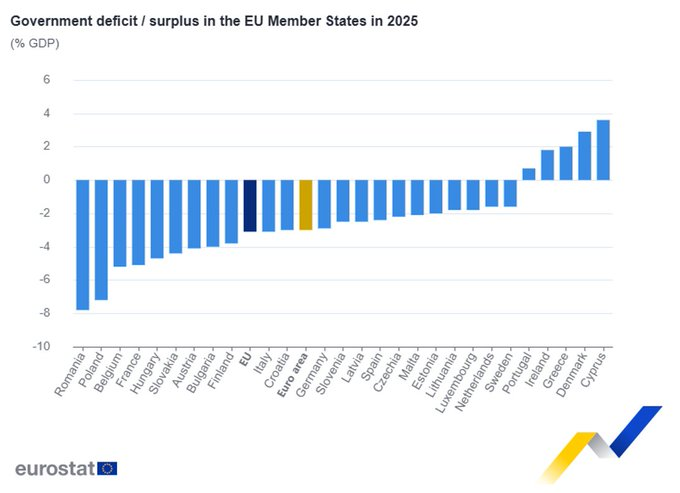
And that is not all. On the deficit and surplus front, the country presents a picture that, just a few years ago, would have seemed almost unimaginable for Greece.
It is among the eurozone’s “top performers”, alongside a handful of other countries that maintain surpluses or near-balanced accounts, as last year’s figures show.
This is precisely what is paying off in the markets.
Not only in bonds, where Greece is now much better protected against turbulence among the eurozone’s weaker links, but also in the country’s broader investment profile. Put simply, the market sees a fiscal “cushion” of credibility built here.
And that may be the most important legacy for the next phase. Such performance is not a political trophy to celebrate, but a national asset that must be protected after the elections.
If it is lost, it will be hard to rebuild.
EFA GROUP: Prominent figures from politics and business attended the opening of the Delta building at EFA Group’s Alexandria Tech Campus in Neo Psychiko, which will now house STHENOS AI and the Hellenic Entrepreneurs Association.
They included the Minister of Digital Governance and Artificial Intelligence, Dimitris Papastergiou; Deputy Foreign Minister Haris Theoharis; PASOK MP and defence spokesman Michalis Katrinis; and the party’s MP Evangelos Apostolakis.
From the business community, the column spotted shipowner Haris Vafeias, EOS Capital Partners head Apostolos Tamvakakis, Athens Medical Group chairman Vassilis Apostolopoulos, Aldemar Resorts CEO Alexandros Angelopoulos and Vitex’s Armodios Giannidis.
Also present, of course, was Markos Hatziminas, the founder’s son and now CEO of STHENOS AI, in which EFA GROUP has invested heavily.
Host Christian Hatziminas, founder and chairman of EFA Group, founder and CEO of THEON International and chairman of the Hellenic Entrepreneurs Association (EENE), recalled the story behind the campus’s name.
The five buildings —Alpha, Beta, Gamma, Delta and Epsilon— refer to the five districts of ancient Alexandria, where the arts and sciences coexisted under one roof in an outward-looking spirit and, as he put it, “knowledge mattered when it also enlightened others”.
At the new “Delta”, the aim is to bring innovation, intelligence and entrepreneurship together. Artificial intelligence, Christian Hatziminas noted, is no longer just another area of technology.
It has become the infrastructure on which every other sector will be built: defence, industry, healthcare and the state itself. For a country like Greece, he added, the question is not whether it will use AI, but whether it will develop and control it itself.
“That is what we are doing now with STHENOS AI,” he added. “We are trying to build the ‘keys’ that will give the country control over defence and dual-use technologies.”
PPC-RWE: The Meton Energy group, a joint venture between PPC Renewables (49%) and RWE Renewables (51%), closed 2025 with revenue of €18.4m, operating profit of €8.4m and a pre-tax loss of just €0.6m (2024: €12.3m).
The improvement came from the energisation of a series of solar farms, which entered trial operation in spring 2025, and from the power purchase agreements held by the group’s companies.
This year, solar farms with a total capacity of 616MW were energised and entered trial operation, so financial performance is expected to improve significantly.
Last month, Idea Fos, a Meton subsidiary, was served with an interim order from the Council of State suspending the relevant construction work on a solar park in Neo Syrrakio until a further court ruling is issued.
The Council of State issued the order following an application to suspend the project’s environmental approval.
IASO HIMITHEA: Oaktree and the Piraeus–Strix duo are continuing to take a deliberately low-key approach to the IASO-Himithea merger.
The difficult parts of the transaction are behind them: the SSM gave the green light last summer, and the related financing was also approved.
The agreement was signed in September, quietly as ever, with reports suggesting that the share exchange ratio will make Oaktree the majority shareholder in the new entity.
Approval from the Competition Commission is still outstanding. Sooner or later, it is expected to be granted, as the authority has approved an even greater concentration of hospital beds in the wider Athens area than would result from the IASO-Himithea merger.
According to competitors, the only way the deal could fall through is if plans change over the treatment of National Insurance’s legacy portfolio.
REFINERIES: The General Index closed at the day’s high of 2,643.62 points, up 1.28%, while banks gained 2.26%—a move some in the market attribute to the SSM decision on dividends from 2027.
Refineries, however, lagged. Motor Oil closed at €67.05 (-3.50%) and Helleniq Energy at €18.60 (-2.97%).
The paradox is that the decline came on a day when Brent rose by more than $2 and approached $111. Analysts link the move to the International Energy Agency’s assessment that transport costs and expensive crude are eroding margins in Europe and Asia. The column recently covered the issue. In addition, both companies have been asked to help bring prices down in Greece by offering discounts.
On the other hand, both shares have risen by more than 110%, and profit-taking is weighing on their performance.
Just yesterday, however, Piraeus Securities raised its target price for Motor Oil to €81 and for Helleniq Energy to €22. Their balance sheets are strong, cash flows robust and dividends are on the way.
ANGELICOUSSIS: Alpha Gas, owned by Anna Angelicoussis, has placed a new order for two large ammonia carriers (VLACs), choosing China’s Hengli Heavy Industry shipyard. The deal is estimated to be worth more than $230m and is reportedly understood to include an option for one additional vessel.
The two vessels, each with a capacity of 88,000 cubic metres, were contracted on 1 September and are expected to be delivered in 2029, according to the Clarksons database.
The new investment is part of the Greek company’s gas fleet expansion. It now has six VLACs, four of which are under construction. Its fleet also includes eight LNG carriers, with two more on order.
In 2024, Alpha Gas ordered four VLACs from South Korean shipyards Hanwha Ocean and HD Hyundai Heavy Industries.
Despite the recent decline in freight rates, prices remain close to record highs, according to Clarksons.
STELLAR V CAPITAL: Stellar V Capital, the SPAC founded by Greek shipowners and financial figures Prodromos (Akis) Tsirigakis and George Syllantavos, is moving ahead with its first deal since listing on Nasdaq through a $150m IPO in January.
The company has signed a letter of intent to merge with an advanced materials company that produces synthetic graphene.
The target company’s shareholders are expected to contribute all of their shares to the new listed company, while the transaction also includes a $30m private placement to fund its growth strategy.
According to Stellar V, the target is one of the few companies worldwide certified as a graphene producer by the Advanced Carbons Council. It produces high-purity graphene with a carbon content of 98.5%.
Completion of the deal is subject to due diligence and the required regulatory approvals. Stellar V shareholders have been called to approve an extension of the deadline for completing the transaction to 31 July 2027 at a meeting on 29 October.
This is the fifth SPAC founded by Tsirigakis and Syllantavos, who have previously been associated with Star Bulk Carriers and DryShips.
VAFEIAS: The estimated net asset value (NAV) of Imperial Petroleum, the Nasdaq-listed shipping company controlled by Haris Vafeias, rose to $691.1m as its fleet expanded to 24 vessels.
Management’s estimate is more than three times the company’s market capitalisation of $217.5m. NAV stands at $14.93 a share, compared with a market price of $4.89 in New York.
The company also announced the delivery of three vessels it had bought earlier this year: the bulk carrier Eco Cathar (38,000 dwt), the product tanker Clean Raider (50,000 dwt) and the bulk carrier Eco Nemesis (33,000 dwt).
Its fleet now includes crude and product tankers, as well as bulk carriers. Imperial Petroleum has also taken advantage of rising values in the second-hand market. In August, it reportedly sold the suezmax Suez Enchanted for about $50m, having paid just $21.2m to acquire it in 2022.
The company has no debt and held $212.6m in cash, cash equivalents and time deposits in May.
PROKOPIOU: The suezmax Zouzou N, owned by George Prokopiou’s Dynacom Tankers Management, is reportedly being sold at a record price, with shipbroking sources putting the figure at $103m.
The 150,000 dwt tanker, built in 2010, is reportedly fetching the highest price ever recorded for a vessel of its age and class, even after adjusting for inflation.
The deal reflects strong demand for second-hand tankers, as buyers in the Middle East seek to secure immediately available tonnage to carry crude oil. Uncertainty surrounding the Strait of Hormuz and the risk of attacks, damage or vessels being immobilised are adding to the need for available capacity.
According to Clarksons, the benchmark price for a 15-year-old suezmax rose to $101m last week, its highest level since records began in 2008.
At the same time, the second-hand market is marked by limited transparency, with many reports of purported sales being denied or remaining unconfirmed.