After gains of 21% in 2024 and a 78% surge in 2025, Greek banks are posting another strong year, up 32% so far, outperforming the domestic market and further narrowing their discount to European peers, which now stands at about 10%, CrediaPantelakis says in a sector analysis.
Greece’s upgrade to Developed Market status undoubtedly helped drive the recent gains, bringing banks into the spotlight for investors. However, strong fundamentals, a lower-risk profile and increased shareholder returns deserve most of the credit for the market’s prolonged re-rating.
The key investment arguments remain in focus, with a favourable domestic macroeconomic environment and faster growth in net lending — 8% a year in 2025-2028e, compared with 3-4% in the EU — providing key points of differentiation.
These trends are expected to continue, particularly given low private-sector borrowing, the economy’s longstanding investment shortfall and the now-revived momentum among households.
At the same time, banks are deploying excess capital through bolt-on acquisitions that boost fee income, keeping operating-cost growth in check and gradually reducing the cost of risk (CoR). Together, these factors are expected to drive compound annual earnings growth (CAGR) of about 10% over the next three years.
The report sees scope for earnings upgrades, as the market is pricing in a peak ECB deposit facility rate of 3.25%, compared with the firm’s forecast of 2.75%.
Greek banks are among the most sensitive to rising interest rates, given that more than 90% of their loan portfolios carry floating rates and that they rely heavily on net interest income (NII) as a share of total revenue.
Meanwhile, fee income is growing strongly across all areas, including lending, wealth management and investment banking, while acquisitions of insurance companies create scope for outperformance.
Caution is warranted over the risk of contagion from concerns that continue to surround France, casting a shadow over the eurozone and its banks as a whole. Greece has put its public finances in order, while spreads on Greek government bonds (GGBs) over German Bunds remain under control, unlike those on French bonds, which have surged to 150 basis points.
Domestic banks do have significant exposure to Greek and EU government bonds, but these are not marked to current market prices.
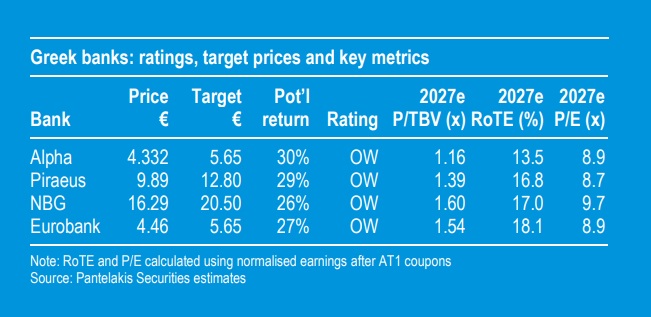
We maintain an Overweight (OW) rating on the sector, which now trades at 9 times estimated 2027 earnings per share (EPS), a discount of about 10% to European peers, and 1.4 times tangible book value (TBV). It offers a return on tangible equity (RoTE) of about 17% and a dividend yield of 7% from distributions, with scope for the payout ratio to rise further.
We highlight Alpha’s slightly stronger earnings outlook, which is narrowing the RoTE gap with peers — with its Investor Day on 5 November potentially acting as a catalyst — as well as Piraeus’s attractive valuation relative to its returns and the optionality offered by National Bank of Greece (NBG), whose exceptionally high capital levels leave significant scope to pursue growth opportunities and increase shareholder returns.
Price targets are €5.65 for Alpha Bank, €12.8 for Piraeus, €20.5 for National Bank of Greece and €5.65 for Eurobank.