Greece’s tourism industry completed the first eight months of 2026 with more visitors and higher overall revenue, but with average spending per trip falling in August.
The recovery recorded in July proved temporary: at the height of the season, average spending fell by 6.5%, reversing the positive picture that had emerged in the first seven months.
At the same time, Bank of Greece data highlight significant differences among the main countries of origin for foreign visitors. Americans continue to stand out as the travellers with the highest average spending; Italy is recording strong growth in both arrivals and visitor spending, while France is seeing declines across all the main measures for the eight-month period.
August reversal
The trend in average spending per trip during 2026 is particularly noteworthy, as July’s recovery did not continue in August.
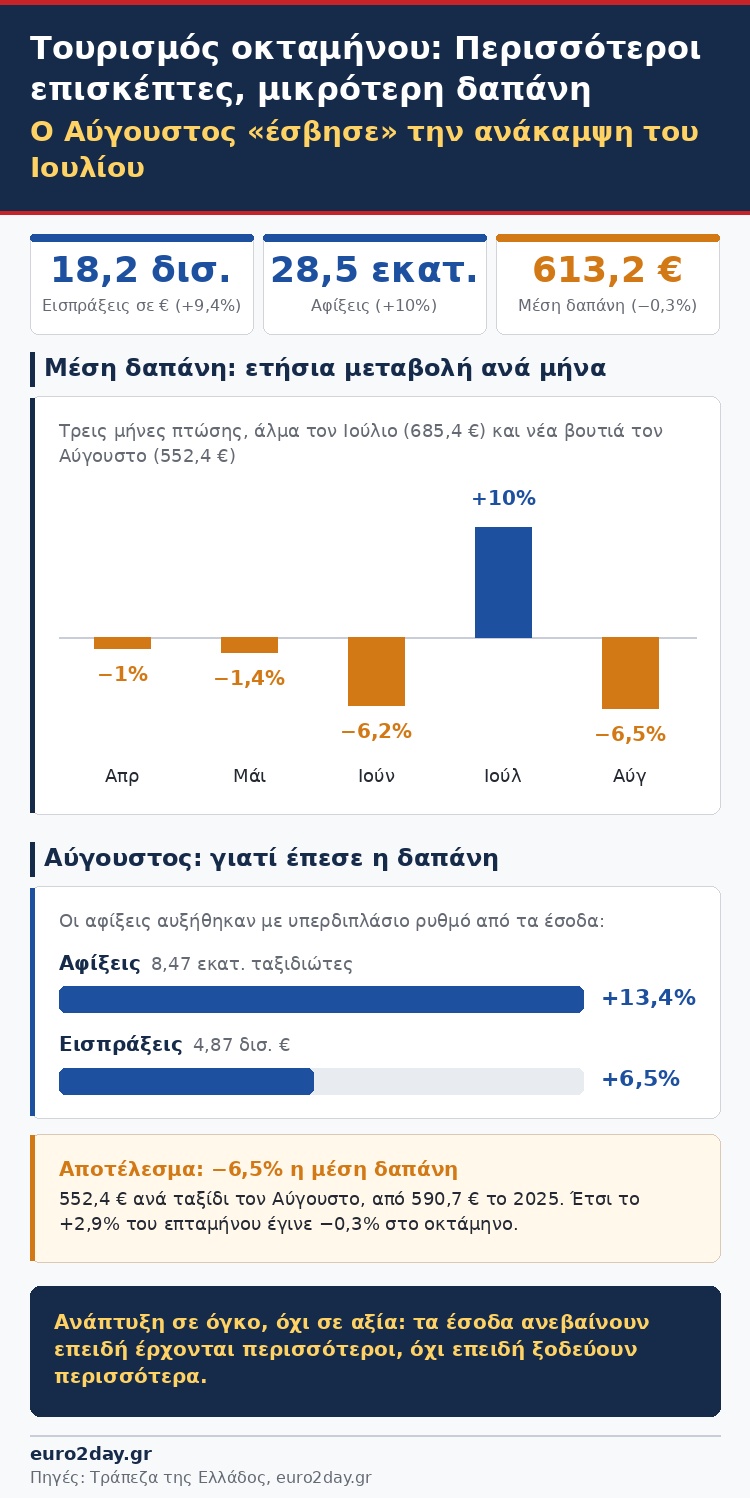
After three consecutive monthly falls, in April (1%), May (1.4%) and June (6.2%), average spending rebounded in July, rising 10% to €685.4.
However, in August the trend reversed again, with the figure falling by 6.5% to €552.4, from €590.7 in the same month of 2025. The decline was enough to reverse the positive picture for the first seven months, when average spending had risen by 2.9%, leaving it marginally lower by 0.3% over the first eight months.
The divergence is even clearer when arrivals and receipts are compared in the busiest month of the season. Travel receipts rose by 6.5% to €4.87 billion, while arrivals increased at more than twice that rate, climbing 13.4% to 8.47 million travellers.
Americans spend the most
Among individual markets, the US stands out from Greece’s other main tourism markets, with average spending per trip by visitors from the US reaching €1,380.8, more than twice the overall average.
Average spending by Americans rose by 22.8% compared with the same eight-month period in 2025, when it stood at €1,124.7. This increase was also reflected in total revenue from the market, which rose by 21% to €1.47 billion, from €1.21 billion last year.
Notably, receipts increased despite a 1.5% decline in arrivals from the US, to 1.06 million travellers. The rise in revenue therefore came from higher average spending, not from an increase in visitor numbers.
The US market also performed strongly in August, with receipts rising by 52.3% to €346.3 million and arrivals increasing by 33.4% to 232,411 travellers.
Germany and the UK are the biggest sources of revenue
Germany remains the largest source of travel receipts among individual countries, with revenue of €2.86 billion, up 7.2% on the same eight-month period in 2025.
Arrivals from Germany rose by 8.1% to 4.21 million travellers. Average spending, however, fell by 0.9% to €679, from €685.1 last year.
Germany therefore remains the largest single source of tourism revenue, with the increase in receipts driven by stronger visitor numbers.
The United Kingdom ranks second, with receipts of €2.67 billion, up 5%, compared with growth of 23.3% in the first seven months. The number of British visitors reached 3.4 million, an increase of 3.9%, while average spending per trip edged up by 1.1% to €783, from €774.4 in 2025.
The sharp slowdown is linked to August, when receipts from the UK market fell by 32.8% to €564.9 million, while arrivals also declined, by 15.9%.
Italy gains ground as France falls back
Among the main European markets, Italy performed particularly strongly, with travel receipts rising by 31.7% to €1.26 billion, from €955.4 million in the same period of 2025.
Arrivals from Italy rose by 22.1% to 1.92 million, while average spending increased by 7.9% to €653.6, from €605.9 last year.
France moved in the opposite direction, with travel receipts falling by 8.1% to €931.9 million, from €1.01 billion in the same eight-month period of 2025.
Arrivals from France fell by 5.4% to 1.35 million, bringing average spending down by 2.9% to €692.1, from €712.8 last year. Despite the overall decline, receipts from France rose by 16.2% in August to €307.5 million, even as arrivals fell by 6.1%.
How receipts from Europe performed
Overall, European Union countries remain Greece’s main source of tourism revenue.
Receipts from residents of EU-27 countries reached €10.1 billion, up 10.3%, while arrivals rose by 11% to 16.97 million travellers. Average spending per trip stood at €595, compared with €599.1 in 2025, a marginal decline of about 0.7%.
Growth was stronger in the eurozone, where travel receipts rose by 15.3% to €8.39 billion. Arrivals increased by 14.7% to 13.82 million travellers, while average spending edged up to €607.3, from €604.5 last year.
By contrast, receipts from EU countries outside the eurozone — namely Poland, Romania, Sweden, Denmark, the Czech Republic and Hungary, fell by 8.5% to €1.72 billion, while average spending declined to €544.5, from €579.2 in 2025.
Receipts from other countries outside the European Union totalled €7.38 billion, up 8.9%, while average spending stood at €639.9, from €637.6 last year.
Cruise revenue
Overall tourism revenue also includes cruise receipts, which reached €716.5 million in the first eight months of 2026, compared with €701.3 million in the same period of 2025, an increase of 2.2%. In August alone, cruise receipts rose by 20% to €190.5 million.
Overall, according to Bank of Greece data, travel receipts in January-August reached €18.2 billion, up 9.4% from €16.64 billion in the same period of 2025. Inbound travel increased at a slightly faster pace, rising by 10% to 28.51 million travellers, from 25.92 million last year.
As a result, average spending per trip over the eight-month period edged down to €613.2, from €614.9 in 2025, a decline of 0.3%.