From November, the way public servants apply for their pensions is changing, as the paper-based process is gradually giving way to online applications through e-EFKA.
The move to the new digital process affects thousands of employees planning to leave public service, as well as beneficiaries applying for survivor’s pensions, who will need to adapt their actions to the new timetable.
The key point is that the change involves more than replacing a paper form with an online one. It requires coordination with the personnel department, checks of insurance and personal details, the correct choice of application and the timely forwarding of the employee’s file to the relevant bodies.
The new system will be activated on two separate dates, depending on the type of pension benefit. The first applies to old-age pension applications and is set for Monday, 2 November 2026.
One week later, on Monday, 9 November, online applications for survivor’s pensions following the death of an insured person will open. The distinction has practical implications: applicants must check which process applies to their case and act according to the relevant launch date.
The first phase covers applications for a main old-age pension, as well as related procedures for supplementary pensions and lump-sum benefits. Applications connected with the Civil Servants’ Share Fund (MTPY) are also included, where applicable.
The second phase, starting on 9 November, provides for online applications for survivor’s pensions, with the corresponding benefits following the procedure prescribed by each body. For insured people and their families, therefore, the first step is not simply to log in to the platform, but to establish which service they need to use and which documents are required.
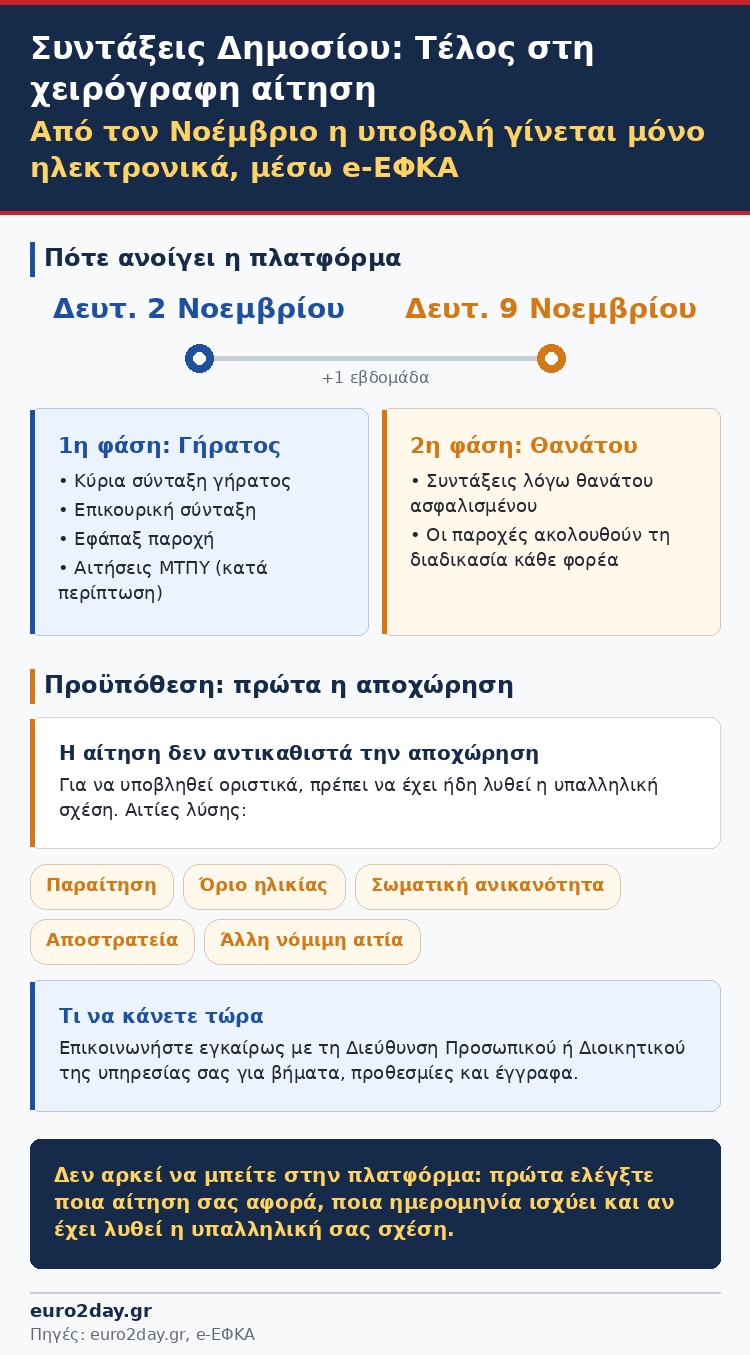
Particular attention should be paid to the termination of the civil-service employment relationship, which is a key requirement for the final online submission of an application under the procedure outlined for public servants.
In other words, the digital application does not replace the formal act of leaving public service and cannot be treated as a standalone process independent of the applicant’s employment status. The required termination of the civil-service employment relationship must have taken place first, whether through resignation, reaching the age limit, physical incapacity, retirement from service or another lawful cause.
This requirement makes it essential to plan the departure in good time. Those intending to retire should contact their service’s Personnel or Administrative Directorate well in advance to find out about the steps required, the deadlines and the documents that must be issued.
The online application will be submitted through the official e-EFKA website, at www.e-efka.gov.gr, using personal TAXISnet credentials.
Applicants should go to “Online Services”, select “Public-Sector Employees & Legal Entities Governed by Public Law” and then choose the service for pension and lump-sum benefit applications for the public sector.
They should then select the category that applies to their case, such as “Application for a Main Old-Age Pension”, and fill in the requested fields.
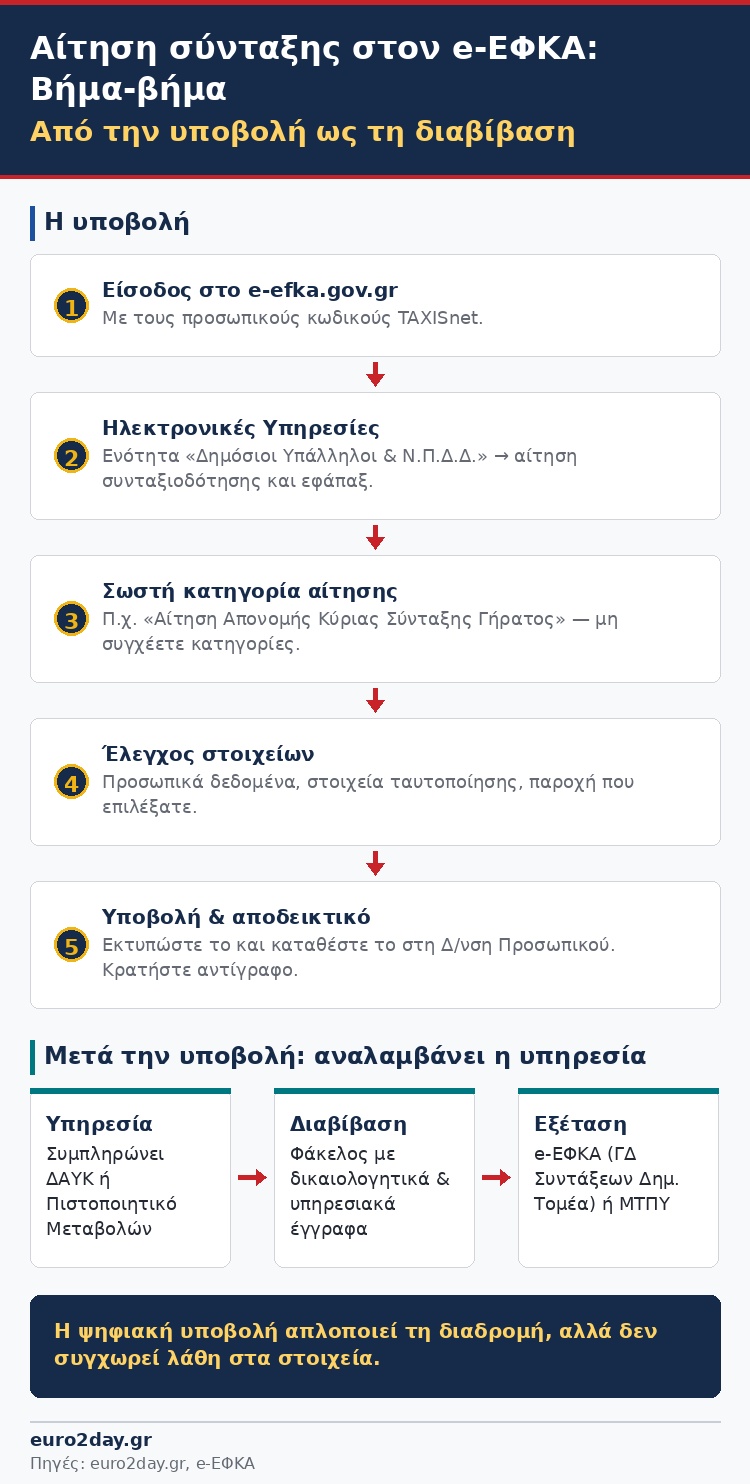
Choosing the correct application is crucial, as different categories of pension entitlement should not be confused. Before submitting the application, applicants should carefully check their personal details, the information displayed in the application and the type of benefit they have selected.
They should pay particular attention to any discrepancies in their identification details or missing information that could prevent the process from being completed. Online submission streamlines the application process, but does not remove the need to ensure that the information provided is accurate.
After submitting the application, applicants should print and keep the confirmation. This document should not be considered unnecessary, as it must be submitted to the Personnel or Administrative Directorate of the body they are leaving.
Keeping it is also useful for tracking the process, as it proves that this stage of the online application has been completed.
Applicants are therefore advised to keep a copy of the confirmation and the relevant documents they have collected, so that they can refer to them if necessary.
After submission, much of the process passes to the competent public-sector department. This department is responsible for completing the electronic or paper Individual and Service Status Record (DAFK) or, where required, the relevant Certificate of Changes in Service Status.
These are employment records needed to document the employee’s insurance and work history and forward the application to the competent body.
The file is then forwarded with the required supporting documents and employment records. Pension cases falling under the remit of the General Directorate for Public Sector Pensions are examined by e-EFKA. For benefits linked to the MTPY, the prescribed procedure for submission to the Fund is followed.
One potential source of difficulty is the verification of personal details. If the application does not recognise an insured person’s details or displays a matching problem, they should check that their information has been correctly recorded in the relevant registers. Under the guidance set out for the process, their details may need to be updated in the AMKA-EMAES registry and the National Communications Registry (EMEp).
This should be done without delay, as an inability to verify an applicant’s identity may prevent the online application from being finally submitted.
If the problem cannot be resolved online, the relevant guidance provides for applicants to visit the Registry Department of the competent local e-EFKA directorate within 15 days, bringing a printed preview of the application.
Applicants who encounter identity-verification problems should pay particular attention to this deadline, as contacting the relevant registry promptly may prevent a larger backlog from building up.
Insured people should confirm the precise instructions for their case with the competent department, especially if the application displays a specific error message or requests an additional action.
For technical issues relating to the application, applicants can email [email protected]. For procedural and administrative enquiries, the freephone number 1555 is available, as is the digital platform 1555.gov.gr.
For matters within the remit of the Civil Servants’ Share Fund, insured people can find information on its official website, www.mtpy.gr.