Summary
Natural gas has topped €100 for the first time since December 2022, while wholesale electricity prices are above €300/MWh in 15 European markets. Yet the Energy Ministers’ Council in Luxembourg is showing no sign of an emergency response. In Greece, the average wholesale price is set to end the month at €191, and November tariffs will bring a fifth consecutive month of increases, as Athens seeks fiscal flexibility ahead of the Eurogroup meeting on 9 November. |
Consumers are once again experiencing scenes reminiscent of the 2022 energy crisis, with natural gas yesterday breaching the €100 mark for the first time in four years and almost all European electricity exchanges in the red, while Brussels shows little sense of urgency.
Against the toxic mix of oil holding steady at $115, gas at €100 and electricity prices hitting the €300s today in half of Europe, the first item on the agenda of today’s Energy Ministers’ Council in Luxembourg is a discussion of the European Commission’s proposal to… reform electricity network charges.
The rest of the agenda also points to Europe’s continued inaction in the face of the crisis: from the role of each country’s National Energy and Climate Plans (NECPs) as tools for attracting investment to targets for electrification and more renewables after… 2030, nothing suggests an emergency response to the crisis.
What is changing now
| Key developments |
| ► Natural gas tops €100 for the first time since December 2022, having tripled in the past 12 months. |
| ► Wholesale electricity prices are above €300/MWh in 15 European markets, with evening peaks of up to €560 in Germany. |
| ► Greece is set to end the month with an average wholesale price of €191, almost 22% higher than in September and 74% higher than in July. |
| ► November tariffs are rising for a fifth consecutive month, with increases varying between large and small suppliers. |
| ► Athens is seeking a more flexible spending cap to fund targeted subsidies for fuel, heating and electricity. |
It is telling that energy security this winter and in the months ahead has taken second place, with the 27 ministers set to discuss it somewhere between all the other items on the agenda.
All this is unfolding against the backdrop of a frenzied rally in gas, which yesterday broke through the psychological €100 threshold for the first time since December 2022. The price has tripled over the past 12 months, sending wholesale electricity costs above €300/MWh from Bulgaria and Romania to Germany and the Netherlands.
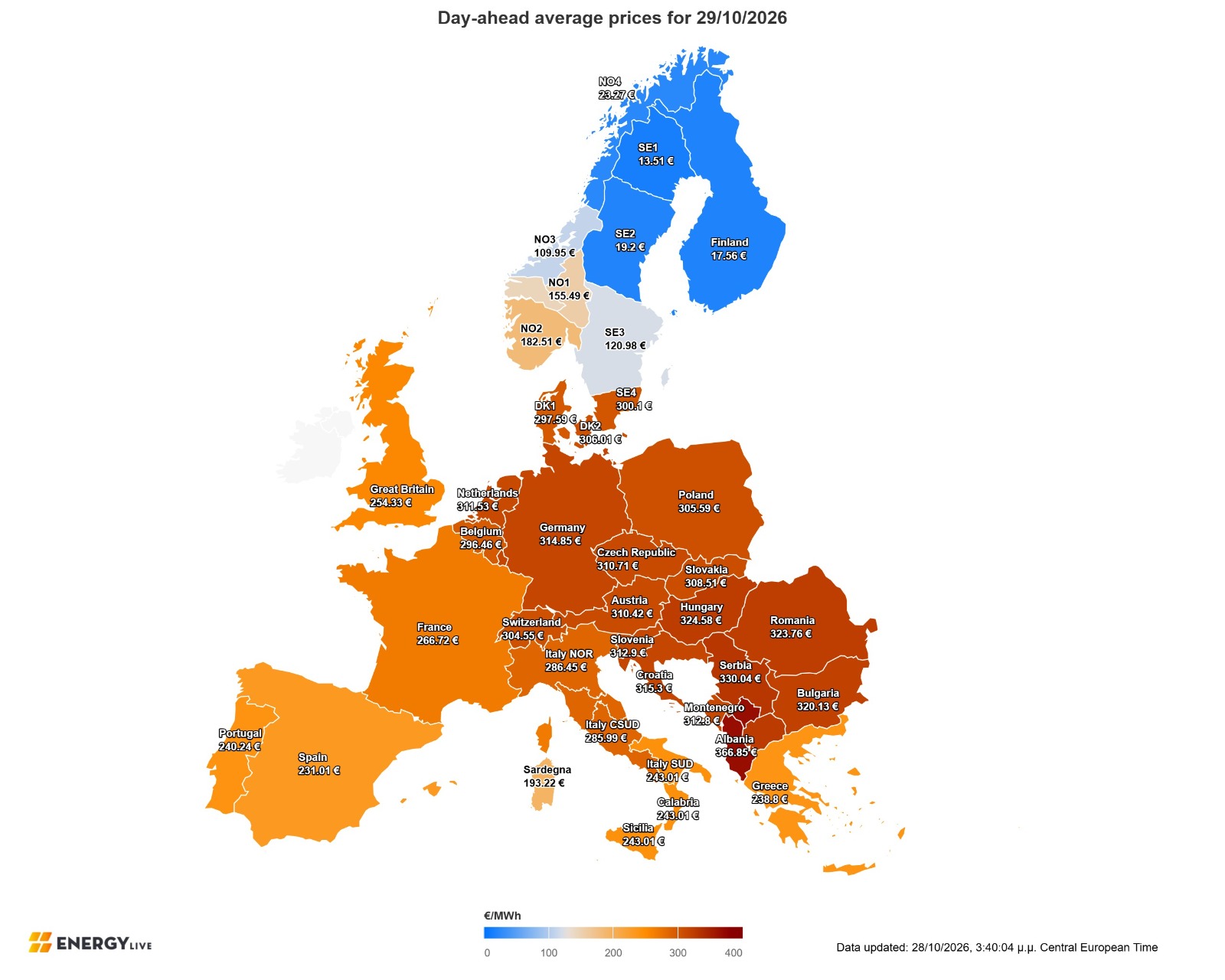
In the red across Europe: wholesale prices above €300 in 15 markets
Today’s European price map shows 15 markets — almost half of Europe — on red alert, in a picture that bears an unmistakable resemblance to 2022.
From Poland, where the average price stands at €305.59/MWh today, to Germany (€314.85) and the Czech Republic (€310.71), as well as Austria (€310.42), Hungary (€324.58) and Serbia (€330), wholesale markets — that is, prices on energy exchanges — are hitting year-to-date records across the board.
Even though evening peaks, when solar power drops out of the equation, are still some way off the €700 and €800 levels seen during the 2022 crisis, today’s prices of €520/MWh in Romania, €540 in the Netherlands, €542 in Poland and €560 in Germany point only to worse records ahead.
In traditionally low-cost Spain, thanks to renewables, the average wholesale price is €231. In France, with its large nuclear fleet, prices have surged to €267 because of problems with plant operations. Greece is still at €238.8/MWh, thanks to high solar power output, but these levels are hardly cause for celebration.
The month is set to end with an average wholesale price of €191, almost 22% above September’s €157 and 74% above July’s €110.
With four days to go before suppliers announce their November tariffs — the fifth consecutive month of increases — a market under mounting pressure is heading for a two-tier pattern of price rises. Increases will be smaller at large suppliers, which will absorb part of the wholesale price rise, and larger at smaller ones.
Low expectations ahead of the 9 November Eurogroup
Against this bleak backdrop, the Greek delegation is heading into today’s Energy Ministers’ Council with very low expectations. Environment and Energy Minister Stavros Papastavrou is set to reiterate the need for fiscal flexibility to clear the way for immediate, targeted measures.
Greece is maintaining the position set out by the prime minister at the latest European Council summit: a more flexible spending cap — the maximum permitted increase in spending under EU rules — to make room for subsidies on petrol, diesel, heating oil and electricity bills, although there are no positive signs so far.
The same applies to the Eurogroup — the eurozone finance ministers’ council — on 9 November, where the next battle over fiscal flexibility will take place. A number of countries in the “frugal” camp are less keen on relaxing the spending cap than those in Southern and Eastern Europe. It is no coincidence that at the recent European Council summit, almost all Western and Northern European countries opposed the call by Athens and Rome, which are leading a group of governments from the wider region seeking central intervention to curb prices.
Watch Now
| What to watch |
| ► Check the November tariffs announced by suppliers to see the range of increases at large and small companies. |
| ► Watch the 9 November Eurogroup meeting for signs that the way is being cleared for fiscal flexibility and support measures. |