NATURAL GAS: European natural gas prices hit 100 euros per megawatt-hour the day before yesterday, for the first time since 2022. At the same time, prices in the US were hovering near 3 dollars per million BTU.
On a like-for-like basis, the European price is about ten times higher, as the following chart also shows!
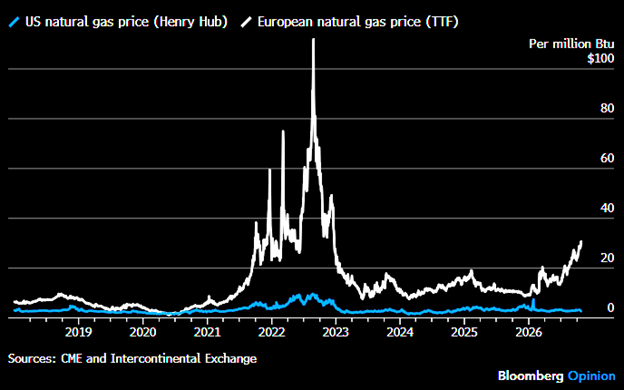
These are not fully comparable delivered prices, since liquefying and transporting US gas adds extra costs. The difference, however, remains ENORMOUS, with all that means for European consumers and industry, as natural gas prices also largely determine wholesale electricity prices.
Unfortunately, Europe’s new energy crisis is not solely the result of wars and geopolitical upheaval.
It also has a serious ideological dimension.
For much of Europe, Russian natural gas has become a political taboo because of the invasion of Ukraine. US gas, meanwhile, is viewed with deep misgivings by a large part of Europe’s political elite, both because of the risk of a new dependency and because of the confrontation with Donald Trump (above all, this).
The thing is, energy security has no political colour. Nor does it have a... smell.
Asked whether to choose “American, Russian or other natural gas?”, the answer from an economic and energy perspective should be simple: All of it!
From as many reliable sources as possible, weighing cost, risks and security of supply. Without replacing one dangerous dependency with another.
And here the example of Qatar offers an exceptionally valuable lesson these days.
NATURAL GAS II: Qatar, one of the world’s largest LNG exporters, with huge investments in its own fields, has decided to buy US natural gas as well.
It has signed long-term agreements for up to 7 million tonnes a year, with deliveries starting in 2030-31 and terms that in one case run until... 2054.
Why?
Because the war with Iran has shown how dangerous it is to depend on a single geographical route, the Strait of Hormuz. Qatar has therefore opted for diversification and long-term supply security, without abandoning its own production.
In Europe, Alexandros Exarchou has repeatedly stressed the need for long-term contracts with the US. Last February, he warned via Reuters that if Europe did not want to become hostage to natural gas again, it needed to secure such agreements in good time.
From a different starting point, Evangelos Mytilineos had long warned of the consequences of excluding Russian energy. In September, he told the British Times unequivocally that Europe should continue buying Russian energy or risk further price increases and a further loss of industrial competitiveness.
Different approaches, but with one point in common: energy security and availability at reasonable prices cannot be delivered through political declarations.
Diversifying suppliers limits risks. And long-term contracts, particularly when they include appropriate pricing mechanisms, offer greater predictability than constant exposure to spot-market volatility.
Everyone in the energy industry knows this.
Yet Europe’s political leaders apparently do not want to learn it, even after the difficult years we have just been through!
And now they are scrambling as the many (and important) elections ahead draw closer…
SAMARAS: Will the former prime minister form a party or not? All indications point to “yes”, and this was confirmed for the first time by Akis Gerontopoulos, a former deputy foreign minister and one of the Messinian politician’s closest political friends.
“The decisions have been made. The die has been cast. Antonis Samaras is about to found a party,” he said in a radio interview, attributing the delay in official announcements to the fact that the former prime minister “is experienced, sees what is going on and tries to make the most of every moment”.
At the same time, on television, LAOS founder George Karatzaferis said he believed that “there is something behind Samaras’ delay. He is afraid of something. I’m not sure whether he will form a party,” adding that the former prime minister had lost some of the political momentum he had two months ago.
And the will-he-won’t-he guessing game goes on…
KARYSTIANOU: Maria Karystianou protested strongly after she was not allowed to lay a wreath before the military parade in Thessaloniki. She chose to honour the heroes of 1940 on her own, laying a wreath at Sports Friendship Park, between Toumba and Charilaou in the city.
In a video posted on social media, the head of “Hope for Democracy” said: “They would not let us lay a wreath for the glorious ‘NO’ spoken by the Greek people. But we are laying a wreath and saying no to sports violence, no to lawlessness, no to impunity, yes to real, genuine democracy, yes to life, yes to a hopeful future.”
She alleges that there was a deliberate attempt to prevent the wreath-laying, saying she was notified of the refusal in writing late, on the eve of the anniversary.
KONSTANTAKOPOULOS: Costamare has completed a fleet refinancing worth about 1.4 billion dollars, taking advantage of conditions in the containership market.
The New York-listed Greek shipping company, led by Konstantinos Konstantakopoulos, completed financing agreements worth about 1.3 billion dollars in the third quarter, covering existing debt obligations on 39 vessels.
It also signed a 92 million dollar loan with an Asian bank for two more vessels, with the funds expected to be drawn down in the fourth quarter. Chief financial officer Grigoris Zikos said the new agreements would reduce interest costs and leave the company with no loan maturities until 2030.
The number of vessels free of debt now stands at 23. Third-quarter net profit was 95 million dollars, compared with 99 million a year earlier, while liquidity stood at 733.1 million dollars on 30 September. Costamare has secured charters for its entire fleet for 2026 and has 99% coverage for 2027.
Contracted revenue stands at about 6 billion dollars, with a capacity-weighted average charter duration of 5.8 years. Its fleet comprises 69 containerships, and it has 22 vessels on order.
ALLWYN: Brazil’s Supreme Court has scheduled a public hearing for 3 November on a challenge to the constitutionality of the country’s ban on betting, following President Lula’s re-election.
Various parties will take part in the hearing, including betting companies, football clubs and government representatives. It marks the first major judicial milestone since the election.
Meanwhile, industry association ANJL has renewed its calls for dialogue with the government, pointing to the tax revenue being lost since the market was suspended.
The issue is, as is well known, a hot-button one for the Greek-listed company.
BALLY’S INTRALOT: Bally’s Intralot has won a significant legal victory in the US, overturning its exclusion from the race for a major contract with the state lottery of Maryland.
The process began on 19 July 2024, when a tender was issued for the lottery’s central system, which serves about 4,300 retail outlets. On 15 July 2025, Intralot was selected as the preferred bidder for the 10-year contract, with an offer of 260.4 million dollars. Its bid was 110.7 million dollars lower than that of Scientific Games, which currently operates the system.
However, on 1 August 2025, its bid was rejected because of certification issues involving two subcontractors, and on 19 December the entire tender was cancelled. Then, on 4 May this year, the relevant administrative body upheld Intralot’s exclusion.
A few days ago, however, the Baltimore trial court overturned the decision, ruling that the authorities should have notified the company of the deficiencies and allowed it to submit corrected documents.
What does this mean in practice? Intralot has prevailed in a crucial legal dispute, but it does not automatically win the contract. In the meantime, a new tender has been issued, relaunched on 7 October, with bids due by 30 December.
The legal victory therefore does not guarantee the contract, but it significantly strengthens the company’s position.
ADMIE: There is one detail in Ambrosia Capital’s new report on the operator that is not immediately apparent. In the valuation sensitivity table, even the most conservative scenario puts the value above the current share price.
This scenario assumes a WACC of 6.75% and a valuation of just 1 times RAB. The implied value is 4.49 euros, compared with 4.30 euros on the screen. There are other potential upsides, too. The first is about 243 million euros that will flow back into revenue between 2027 and 2031 because of the lag in charges.
The second is GRITA 2, which RAAEY has deemed reasonable in principle for inclusion in the regulated asset base. The big test, however, lies ahead. ADMIE is valued at a P/E of 10.1 times for 2028, compared with 14.7 times for European bonds.
According to the brokerage, the operator’s adjusted earnings will reach 459 million euros in 2030. On that basis, the valuation gap with the sector is unlikely to last long.
REFINERIES: According to analysts, the sharp falls in Motor Oil and HelleniQ Energy look like a delayed bill coming due. While the Greek stock market was closed for the 28 October holiday, US refiners had their worst session since April 2025.
Valero, for example, fell more than 9% as investors priced in the prospect that refining margins had peaked. Yesterday’s session added fuel to the fire. Brent fell towards 114 dollars on signs that US-Iran dialogue could resume. Meanwhile, Europe announced the release of 42 million barrels from strategic reserves, half of it in the form of diesel.
For two refineries that derive a large share of their earnings from diesel and jet fuel, the news mattered. The same goes for reports of increased Russian fuel production. Yesterday, however, Repsol, OMV and Shell rose, supported by strong results and generous buybacks. The Greek refineries had no such offset.
Analysts say the correction does not necessarily overturn the fundamental case. The third quarter is expected to be excellent and analysts’ price targets remain higher. But after a gain of more than 100% this year, any news of de-escalation around Hormuz will be reflected in share prices.
Notably, the two shares were the biggest fallers among all stocks traded on Euronext Athens. Motor Oil fell 5.63% to 65.4 euros, while HelleniQ Energy fell 5.02% to 17.77 euros.