Data for August and September 2026 from the ERGANI information system highlight two contrasting aspects of the Greek labour market. The positive balance for the first nine months confirms that more jobs continue to be created than lost.
However, the year-on-year decline in hiring and the increased share of flexible forms of employment point to a market that is maintaining its momentum, but at a slower pace. Autumn is therefore emerging as a critical period for assessing how that momentum will hold up.
Specifically, the employment balance for January–September 2026 remained positive, with 309,835 net new jobs, compared with 308,105 in the same period of 2025. The difference of just 1,730 jobs confirms that employment is continuing to grow, but is not in itself evidence of an acceleration. On the contrary, overall flows point to a market that remains in positive territory chiefly because departures and redundancies have fallen.
In detail, September saw 348,336 hires and 342,655 departures, resulting in a positive balance of 5,681 jobs. This was a clear improvement on September 2025, when departures exceeded hires by 9,196. The balance thus improved by 14,877 jobs year on year.
However, the data show that hiring fell by 12,158 compared with last year, while departures declined by 27,035, with employers less willing to make redundancies amid difficulties finding workers with suitable qualifications. The improvement in the net balance therefore did not stem from stronger demand for workers, but from the fact that redundancies are becoming less common.
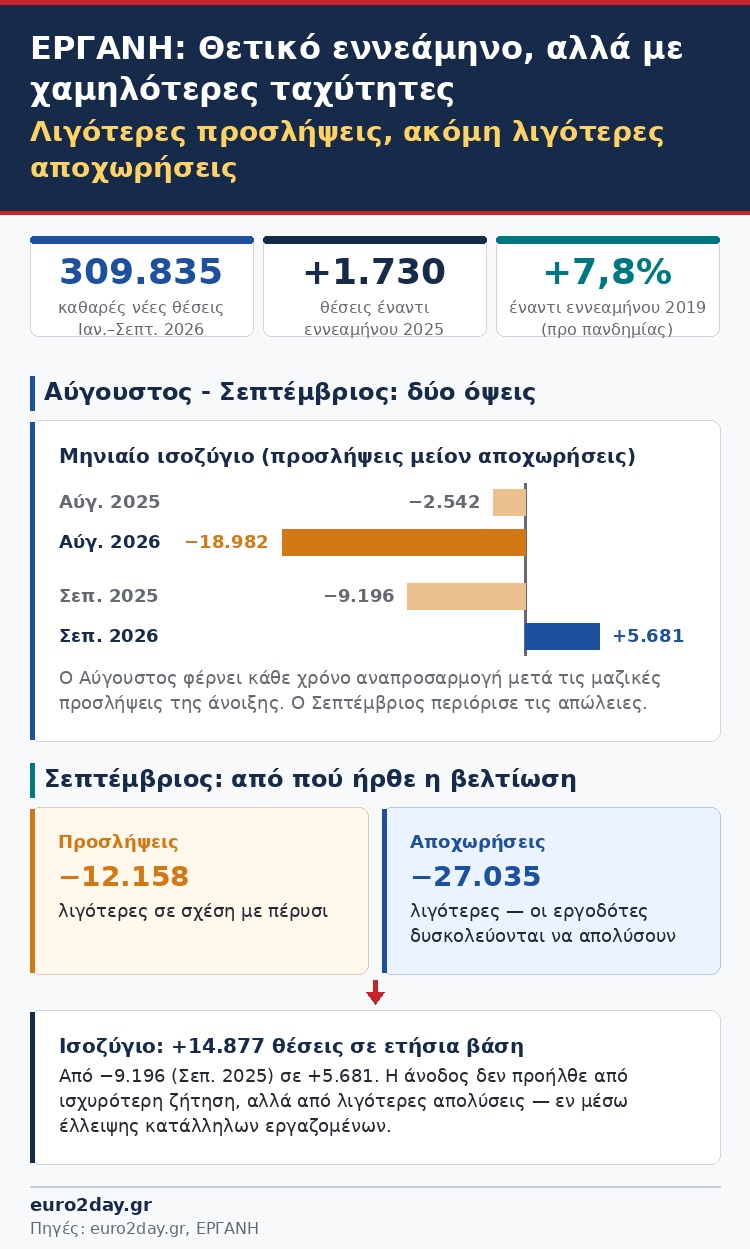
August presented a markedly different picture. Hires totalled 204,557, compared with 213,332 in 2025, while departures rose to 223,539 from 215,874. The result was a negative balance of 18,982 jobs, compared with a loss of 2,542 jobs a year earlier. Those who follow the Greek labour market had, of course, observed a sharp increase in hiring in the spring; as happens every August, this year too saw the necessary adjustment.
September’s positive result pared summer losses, without dispelling signs of weaker hiring momentum. One positive point, however, is that the hiring–departure balance for January–September 2019, before the pandemic, stood at 287,537 jobs, compared with 309,835 in 2026 — an increase of 22,298 jobs, or about 7.8%.
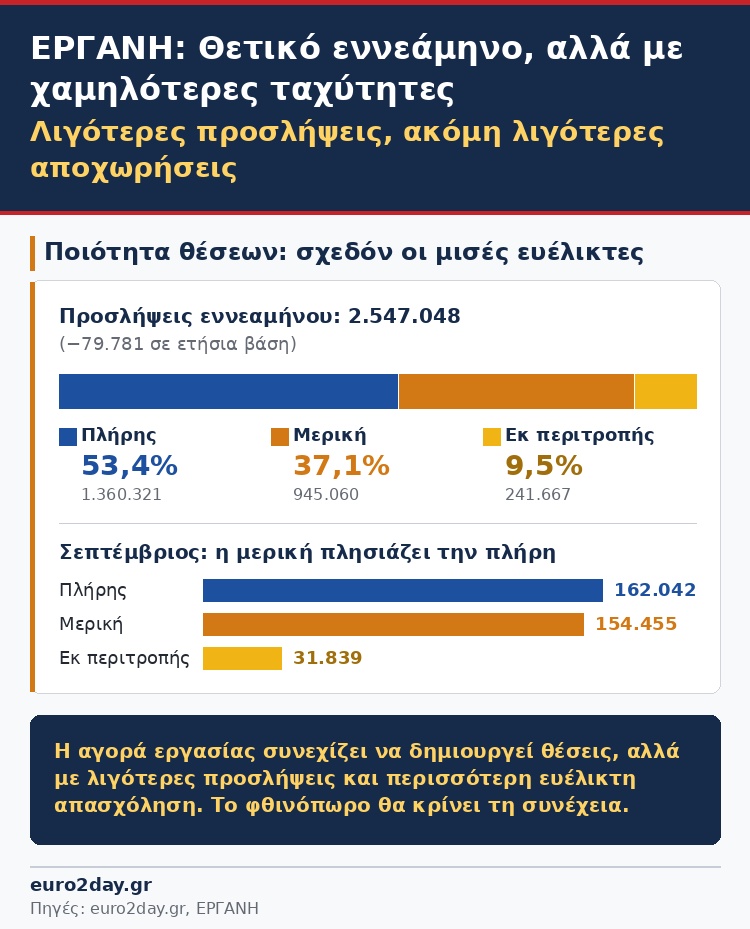
This improvement suggests that the labour market continues to generate more jobs on a net basis than before the pandemic. In the first nine months of 2026, there were 2,547,048 hires, down by 79,781 year on year. Departures, however, fell by 81,511, explaining why the net balance remained slightly higher than a year earlier.
The quality of the new jobs is equally important. Of the hires in the first nine months, 1,360,321 were in full-time employment, 945,060 in part-time work and 241,667 in rotating-shift work. Full-time jobs accounted for 53.41% of the total, while the two flexible forms made up 46.59%.
In September, part-time hires reached 154,455, close to the 162,042 full-time hires. The gap between the two categories narrowed, while a further 31,839 hires were for rotating-shift work.