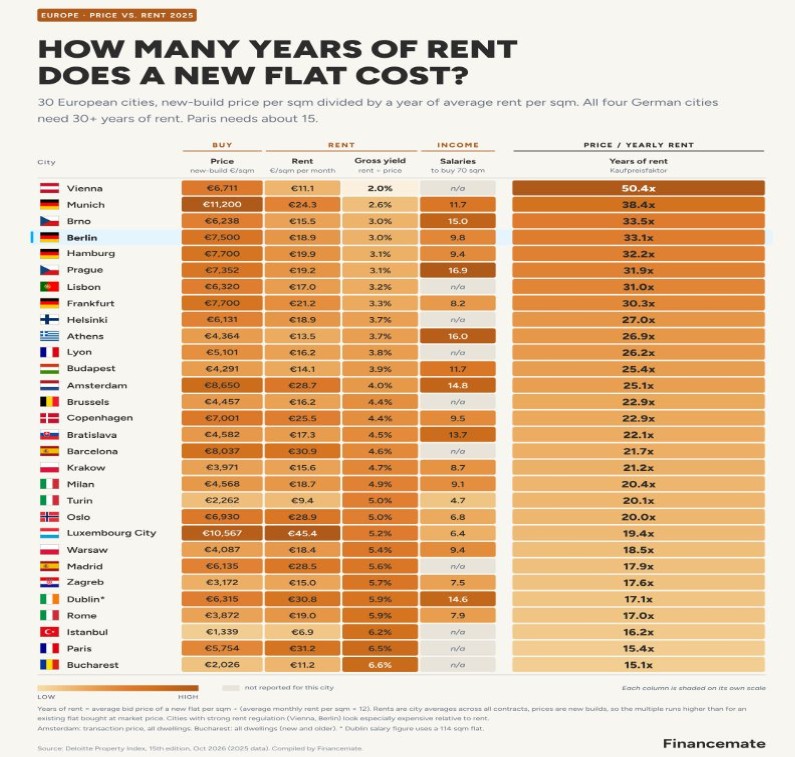
The housing crisis has become a major global issue, with property sale prices and rents rising faster than incomes. In Athens and other European capitals, sale prices have risen faster than rents, reducing the gross yield on such an investment. But that is not the case everywhere.Dividing the average sale price of a newly built property by the average rent allows us to calculate how many years’ rent it would take to buy such a home. The more years of rent it takes to buy a home, the lower its average annual gross yield, and vice versa.
The price-to-rent ratio is also used as a guide when deciding whether to buy or rent a property. Broadly speaking, renting is generally considered preferable to buying if the ratio exceeds 20, meaning more than 240 monthly rent payments are needed, while buying is preferable if the ratio is below 15, equivalent to 180 monthly rent payments.
According to Deloitte data, the ratio of the price of a newly built property per square metre to the average rent per square metre equated to 50.4 years’ rent in Vienna, 38.4 years in Munich and 33.5 years in Brno, Czechia. The figures were also, 33.1 years in Berlin, 32.2 in Hamburg and 31.9 years’ rent in Prague, according to the Financemate table reproduced below.
Athens ranks eighth among 30 European cities, at 26.9 years, with an average annual yield of 3.7%. Judging by the sale and rental prices, these must refer to newly built homes in the southern suburbs. This is because the sale price is €4,364 per square metre and rent is €13.5 per square metre. Research by Spitogatos and RE/MAX, published in the spring, also showed that 311 monthly rent payments, or 25.9 years, were needed to recoup the cost of a property in the southern suburbs, for an annual gross yield of 3.5%, compared with 17.6 years in central Athens, where the yield was 5.7%.
By contrast, the price-to-rent ratio stood at 15.1 in Bucharest, 15.4 in Paris, 16.2 in Istanbul, 17 in Rome and 17.1 in Dublin.
If the sole criterion for deciding whether to buy or rent a newly built property were the price-to-rent ratio, perhaps no one would buy a home in cities such as Vienna, Munich, Berlin, Prague, Lisbon and so on. However, there are also other factors that play a role, such as bank financing, tax incentives and so on.
NOTE: Comparing the sale price of newly built properties on the one hand with the average rent on the other is not the most methodologically sound approach. In addition, the average sale price in central Paris, and perhaps in other major cities, is considerably higher than the €5,754 per square metre shown here.