The GSI cable will clearly reduce energy costs, curb renewable energy curtailment and lower procurement costs. The benefits will naturally “tilt” towards Cyprus, which will end its energy isolation, but will also extend to Greece.
Depending on a range of scenarios and assumptions, from the cost of natural gas to the cable’s capacity, the benefits for the countries involved in 2035 are estimated at €123 million to €138 million a year.
The study, presented by Pantelis Biskas, an associate professor at the Aristotle University of Thessaloniki, at the annual “Energy & Development” conference organised by the Institute of Energy for South-East Europe (IENE), considers three scenarios for the cable’s transmission capacity: 500 MW, 750 MW and 1,000 MW.
The simulation also makes two assumptions about natural gas prices in 2035. In the first, the price is €27.97/MWh in both countries; in the second, it is €17.97/MWh in Cyprus, or €10 lower, on the assumption that by then Nicosia will have its own production. This is because gas production in Cyprus from the Kronos field is expected to begin in the first half of 2028, according to recent statements by government officials in Nicosia.
In practice, the study compares how much more competitive the electricity transmitted through the Greece-Cyprus interconnector will be in 2035 than electricity produced by Cyprus’s domestic power plants, once they begin using locally produced gas. It considers a range of cost factors and assumptions.
For example, it also takes into account that the price of CO2, which contributes to the cost of electricity generation at conventional power plants, will stand at €121.9 per tonne at that point, up from €90 today.
The three scenarios
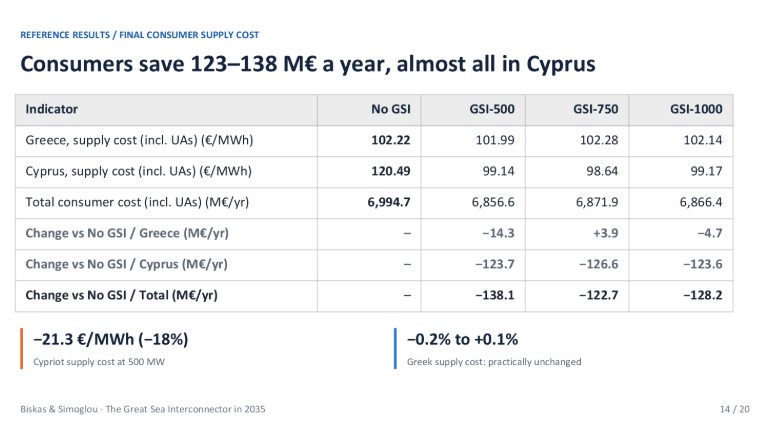
In the scenario with a transmission capacity of 500 MW, consumers’ energy costs fall by €138.1 million, as the slide above shows. Of that, Cypriots save €123.7 million and Greeks €14.3 million. The cable is bidirectional, meaning that, if built, it will allow electricity to be exported both from Greece to Cyprus and in the opposite direction.
In the scenario with an interconnector capacity of 750 MW, the total benefit comes to €122.7 million, with Cyprus saving €126.6 million a year and Greece incurring an additional cost of €3.9 million.
In the third scenario, involving a cable with a capacity of 1,000 MW — the transmission capacity on which GSI was designed — Cypriot consumers will pay €123.6 million less a year for their energy needs, while Greek consumers will save about €4.7 million.
Comparison with cheaper natural gas
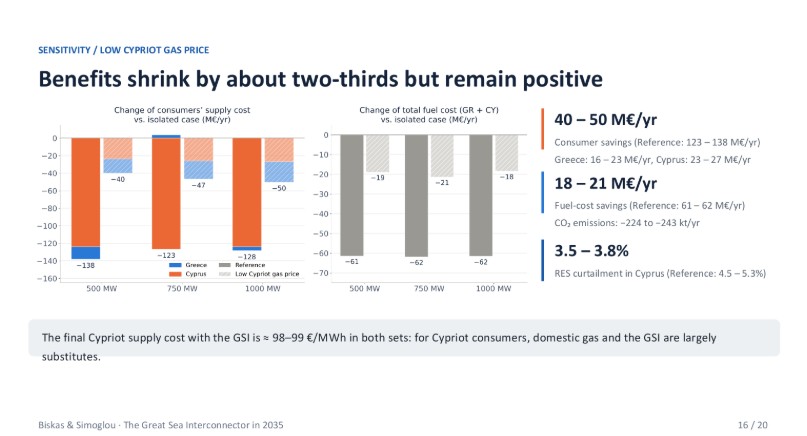
If domestic natural gas in Cyprus is even cheaper in 2035 than assumed above, GSI will still be a competitive project; consumer savings will simply be limited to €40 million to €50 million a year.
What it means for wholesale prices
On the question of how much wholesale prices in Cyprus will fall, the study estimates that, from €120.49/MWh in 2035 in the scenario without GSI, they will drop to €99.14/MWh in the scenario involving a cable with a transmission capacity of 500 MW. The benefits for Greece’s wholesale price are limited: it falls slightly from €102.22/MWh without the interconnector to €101-102/MW, depending on the cable-capacity scenario.
The significant fall in Cyprus’s wholesale price is notable, however. With the end of the country’s energy isolation, the price drops by about €21.5/MWh (19%) to reach Greece’s level.
Less curtailment
What does it mean for Cyprus to be able to export its green electricity to Greece? Less curtailment in Cyprus, with the rate falling from 11.8% to about 5%, depending on the cable-capacity scenario. Cypriot thermal power plants will also operate much less. The impact on curtailment in Greece will be considerably smaller, with the study pointing to a marginal decline from 3.1% to 2.9%.