The clock is ticking down to the departure of the vessel Abeille Marengo for international waters east of Karpathos, with a flurry of behind-the-scenes activity setting the tone. Athens is reading Fidan’s “all is well, everything is normal”, following the note verbale Paris sent to Ankara on Friday, according to reports, as a sign that Turkey does not want to inflame the situation.
Whether the behind-the-scenes French-Turkish consultations of the past month and a half have borne fruit, and what is contained in Friday’s diplomatic document — the much-discussed French communiqué to Ankara, which opposition parties are demanding explanations about — will become clear in the coming hours or days off Karpathos, with speculation at fever pitch.
The scenarios being discussed range from the surveys proceeding smoothly, if Turkey ultimately decides that obstructing work on the GSI is not in its interests, to a change in circumstances and a confrontation on the ground. The key lies in the communiqué sent from Paris to Ankara and, of course, in how Turkey weighs the situation.
According to the interpretation offered by sources familiar with the discussions, which remains to be tested on the ground, Fidan’s statement suggests that the understanding has produced the expected results and that contacts between France and Turkey have led to a formula that will allow the surveys to proceed without incident or undermining Greek sovereign rights.
The contents of the “communiqué”
Indeed, the same sources say that the contents of the “communiqué” — which evidently distinguishes notification from the request for a permit — were thoroughly vetted by Greece and Cyprus before the French side sent it to Turkey.
According to reports, similar communications have taken place several times recently, and their contents had taken shape well before the Prime Minister’s instruction last week to issue the NAVTEX on Friday.
And, our interlocutors say, no one can believe that either Athens or Nicosia would have allowed even the slightest one-sided or ambiguous wording in the text that could be interpreted as undermining national sovereign rights.
Turkey could, of course, use the “communiqué” as a tool and interpret it as proof that it has sovereignty over the area and therefore the authority to issue a permit for the vessel’s seabed surveys. But, as government sources said the day before yesterday, “the domestic handling of Turkey’s reaction is not our concern”.
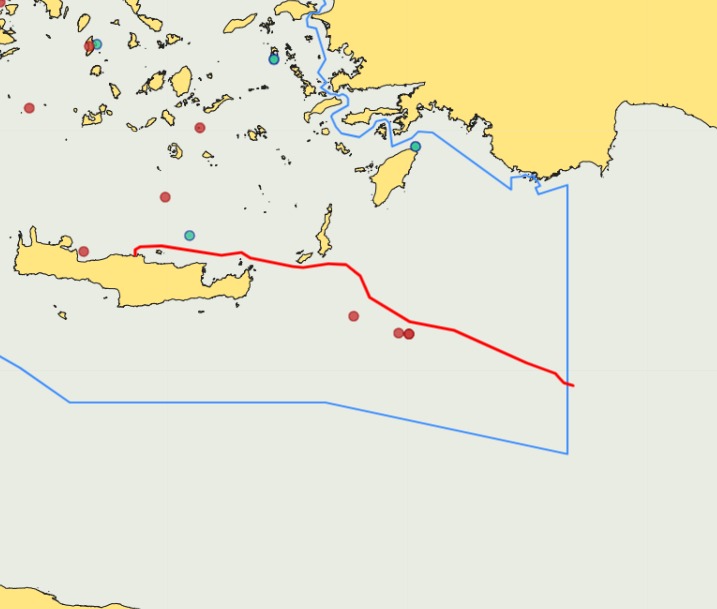
The question, the same sources say, is whether Turkey would risk disrupting relations with Paris over a project backed by the EU and involving France, when it has signed defence cooperation agreements with Paris, including one in October, and is seeking a way to take part in the EU’s SAFE defence programme.
Also relevant is the view that an escalation would put Turkey on the radar of the Democrats, who are set to take control of both chambers of Congress — the Senate and the House of Representatives — in early 2027, with possible implications for the Turkish request to rejoin the F-35 programme.
These, however, are only theories. Athens is preparing for every eventuality, while bearing in mind that power in Turkey is not concentrated in a single institution, with the Turkish Defence Ministry taking a tougher line than the Turkish Foreign Ministry.
The game will be played off Karpathos, where the Abeille Marengo is due to arrive no later than a day after leaving Heraklion. In the meantime, it will “calibrate” its instruments, from its sonar to its seismic equipment.
The three scenarios
1. In the first, extremely mild scenario, Turkey will limit itself to the counter-NAVTEX issued last Friday, and its response will be confined to the now customary practice of harassing the vessel conducting the surveys by radio (hailing). A Coast Guard vessel will monitor the work, with a Navy ship also present at a distance.
2. In the second scenario, Turkey will issue a NAVTEX indicating that it is the licensing authority for the vessel’s surveys. As the counter-NAVTEX issued a few days ago stated, “part of the area lies within the Turkish continental shelf, the Turkish authorities have not given their consent, and all surveys in the area must be coordinated with the competent Turkish authorities”. Here, too, a Navy frigate will maintain a discreet presence.
3. The third scenario is one of confrontation, in which the situation gets out of hand for whatever reason — either because of a lack of coordination between the Greek and Turkish foreign ministries or because the French fail in their negotiations — making it necessary to protect the Abeille Marengo on site. Government sources say that in such a case Athens would not back down, and the vessel would remain in the area.
First, the government cannot politically afford to endure a new “Kasos”, especially just a few months before the elections and at a time when developments concerning the cable are under the microscope of everyone from the US to Israel and Egypt.
Second, the Kasos scenario cannot be repeated because there is a single NAVTEX: its validity through 6 March 2027 covers the entire remaining 40% of surveys along the route where the cable is to be laid. That is unlike 2024, when the notice was issued for one section of the route at a time, with each NAVTEX due to be followed by the next, and so on.