The three banks’ nine-month results point to three different paths in the same environment of credit expansion and interest rates that fell year on year but rose in the third quarter.
Optima bank combines 38% loan growth with a return on tangible equity of 27.8%. CrediaBank is growing even faster, but from a very low earnings base, while also building a group through acquisitions. Bank of Cyprus is growing at 9% and relying on its capital strength and shareholder distributions.
We believe the three cases should not be assessed by the same criteria, as we explain below. The analysis is based exclusively on the banks’ nine-month announcements and does not include a valuation.
Optima bank: quality growth
Nine-month net profit reached €165.1 million, up 34%. Third-quarter net profit was €60.8 million, up 44% year on year and 7% on the previous quarter. Loans rose to €6.1 billion (+38%) and deposits to €7.5 billion (+32%).
Net interest income increased 33% to €203.5 million, while the net interest margin fell to 3.26% from 3.34%, mainly because of the decline in Euribor. Revenue growth therefore came from volumes, not margins.
The quality of that growth is evident in the other lines. Net fee and commission income rose 55% to €62.4 million, helped by investment banking and asset management. Operating expenses increased 20%, well below the 33% rise in revenue, and the cost-to-core-income ratio fell to 22.1% from 25.2%.
Provisions rose 44% to €21.7 million, with a cost of risk of 52 basis points against 50 a year earlier. The NPE ratio stands at 1.62%, with coverage of 127% including collateral. The one area of weakness was the result from financial transactions, which fell to €16.0 million from €19.1 million.
Management has kept its 2026 targets unchanged: net profit of more than €210 million, RoTE of about 25% and a cost of risk of about 55 basis points. With €165.1 million earned in the first nine months, 79% of the profit target has already been achieved, while the current run rate points to about €220 million for the year. We consider the target conservative.
The loan target (an increase of €1.35 billion for the year, compared with €1.0 billion so far) requires about €350 million of new net lending in the fourth quarter, which appears achievable. The targets do not include the acquisition of Euroxx.
The two main risks
There are two risks. The first is interest rates: their rise in the third quarter lifted the margin to 3.34%, but the bank’s presentation says about 95% of its book is floating-rate, so a renewed reversal would feed through quickly to income. The second is capital.
The CET1 ratio is 12.02%, against a minimum requirement of 8.47% — the smallest buffer among the three banks. It nevertheless rose from 11.83% in the previous quarter, despite a 5% increase in the balance sheet.
As long as growth remains at 38%, capital will be the limiting factor.
CrediaBank: rapid expansion and transition
CrediaBank has reported the best nine-month period in its history. Net interest income rose 32% to €158.1 million, net fee and commission income increased 34% to €35.1 million, and recurring pre-provision profit climbed 56% to €87.3 million.
Loans excluding securitisations stood at €6.0 billion, up 45% year on year and 13% during the quarter — five times the system’s rate, according to the bank. Net credit expansion in the first nine months was €1.5 billion, exceeding the full-year target of €1.3 billion. Shipping was particularly strong, up 149% to €640 million, as was structured finance, up 67%.
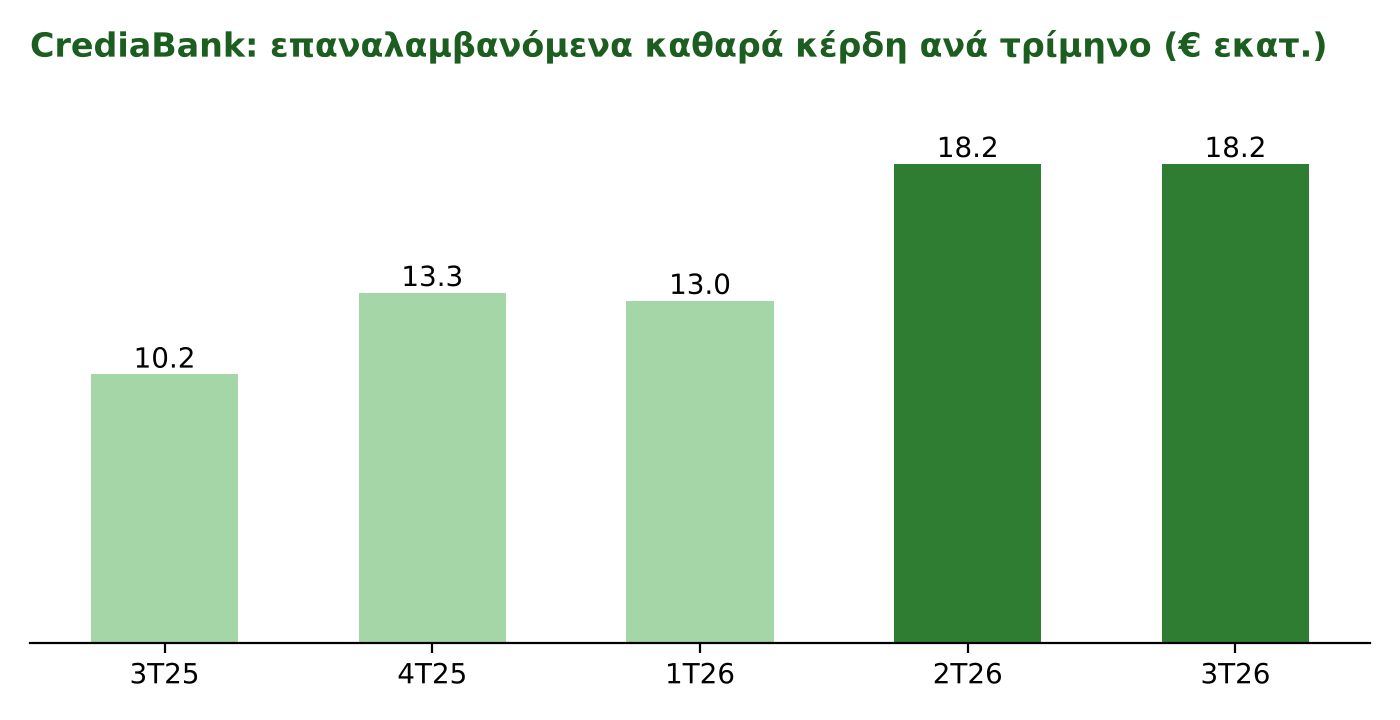
The cost-to-income ratio improved by 861 basis points to 57.2%, reaching 54.2% in the third quarter. Recurring expenses rose 8%, or just 2% excluding about €6 million in front-loaded costs for Malta and the digital transformation.
Reported net profit was €37.4 million (+278%), while recurring net profit was €49.5 million (+56%). The €12.1 million difference reflects exceptional pre-tax costs of €16.6 million, mainly voluntary-exit and incentive programmes (€13.6 million).
Three areas to watch
We believe three areas warrant attention. First, the return on tangible equity is 7.4%, well below the cost of capital. Management estimates it would be 10.4% following the acquisition of HSBC Malta and is targeting a high double-digit figure over the medium term.
Second, deposit growth (+32% to €8.8 billion) was driven by businesses, whose deposits rose 86% year on year and by about €1.2 billion during the quarter. Term deposits now account for 55.8% of deposits, and deposit interest expense rose 45% from the second quarter. The LCR fell to 139% from 145%.
Third, in terms of portfolio quality, NPEs rose to €169.9 million from €151.8 million because of two legacy business loans.
The ratio remained at 2.4%, but coverage fell to 55.3% from 57.1%, the lowest level among the three banks. The organic cost of risk reached 57 basis points in the third quarter, up from 35, while quarterly recurring profit remained at €18.2 million despite a 14% increase in pre-provision profit.
The strategic direction is clear. The acquisition of a 70% stake in Pantelakis Securities and the merger with Europe Holdings have been completed, while the acquisition of HSBC Malta is expected to take assets above €18 billion, subject to regulatory approval.
The CET1 ratio is 15.5% pro forma for Europe Holdings, 648 basis points above the minimum. Fitch gave the bank its first rating, BB with a positive outlook.
The growth trajectory is strong; the challenge over the coming quarters will be execution: approval and integration of the Malta business, control of deposit costs and stabilisation of NPE coverage.
Bank of Cyprus: capital strength
Bank of Cyprus reported net profit of €383 million (+9%), RoTE of 18.9% and earnings per share of €0.88 (+9%). Revenue, however, rose just 2% to €785 million, net interest income increased 3% to €565 million, and the margin fell by 14 basis points to 2.84%.
Operating expenses rose 3% to €281 million, while the special levy on deposits and contributions increased 29% to €37 million. As a result, operating profit before the levy and contributions rose by just 2%, to €504 million from €495 million.
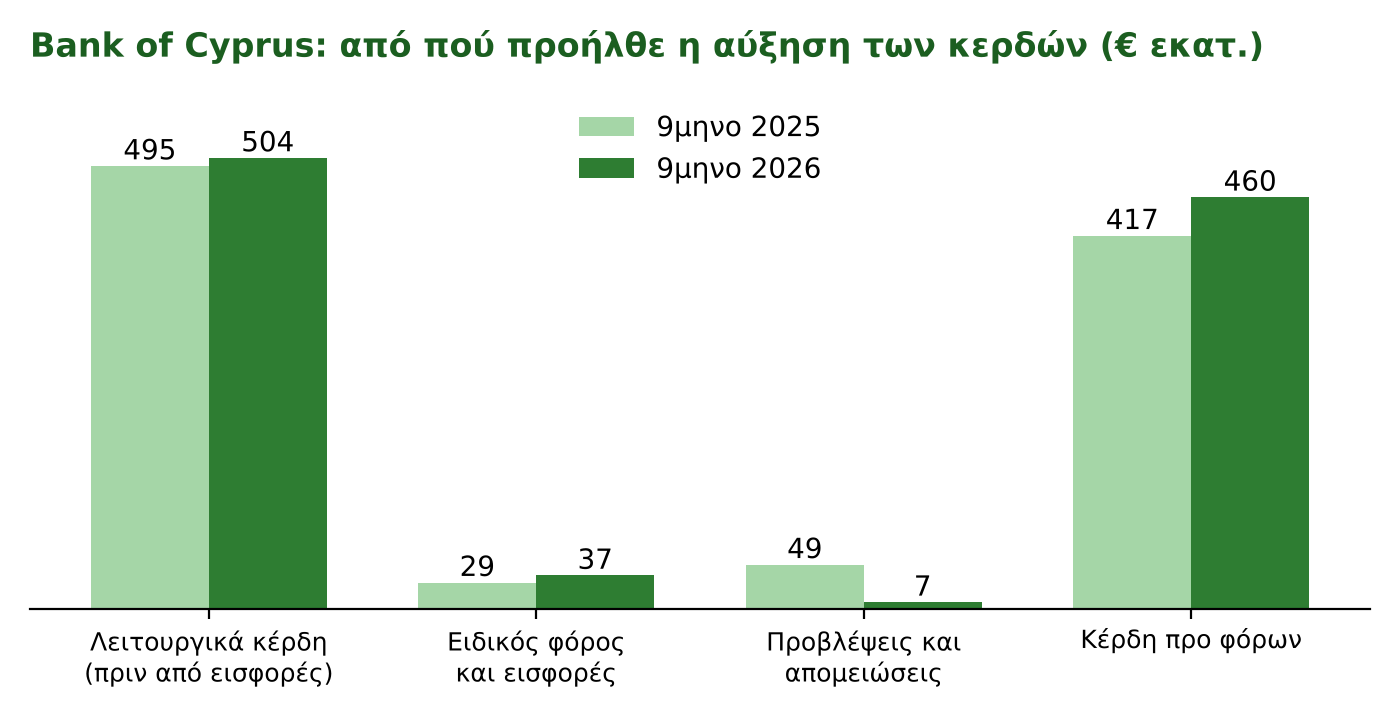
Almost all the increase in profit came from provisions. Loan credit losses resulted in a net release of €12 million (−14 basis points), compared with a charge of €28 million a year earlier, while total provisions and impairments fell to €7 million from €49 million.
Pre-tax profit rose by €43 million. Operating profit contributed €9 million of that increase, higher levies reduced it by €8 million, and lower provisions added €42 million. The bank attributes the reversals to specific customer cases and improved macroeconomic forecasts.
The clearest sign of progress came from insurance, where net profit was €51 million (+39%). Adjusted recurring profit in the presentation was €370 million (+9%), including €131 million in the third quarter, against €118 million in the second.
Balance-sheet quality and distributions
Balance-sheet quality is very strong. Performing loans total €11.6 billion (+9%), deposits €23.5 billion (+9%), the loan-to-deposit ratio is 49%, the NPL ratio is 1.0% and coverage is 144%. The CET1 ratio is 20.6%, with a 70% payout provision, and organic capital generation reached 341 basis points in the first nine months.
According to the presentation, the 2026 target was raised to more than 400 basis points, from 350–400. The bank has raised its 2026 RoTE target to the high teens and maintained its distribution plan: a 70% regular payout and up to a 20% additional dividend for 2026, and 70% plus up to 30% for 2027 and 2028 — up to 100% of adjusted profit.
The interim dividend was €0.24 per share (+20%). Tangible book value per share is €6.21, up 11% since the start of the year.
The risks here are different in nature. Interest income is relatively protected: hedges cover 47% of interest-earning assets, and a 25-basis-point change in interest rates would alter income by about €17 million, or 2%.
Management expects net interest income of about €765 million in 2026, implying roughly €200 million in the fourth quarter, compared with €196 million in the third. The real question is provisions. For 2026, the bank expects small net reversals, while for 2027–28 it puts the normal cost of risk at 40–50 basis points and its RoTE target in the mid-teens, below the 18.9% recorded in the first nine months.
We read this as a sign that this year’s benefit will not be repeated. On capital, the Central Bank of Cyprus introduced a systemic risk buffer of 100 basis points in November, effective from 31 December 2026, while the acquisition of a portfolio from CDB (about €130 million in loans and €440 million in deposits) will cost about 30 basis points.
With the existing buffer, both appear manageable.
The comparison
Nine-month financials (amounts in € millions, changes year on year)
| Metric | Optima bank | CrediaBank | Bank of Cyprus |
|---|
| Nine-month net profit (€ million) | 165.1 | 37.4 (recurring 49.5) | 383 |
| Year-on-year change | +34% | +278% (recurring +56%) | +9% |
| Return on tangible equity | 27.8% | 7.4% | 18.9% |
| Net interest income | +33% | +32% | +3% |
| Net interest margin | 3.26% | 2.25% | 2.84% |
| Net fee and commission income | +55% | +34% | +3% |
| Cost-to-income ratio | 22.1% | 57.2% | 41% |
| Cost of risk | 52 bps | 46 bps | −14 bps |
| Non-performing exposure/loan ratio | 1.62% (NPEs) | 2.4% (NPEs) | 1.0% (NPLs) |
| Coverage ratio | 127% | 55.3% | 144% |
| Loans, annual growth | +38% | +45% | +9% |
| Deposits, annual growth | +32% | +32% | +9% |
| Loans to deposits | 81.6% | 68.5% | 49% |
| CET1 | 12.02% | 15.5% | 20.6% |
| Total capital ratio | 17.29% | 20.1% | 25.2% |
The ratios are not fully comparable. Optima measures costs against core income, CrediaBank against recurring income, and Bank of Cyprus against total income (36% excluding the special levy and contributions).
Optima calculates NPE coverage including collateral, while Bank of Cyprus reports NPLs. Even so, the direction is clear.
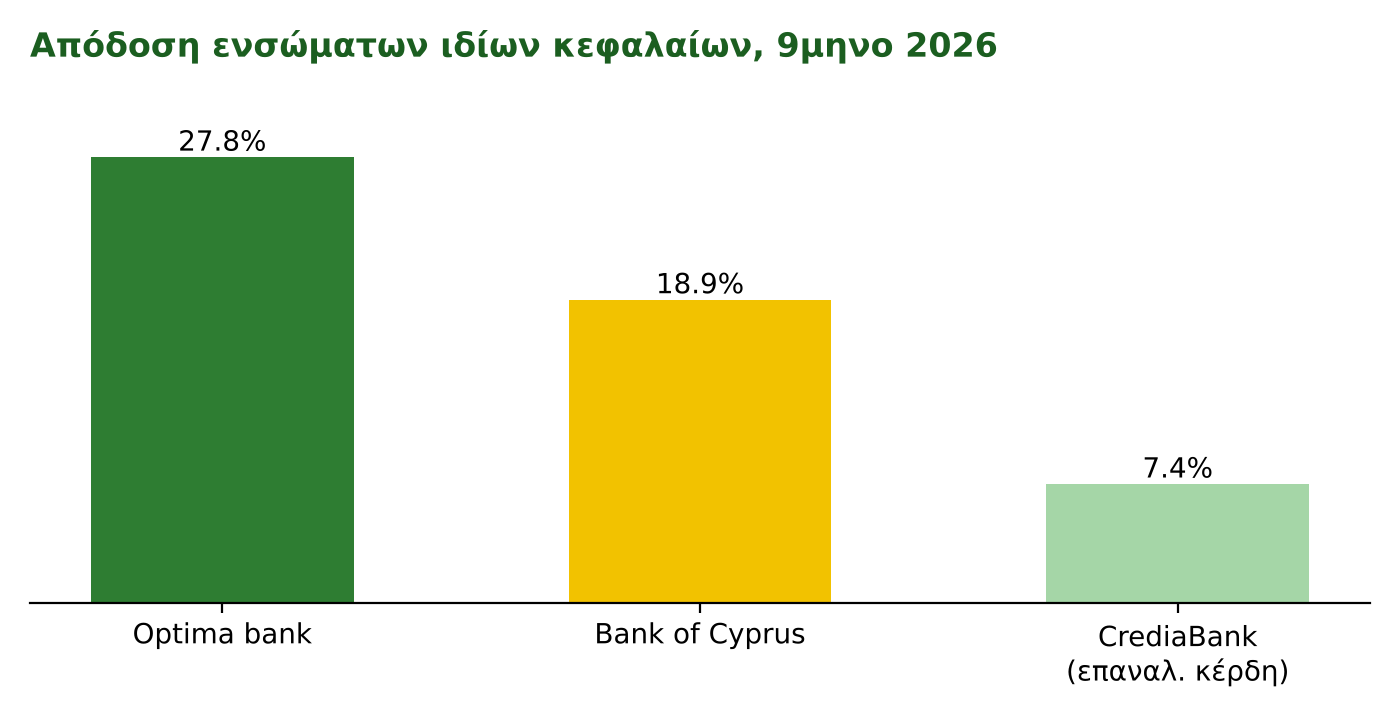
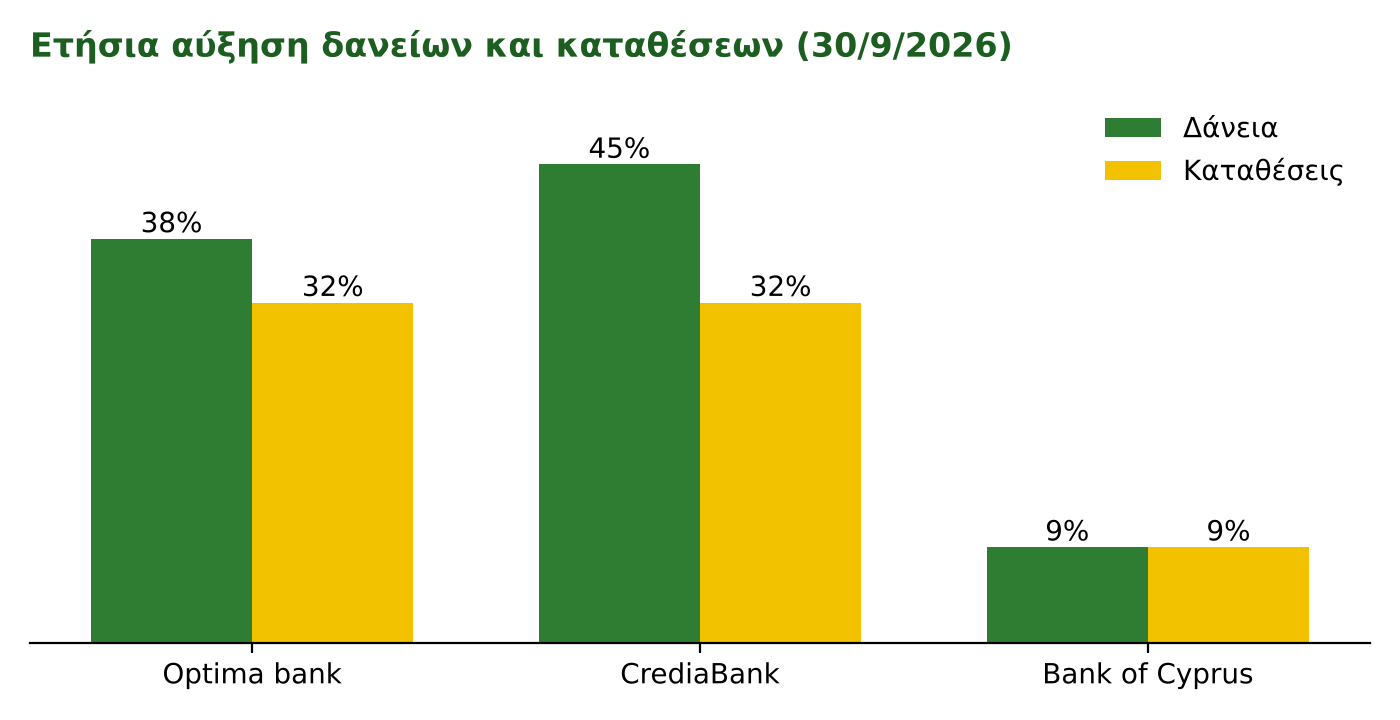
Optima has the highest return and the lowest cost ratio. CrediaBank has the fastest expansion and the largest gap to its return target. Bank of Cyprus has the slowest growth and the largest capital and liquidity buffers.
Capital: who has room to keep growing?
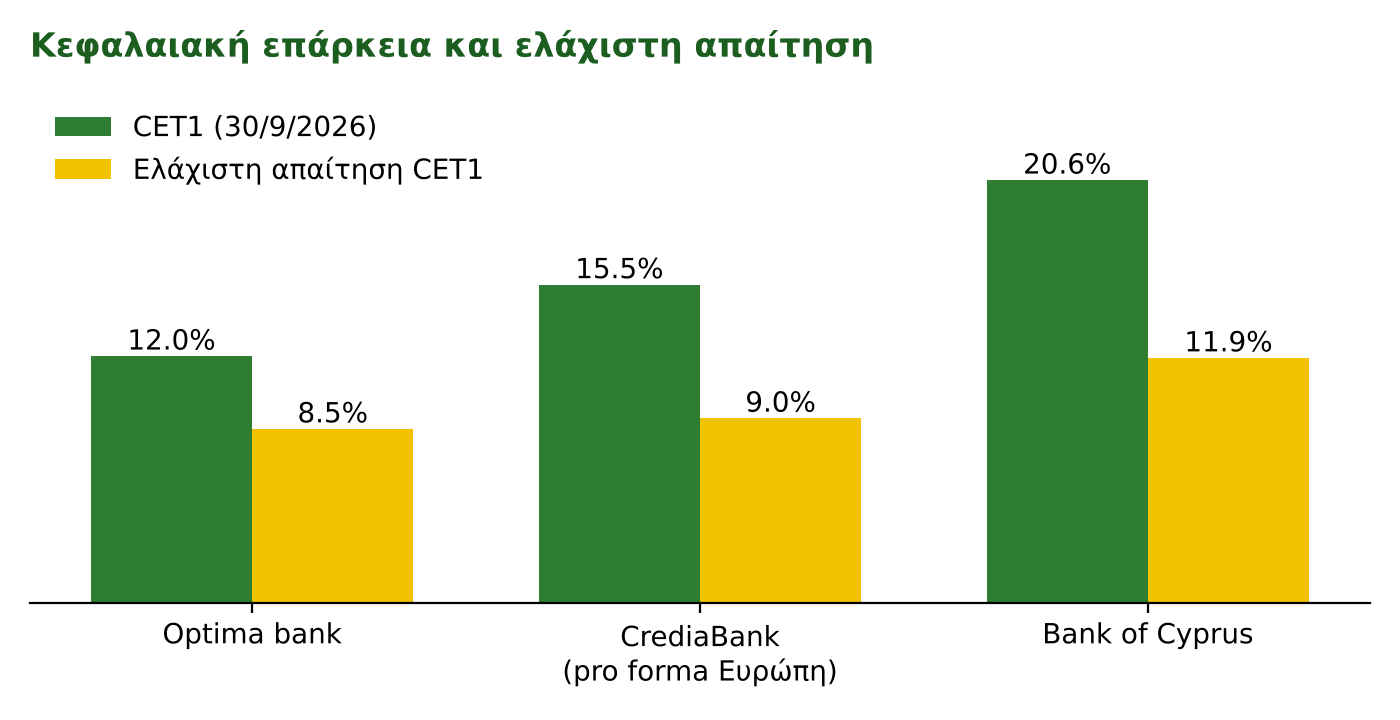
The CET1 surplus over the minimum requirement is about 3.6 percentage points for Optima, 6.5 for CrediaBank and 8.7 for Bank of Cyprus.
On this basis, Bank of Cyprus can fund high distributions without putting pressure on capital, while Optima will need to balance growth against retained earnings. CrediaBank has headroom, but some of it will be absorbed by the Malta acquisition and continued credit expansion.
In conclusion, Optima is the clearest growth story: earnings are following volumes, costs remain low and the full-year targets look achievable. The trade-off is a smaller capital buffer and exposure to interest rates. Second, CrediaBank is a story of transition and execution.
Its growth figures are impressive, but returns and NPE coverage have yet to reach mature levels, and the next phase depends on Malta.
Third, Bank of Cyprus is a capital and distributions story, with slower growth and profits that benefited from provisions this year. Normalisation of the cost of risk will determine whether earnings growth continues.
* Director of Research at Solidus Securities S.A., responsible for portfolio analysis and asset-allocation optimisation, developing comprehensive financial models to assess risk and forecast market trends. President of EEAPAMA – HACSA.
** This article is for informational and educational purposes and does not constitute investment, tax or legal advice. The figures are indicative, based on publicly available historical data, and do not guarantee future returns. Before making any investment decision, consult a certified investment adviser.