Three developments involving a series of blocks, a host of Greek and foreign companies and several maritime zones across Greece highlight the recent increase in activity and investment interest in the hydrocarbons sector, as well as its ability to attract new players.
From the south-west and south of the Peloponnese to the north-western Ionian Sea, and from the waters off western Greece to those in the south, developments in recent days point to an unusually high level of activity in the sector by Greek standards.
- Work began in recent days to prepare the port of Igoumenitsa, which has been chosen by the Energean-Helleniq Energy-ExxonMobil consortium as the base for exploratory drilling next April at the Asopos 1 prospect in Block 2 in the north-western Ionian Sea. The drilling will be the first in 40 years. Establishing the infrastructure, resupplying the operation and providing offshore support are among the key issues that need to be resolved before drilling begins. Meanwhile, the Shipping Ministry on Thursday approved the use of two specialist vessels to support the Stena DrillMAX floating drilling rig.
- The Ramform Tethys, flying the flag of the Bahamas, is already in the Ionian Sea and is due to begin seismic surveys immediately in the “A2” and “South Peloponnese” blocks on behalf of the Chevron-Helleniq Energy consortium. The area covers about 12,000 sq km. The vessel will map the area through to the end of January 2027. The relevant NAVTEX was issued earlier.
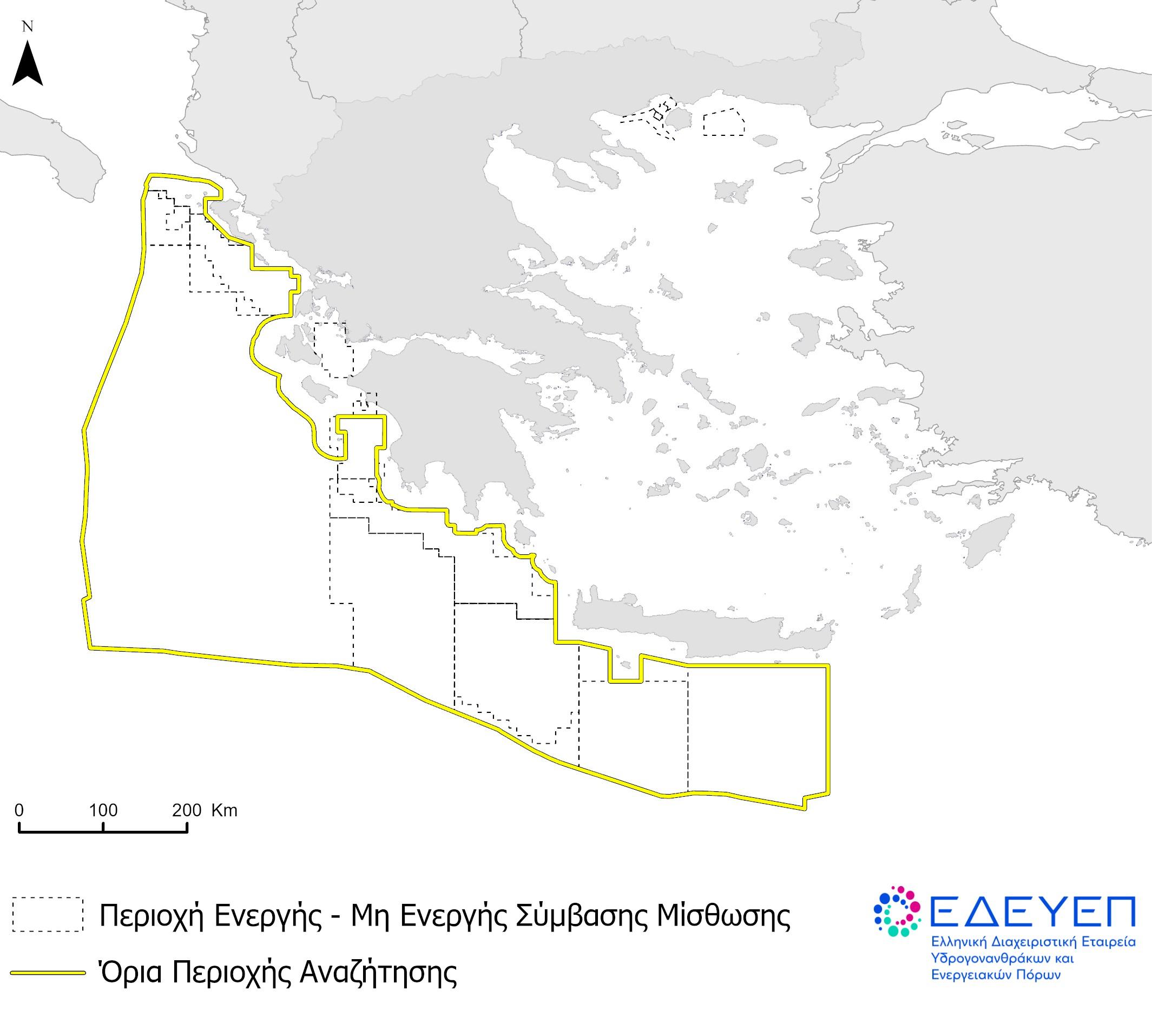
- Three of the world’s largest players in seismic surveys — France’s Viridien and SLB, and China’s BGB — have been vying since the day before yesterday to map several new, uncharted areas and collect and process non-exclusive data across a vast maritime area in western and southern Greece, as the map below shows. All three submitted bids in the international tender launched by the Hellenic Hydrocarbons and Energy Resources Management Company (HEREMA), amid interest from their clients in buying the new 2D and 3D data and subsequently bidding for specific blocks.
Meet the new players
France’s Viridien (formerly CGG) is one of the world’s leading groups in geoscience and geophysical imaging, with operations in dozens of countries, from the Mediterranean and the North Sea to the Gulf of Mexico and Asia.
France’s Schlumberger (SLB/WesternGeco) is also one of the leading oilfield services companies, with a presence in 100 countries. It operates across the oil industry’s value chain, employs tens of thousands of people and conducts seismic surveys through its WesternGeco unit.
China’s BGP is a subsidiary of Chinese state-owned giant China National Petroleum Corporation (CNPC). It employs more than 23,000 people, operates a large fleet of vessels and has a presence in more than 80 countries, with over 300 clients worldwide.
All three already operate in the eastern Mediterranean, a region high on their agenda. They are taking part in the large-scale offshore exploration programme launched by Egypt, which covers a vast maritime area of up to 95,000 sq km.
Client interest and future concessions
In practice, both the French and Chinese companies entered the tender because their clients are likely interested in buying the new data and subsequently bidding for specific blocks. This, in turn, could pave the way for a new licensing round in Greek waters or for expressions of interest in specific blocks at a later stage.
These could include, for example, the “West of Crete” block, which ExxonMobil has returned to the state, or the “Ionian” block, which has been awarded to Helleniq Energy. The Greek group, which has been granted an extension until October 2027 for the second phase of seismic surveys, is known to be seeking a strategic partner.
The exact locations of the new areas to be mapped will become clear during negotiations between the candidates and the Hellenic Hydrocarbons and Energy Resources Management Company (HEREMA). The process is likely to take time, given the vast amount of documentation involved; reports suggest there are 75 separate digital files in all.
PGS Exploration (UK) is not among the three bidders. The British arm of Norway’s TGS prompted the tender with its interest, but has since taken on the seismic surveys in the Ionian Sea, in the “A2” and “South Peloponnese” blocks, on behalf of the Chevron-Helleniq Energy consortium.
When will the seismic surveys get under way?
As for when the bids will be opened, what exactly they cover and which areas of the vast expanse of western and southern Greece will be mapped, there is still a great deal to do before they can be assessed.
More than one licence is likely to be awarded, perhaps as many as three, to achieve the greatest possible geographical coverage for the surveys compared with what a single contractor could provide. This is particularly likely given that the three bidders have not chosen exactly the same maritime zones, and their programmes complement each other geographically.
Based on experience so far, and given that after negotiations the agreement must be approved by Parliament and then reviewed by the Court of Audit, it is unlikely that the successful bidders will make the survey window before Easter 2027.
Seismic surveys are scheduled before the start of the tourist season, usually from autumn to early spring, as shipping traffic increases thereafter.
In Chevron’s case, 11 months passed between the expression of interest in South Peloponnese and the award. The expression of interest was announced in January 2025 and the contracts were finalised in January 2026.
The most likely window, therefore, is autumn 2027, and all signs point to the survey vessels gearing up around then.