The increase in construction costs in recent months is slowing the development of new homes, the Bank of Greece says in a new report, at a time when “mild” momentum is being recorded in the market.
As Euro2day.gr wrote in a previous report, the rising inflationary pressures facing the construction market are creating suffocating conditions for infrastructure projects and housing development, even leading to the cancellation of projects.
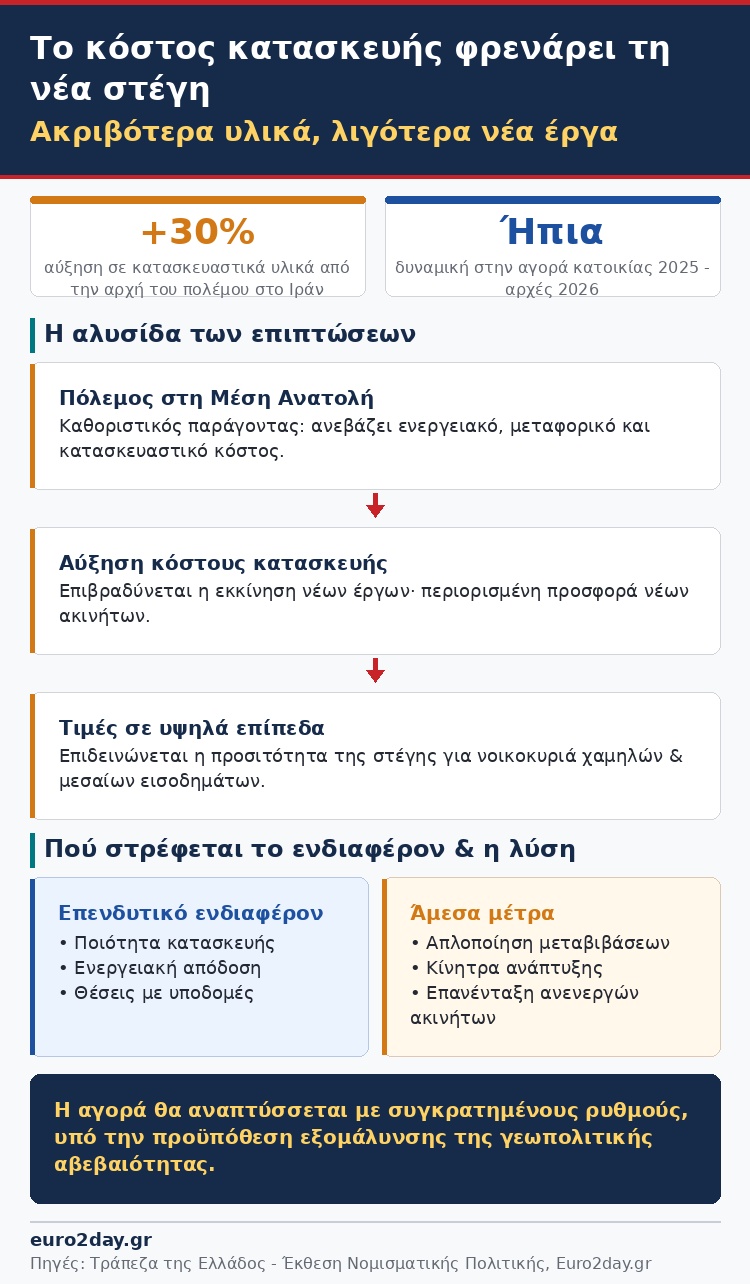
In the Bank of Greece Report on Monetary Policy it is underlined that the war in the Middle East is now emerging as a decisive factor in developments in the economy and in the real estate market in particular, with effects on energy costs, transport costs and construction costs.
“Under the present conditions, property values are estimated to be shaped increasingly not only by location and demand, but also by their energy efficiency and operating cost.
In addition, especially in the housing market, given that the supply of new properties remains limited, the further increase in construction costs is expected to slow the launch of new projects, keeping prices at high levels and worsening housing affordability especially for low- and middle-income households,” it is stated.
Market players speak of 30% increases in construction materials from the beginning of the war in Iran until today, while data for individual products show an even greater increase.
Mild momentum in the market
At the same time, demand for apartments remains sky-high, however the market appears to have reached its limits.
“The mild momentum recorded in the housing market in 2025 continued in the first months of 2026 as well. Interest remains active from both domestic and foreign investors, mainly for housing as well as high-specification commercial uses,” the Bank of Greece emphasizes.
In an effort to strengthen supply, the government has taken action, but more steps are needed for faster results.
“The state, in the context of addressing the housing issue, has announced a series of measures to strengthen supply, however their substantial impact will be visible over time. More immediate results could arise from simplifying the procedures for the transfer and development of properties, as well as from incentives for the reintegration of inactive properties into the market,” the report notes.
“The real estate market is estimated to continue to grow at restrained rates, while investment interest is estimated to focus more on construction quality, improving energy performance and selecting locations with developed infrastructure, provided that geopolitical uncertainty eases and the estimated growth rates of the Greek economy are maintained,” the Bank of Greece concludes.