In the world of asset markets, time is not linear. Stock markets move within two successive time levels, and two distinct and interrelated forces: long-term markets (secular markets) and cyclical markets (cyclical markets).
The distinction between these two concepts is the foundation of strategic asset allocation and the understanding of major economic cycles.
Secular and Cyclical Markets
A secular market refers to a long-term trend — upward (secular bull) or downward/sideways (secular bear) — that usually lasts 10 to 20 years or even longer. The term “secular” comes from the Latin saeculum, meaning generation or century, indicating that this trend goes beyond the individual economic cycle and reflects deeper structural forces of the economy.
A cyclical market, by contrast, describes shorter fluctuations -usually from a few months to 5 years- that develop within a secular trend. A secular bear market, for example, is not an uninterrupted decline, but a sequence of strong cyclical bull rallies and painful cyclical bear corrections, with the general index remaining, in real (inflation-adjusted) terms, downward / sideways-downward for a long period of time.
The factors that determine secular trends
The transition from a secular bull to a secular bear market, or vice versa, is not random. It is determined by the convergence of multiple structural factors:
- Valuations: Secular bull markets usually begin from historically low levels of indicators such as the cyclically adjusted P/E (CAPE/Shiller P/E) and conclude at extremely high valuation levels.
- Inflation and interest rates: Price stability favors the expansion of valuation multiples and therefore secular bulls, while high or unstable inflation compresses valuations and favors secular bears .
- Demographics: Generations that are numerically large in size when they reach saving and investing age (e.g. baby boomers in the 1980s-1990s) channel significant capital into the markets, strengthening secular upward waves.
- Technological revolutions: New technological waves (e.g. railroads, electricity, information technology, artificial intelligence) create new productivity sectors that support multi-year profitable growth.
- Monetary and fiscal policy: The direction of central banks, the cost of money and the level of public and private debt shape the liquidity backdrop within which valuations move.
- Geopolitical environment: Periods of stability and globalization favor the creation of Secular Bull , while conflicts, trade wars , problems in energy and the supply chain , act as a deterrent.
It is worth noting that many of these elements - technological waves, credit expansion, demographics - also form the core of the Kondratieff waves theory, which attempts to connect 40-60-year economic supercycles with the secular phases of capital markets.
The importance of recognizing the secular market
The secular/cyclical distinction has direct consequences for investment strategy. In a secular bull market, the “buy and hold” strategy is rewarded generously, as every decline is a buying opportunity.
In a secular bear or sideways-downward market, however, the same strategy can lead to one or even two decades of zero real return at best, making active management tactics, sector rotation and exploitation of the trading range (range trading) imperative and much more effective.
In addition, recognizing the phase the market is in affects asset allocation: in a secular bull environment, growth stocks are favored, while in a secular bear or high-inflation environment, real assets — commodities, real estate, precious metals — and value stocks tend to outperform.
The effects on society, the economy and assets
Secular trends are not limited to stock markets; they permeate the whole of economic and social life. A prolonged secular bull market strengthens the diffusion of wealth (wealth effect): households feel wealthier, consume more, and businesses invest with greater confidence, fueling a virtuous cycle of growth, employment and tax revenues for the state.
By contrast, a secular bear phase is often accompanied by wage stagnation, increased inequality in wealth accumulation between generations, low consumer confidence and political instability, as investors who entered the market at high valuations experience prolonged disappointment.
Historically, such periods have been associated with increased populism, social unrest and demand for radical political changes, as observed both in the 1930s and in the 1970s.
At the asset level, the phase of the secular cycle determines which asset classes outperform. Long upward phases mainly favor financial assets (stocks, bonds), while secular bear or high-inflation phases favor real assets (hard assets), such as real estate, gold and commodities — a distinction central to any long-term portfolio allocation analysis.
Historical data from the US
American stock market history offers the most well-documented frame of reference for the study of secular cycles, based on the Dow Jones and S&P 500 indices in real terms:
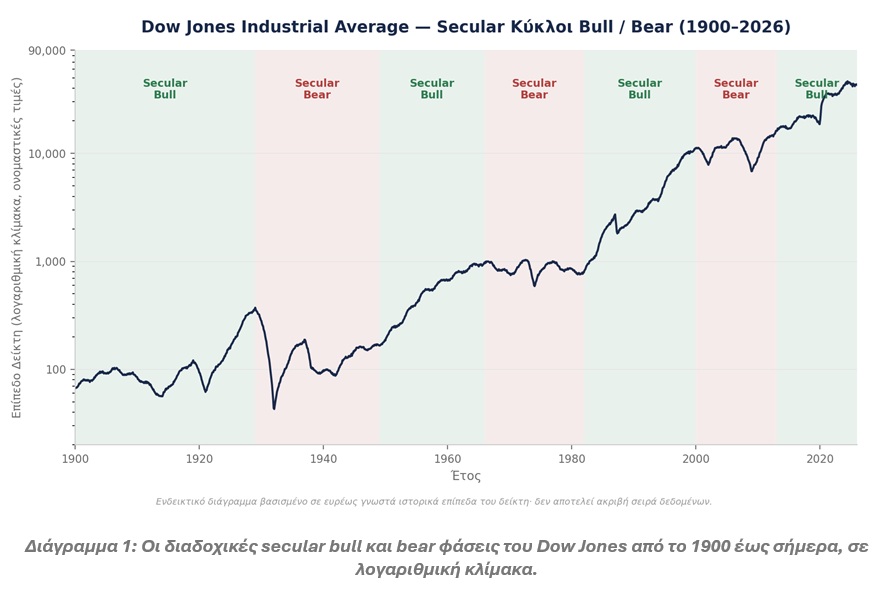
- 1929–1949: Secular bear market, with the 1929 crash and the long deflation/recession of the 1930s keeping valuations very low for two decades.
- 1949–1966: Strong secular bull market, supported by postwar reconstruction, industrial expansion and the demographic boom (baby boom).
- 1966–1982: Secular bear/sideways market, with high inflation (stagflation), the oil crises and high interest rates keeping the Dow Jones essentially stagnant for 16 years in nominal terms and at large losses in real terms.
- 1982–2000: One of the strongest secular bull markets in history, with the decline of inflation under Volker, the reduction of interest rates, fiscal reform and the information technology and Internet revolution.
- 2000–2009 (or 2011 for others e.g. Morgan Stanley) : Secular bear market, marked by the bursting of the dot-com bubble, the 2008 financial crisis and two major declines of more than 50%, with the S&P 500 returning, in real terms, close to 2000 levels only around 2013.
- 2009–today: A new secular bull phase, supported by the low interest rates of the post-crisis era, the digital economy and, more recently, the wave of artificial intelligence, with question marks being raised from 2025-2026 regarding extreme valuations and the return of inflation.
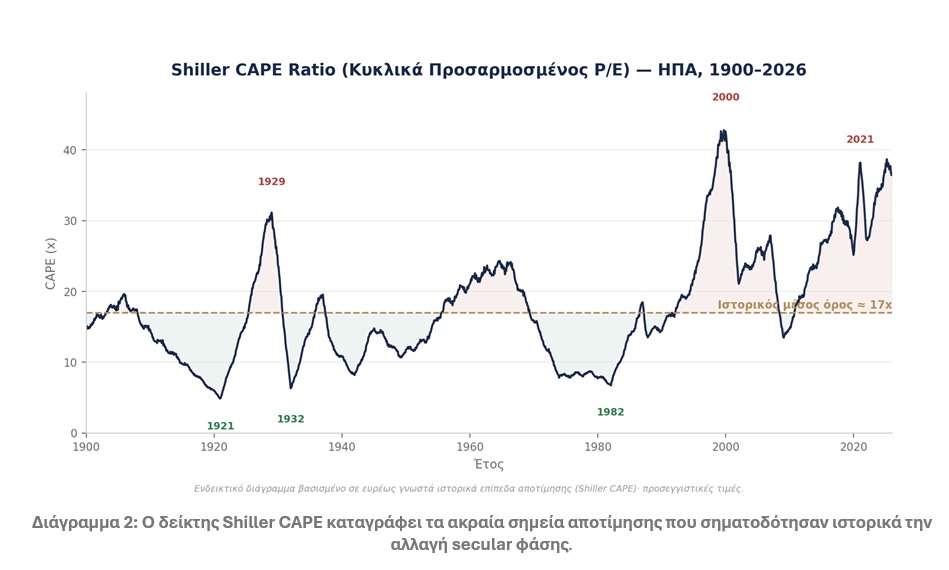
The study of these cycles does not aim at precise timing prediction, something extremely difficult even for very experienced analysts, but at placing the current situation within a historical framework of probabilities.
An investor who understands which phase of the secular cycle the market is in is in a much better position to create or manage their wealth, choose the appropriate mix of assets and avoid complacency or, conversely, excessive pessimism.
Essentially, Secular and Cyclical markets constitute two complementary levels of analysis of reality. The Cyclical explains the when of short- to medium-term fluctuations and the Secular the why of major long-term changes in investment sentiment, valuations and the economy.
* The above article does not constitute a recommendation of investment strategy regarding financial instruments or issuers of financial instruments and does not contain any opinion regarding the present or future value of financial instruments. The information and opinions in this specific article are for the reader’s information only.