The technical picture of PPC is in line with the analysis of its fundamentals: The stock has many chances to see higher price levels in the medium term:
Wave Analysis
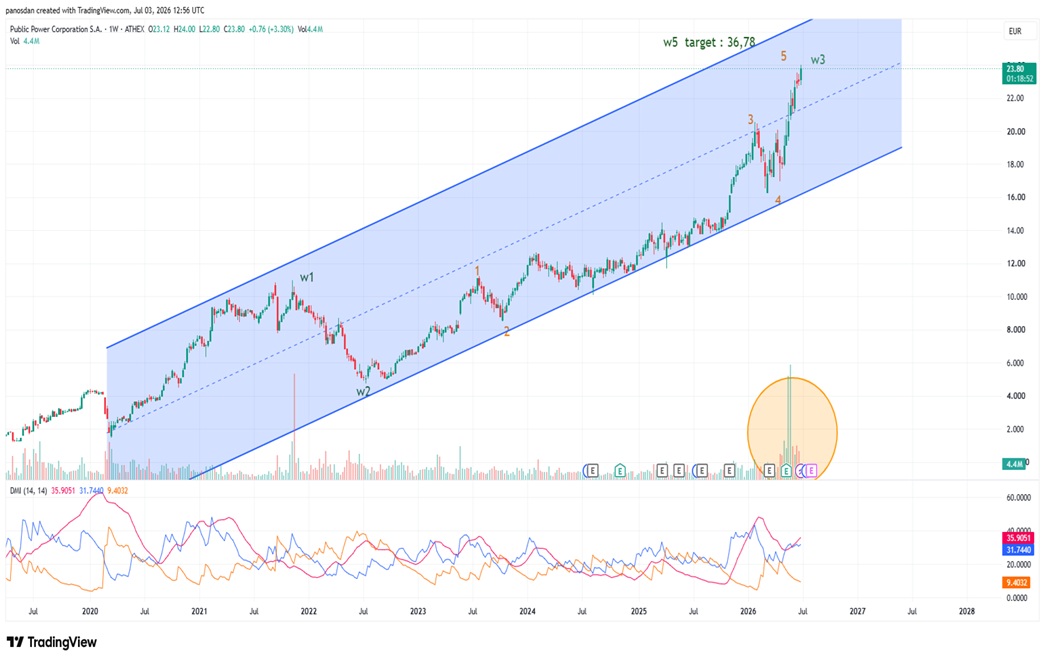
The weekly chart of PPC depicts a particularly clear five-wave upward structure (impulse wave) from the lows of 2020, a fact that strengthens the reliability of the metric and allows the projection of targets based on the classic Fibonacci ratios.
The first major wave (w1) was completed in mid-2021 in the area of 11.00 euros, followed by a corrective wave w2 that led the stock to around €4.76 at the end of 2022 – a deep but typical zig zag correction, in the range of the 61.8% Fibonacci retracement of w1.
From there, the third and strongest wave (w3) began, which internally is analyzed into five sub-waves (1-2-3-4-5): sub-wave 1 led to 11.00 euros (mid-2023), sub-wave 2 corrected to around 8.5 euros, sub-wave 3 –the most dynamic part of the move– propelled the stock to 20.56 euros (early 2026), sub-wave 4 corrected to 16.28 euros, and sub-wave 5 will complete w3 in the area of 27-29 euros.
The current phase of the market is estimated to correspond to the completion of the move of wave 5 of 3, before a sideways-downward wave 4 that will provide entry opportunities since afterwards the stock will move toward 35+ euros.
With a Fibonacci extension projection (typically 0.618–1.0 of the length of w1 above the base of w4/start of w5), the technical target of wave w5 is determined at 36.5-38 euros (36.78), a level that marks the completion of the fivefold upward sequence that began in 2020. This level constitutes a realistic medium-term technical target, provided the structure is maintained above the previous support highs (area 16.28–20.48 euros, former w3-3/w3-4 resistance).
At the risk management level, invalidation of the w5 scenario would arise only in the event of a clear close below the base of wave 4 of w3 (area €16.28), something that does not seem likely under the current momentum conditions.
Fundamentals and Fair Value of the stock
PPC is trading in the area of €23.70-24.00 per share, with a market capitalization exceeding 13 billion euros. The 2026-2028 business plan provides for investments of more than 10 billion euros, with emphasis on Renewable Energy Sources (target of 12.7 GW installed capacity by 2028) and distribution networks, while lignite practically reduces its contribution to profits to zero after 2026.
Market analysts have revised their estimates upward, with the consensus ranging approximately in the 21-26€ range, and an EBITDA target of more than 2.9 billion euros for 2028 (+45% versus 2025).
At the multiples level, the stock is trading at approximately 6x EV/EBITDA 2026E, that is, at a discount of about 30% versus European utilities — a discount that several houses characterize as unjustified given the growth trajectory of earnings.
Based on the valuation model (DCF/RAB-based, incorporating the full RES development program, the regulated asset base of the networks and the free cash flow profile for 2026-2029), the fair value is determined at 47.4 euros per share.
This level is significantly higher than the current average market target prices (21-26€), indicating that the market continues to value PPC mainly as a traditional utility and not fully as a growth RES/networks company with an upside growth profile from data centers, international expansion and discretionary capex.
This divergence essentially reflects a re-rating scenario that has not yet been fully priced in, with catalysts including a possible upgrade of the Greek market to developed status by MSCI/FTSE Russell/Stoxx within 2026, something that could support “more expensive” valuations for blue-chip names such as PPC.
Positive elements (Advantages)
● Strong EBITDA growth trajectory: target of more than 2.9 billion euros in 2028, +45% versus the 2025 target, with clear guidance from management.
● Portfolio transformation toward “clean” activities: approximately 85% of 2026-2028 investments are directed to RES and networks, with the complete withdrawal of lignite from profits after 2026.
● Stable, predictable contribution from the regulated networks activity (distribution/transmission), which offers defense during periods of energy price volatility.
● No new capital raising is required to finance the investment plan, as a large part of capex is discretionary and adjusts to the pace of implementation — an element that strengthens visibility toward investment grade.
● Significant valuation discount (about 30%) versus European peers in EV/EBITDA terms, leaving room for re-rating.
● Possible upgrade of the Greek market within 2026 by MSCI/FTSE Russell/Stoxx, with positive effects on flows and valuation.
● New high-upside activities outside the core plan (data centers, digital services, e-mobility), which have not been fully incorporated into market estimates.
● Dividend policy on an upward trajectory, with an estimated yield of about 5.3% in 2027 and an upward trend thereafter.
Challenges
● High investment cycle in the short term (peak of about 3.45 billion euros in 2026), which leads to negative free cash flows in the middle of the period before capital generation is restored.
● Net debt peaking at about 3.3x-3.5x EBITDA, with a need for disciplined balance sheet management to maintain investment grade.
● Sensitivity to regulatory/political risk (tariffs, energy cost support, networks WACC), given the significant presence of the Greek State in the shareholder structure.
● Exposure to fluctuations in wholesale energy market prices and weather conditions (hydroelectric generation, photovoltaics), which affect the volatility of short-term results.
● Competition in Southeast European markets (Romania, Bulgaria, North Macedonia) and execution risk in implementing the ambitious 12.7 GW RES program.
● Possible increase in financing costs in an environment of variable interest rates, with a direct impact on the discount rate and therefore on the DCF valuation.
● After the strong rally in the stock (new all-time highs), there is a short-term risk of overbought conditions and a technical correction before the continuation of the upward trend.
Conclusion and Strategy
In summary, PPC presents an interesting picture:
- Technically: It is in a strong upward trend (5th Elliott wave) with an immediate target of 33.84 euros.
- Base scenario: 33.84 euros technical target. Long-term optimistic scenario: gradual convergence toward the fair value of 47.40 euros, provided the fundamentals are confirmed. The transition strategy to RES and the strong market position are its main advantages.
- Risks: High debt and limited revenue growth are the main challenges.
Therefore, the combination of technical analysis (target 33.84 euros) and fundamental analysis (47.4 euros) creates an attractive scenario, provided that the company manages to reduce its debt and maintain its profitability during the energy transition.
* The above article does not constitute a recommendation of investment strategy regarding financial instruments or issuers of financial instruments and does not contain any opinion regarding the present or future value of financial instruments. The information and opinions in this specific article are for the reader’s information only.