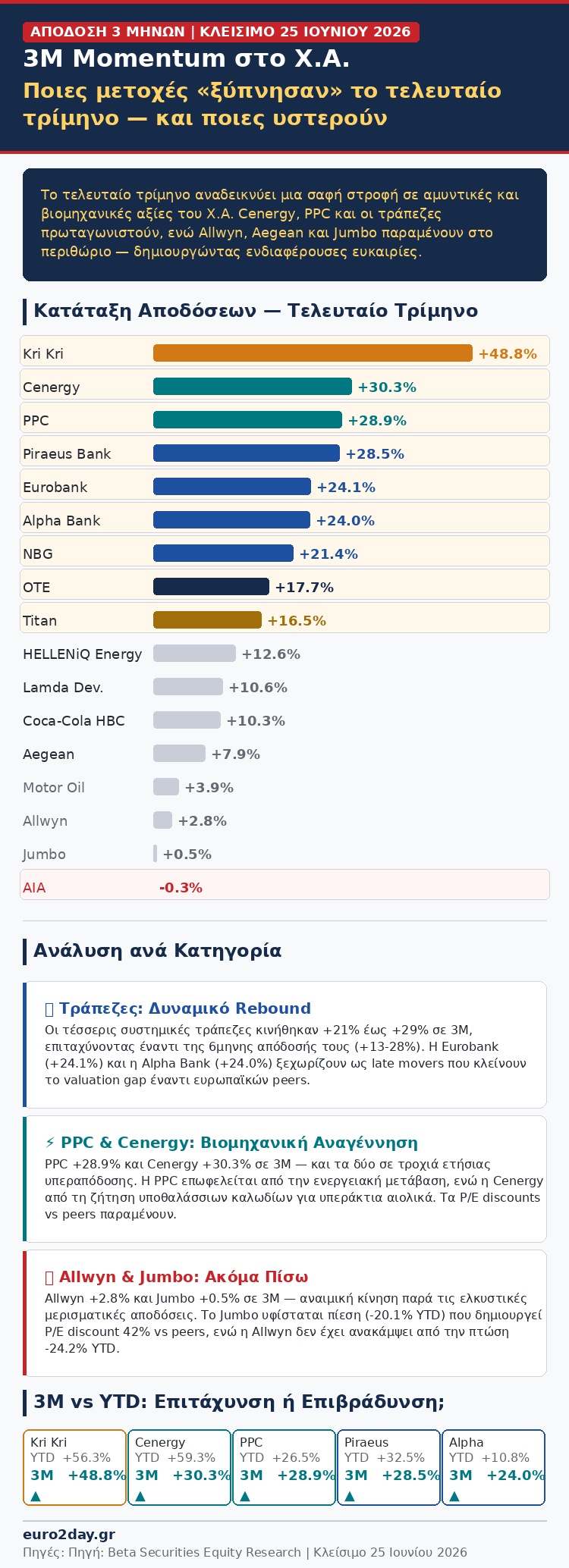
The momentum of the Greek market in the second quarter highlights something that the picture for the half-year as a whole may conceal: the Greek market is not rising only because of a few stocks that ran early — it is broadening. And this is usually the signal experienced investors wait for to confirm that a rally has depth.
Based on data from Beta Securities, at the top of returns in the second quarter is Kri Kri with +48.8%, confirming that its explosive performance so far this year (+56.3%) is not a “flash in the pan” of the first quarter. The stock was boosted by the announcement of significantly increased financial figures for the first quarter of the year.
Its P/E at 23.2x (+45% vs global peers) may seem expensive, but the momentum suggests that the market is pricing in growth.
Cenergy follows with +30.3% in the second quarter, accelerating in absolute terms. The company remains on a structural upward trajectory thanks to demand for submarine cables for offshore wind farms. Gains were even higher at the beginning of the week (high of 26.2 euros), while after the placement that took place at 24.2 euros, the stock came under pressure to close on Friday at 23.82 euros.
The P/E discount of 20% vs global peers (20.5x vs 25.5x) remains intact despite the +59.3% so far this year, leaving the upside open.
The big surprise of the quarter, however, is the banking acceleration. Piraeus Bank (+28.5%), Eurobank (+24.1%), Alpha Bank (+24.0%) and National Bank (+21.4%) show that the banking re-rating has not been exhausted. Alpha Bank is the most characteristic example: Over the half-year it is up only +10.8%, but in the last quarter it ran at +24% — almost double the acceleration.
The reason is obvious to anyone who looks at the figures: Alpha trades at P/TBV 1.1x versus a 2.1x European average, a 48% discount — the largest in the sector. With ROE improving year by year and EPS expected to reach 0.50 euros in 2028 from 0.42 euros in 2026, convergence with European peers remains the central investment case. Similar logic applies to Eurobank (P/TBV 1.5x vs 2.1x peers, 30% discount) and Piraeus (1.4x vs 2.1x, 35% discount).
PPC is soaring +28.9% in the second quarter, driven by the capital increase, also “improving” the stock’s picture for the year as a whole (+26.5% YTD). It trades at P/BV 1.2x versus 2.4x for the European utilities sector — a 52% discount — while its P/E (15.1x) is 14% below the European average.
On the other hand, three stocks remain on the sidelines despite their attractive fundamentals. Allwyn is posting just +2.8% in the quarter, continuing under the shadow of -24.2% so far this year.
The market is struggling to digest the valuation premium (P/E 21.1x, +80% vs peers), despite the fact that the dividend yield of 7.60% is the highest in the Greek universe.
Jumbo (+0.5% in 3M) remains under pressure after -20.1% since the start of the year, creating a P/E discount of 42% vs global retail peers and a dividend yield of 5.38% — a combination that is hard to ignore for long.
Aegean, with +7.9% in the quarter but -9.8% since January 1, remains in the uncertainty zone despite the leading dividend outperformance (+529 bps vs European airlines) and the 27% P/E discount, with its trajectory directly tied to the course of the oil price and the uncertainty in Hormuz.